

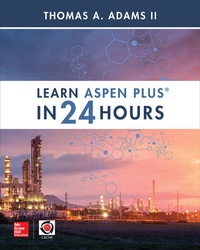
Learn Aspen Plus in 24 Hours
Published on 31. December 2017
Book
Paperback/Softback
208 pages
978-1-260-11645-8 (ISBN)
Description
This self-learning guide shows how to start using Aspen Plus to solve chemical engineering problems quickly and easily
Discover how to solve challenging chemical engineering problems with Aspen Plus-in just 24 hours, and with no prior experience. Developed at McMaster University over a seven-year period, the book features visual guides to using detailed mathematical models for a wide range of chemical process equipment, including heat exchangers, pumps, compressors, turbines, distillation columns, absorbers, strippers, and chemical reactors.
Learn Aspen Plus in 24 Hours shows, step-by-step, how to configure and use Aspen Plus v9.0 and apply its powerful features to the design, operation, and optimization of safe, profitable manufacturing facilities. You will learn how to build process models and accurately simulate those models without performing tedious calculations. Divided into 12 two-hour lessons, the guide offers downloadable Aspen Plus simulation files and visual step-by-step guides.
* Contains a valuable index that lists software icons and commands used in the book
* Features helpful and time-saving links to instructional videos and technical content
* Instructs how to integrate your simulation with other supporting software such as Aspen Capital Cost Estimator, Aspen Energy Analyzer, and Microsoft Excel
* Written by an Aspen Plus power-user and leading researcher in chemical process simulations
Discover how to solve challenging chemical engineering problems with Aspen Plus-in just 24 hours, and with no prior experience. Developed at McMaster University over a seven-year period, the book features visual guides to using detailed mathematical models for a wide range of chemical process equipment, including heat exchangers, pumps, compressors, turbines, distillation columns, absorbers, strippers, and chemical reactors.
Learn Aspen Plus in 24 Hours shows, step-by-step, how to configure and use Aspen Plus v9.0 and apply its powerful features to the design, operation, and optimization of safe, profitable manufacturing facilities. You will learn how to build process models and accurately simulate those models without performing tedious calculations. Divided into 12 two-hour lessons, the guide offers downloadable Aspen Plus simulation files and visual step-by-step guides.
* Contains a valuable index that lists software icons and commands used in the book
* Features helpful and time-saving links to instructional videos and technical content
* Instructs how to integrate your simulation with other supporting software such as Aspen Capital Cost Estimator, Aspen Energy Analyzer, and Microsoft Excel
* Written by an Aspen Plus power-user and leading researcher in chemical process simulations
More details
Language
English
Place of publication
OH
United States
Target group
College/higher education
Illustrations
240 Illustrations
Dimensions
Height: 231 mm
Width: 185 mm
Thickness: 13 mm
Weight
371 gr
ISBN-13
978-1-260-11645-8 (9781260116458)
Copyright in bibliographic data and cover images is held by Nielsen Book Services Limited or by the publishers or by their respective licensors: all rights reserved.
Schweitzer Classification
Other editions
New editions
Thomas A. Adams II
Learn Aspen Plus in 24 Hours, Second Edition
Book
04/2022
2nd Edition
McGraw-Hill Education
€63.00
Shipment within 15-20 days
Person
Thomas A. Adams II is an associate professor of chemical engineering at McMaster University. He serves as chair of the Systems and Control division of the Canadian Society for Chemical Engineering
Content
Introduction
1. Getting Started
2. Physical Property Modeling
3. Heat Exchangers
4. Problem Solving Tools
5. Advanced Problem Solving Tools
6. Chemical Reactor Models
7. Equilibrium-based Distillation Models
8. Rate-based Distillation Models
9. Custom Models and External Control
10. Capital Cost Estimation
11. Optimal Heat Exchanger Networks
12. Solids Handling and Electrolyte Chemistry
Solutions
Command Index
1. Getting Started
2. Physical Property Modeling
3. Heat Exchangers
4. Problem Solving Tools
5. Advanced Problem Solving Tools
6. Chemical Reactor Models
7. Equilibrium-based Distillation Models
8. Rate-based Distillation Models
9. Custom Models and External Control
10. Capital Cost Estimation
11. Optimal Heat Exchanger Networks
12. Solids Handling and Electrolyte Chemistry
Solutions
Command Index