

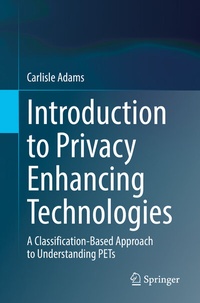
Introduction to Privacy Enhancing Technologies
A Classification-Based Approach to Understanding PETs
Published on 31. October 2021
Book
Paperback/Softback
XIII, 324 pages
978-3-030-81042-9 (ISBN)
Description
This textbook provides a unique lens through which the myriad of existing Privacy Enhancing Technologies (PETs) can be easily comprehended and appreciated. It answers key privacy-centered questions with clear and detailed explanations.
Why is privacy important? How and why is your privacy being eroded and what risks can this pose for you? What are some tools for protecting your privacy in online environments? How can these tools be understood, compared, and evaluated? What steps can you take to gain more control over your personal data?
This book addresses the above questions by focusing on three fundamental elements:
Why is privacy important? How and why is your privacy being eroded and what risks can this pose for you? What are some tools for protecting your privacy in online environments? How can these tools be understood, compared, and evaluated? What steps can you take to gain more control over your personal data?
This book addresses the above questions by focusing on three fundamental elements:
- It introduces a simple classification of PETs that allows their similarities and differences to be highlighted and analyzed;
- It describes several specific PETs in each class, including both foundational technologies and important recent additions to the field;
- It explainshow to use this classification to determine which privacy goals are actually achievable in a given real-world environment. Once the goals are known, this allows the most appropriate PETs to be selected in order to add the desired privacy protection to the target environment. To illustrate, the book examines the use of PETs in conjunction with various security technologies, with the legal infrastructure, and with communication and computing technologies such as Software Defined Networking (SDN) and Machine Learning (ML).
More details
Edition
1st ed. 2021
Language
English
Place of publication
Cham
Switzerland
Publishing group
Springer International Publishing
Target group
Primary & secondary/elementary & high school
Illustrations
7 s/w Abbildungen, 14 farbige Abbildungen
XIII, 324 p. 21 illus., 14 illus. in color.
Dimensions
Height: 235 mm
Width: 155 mm
Thickness: 19 mm
Weight
517 gr
ISBN-13
978-3-030-81042-9 (9783030810429)
DOI
10.1007/978-3-030-81043-6
Schweitzer Classification
Other editions
Additional editions
Carlisle Adams
Introduction to Privacy Enhancing Technologies
A Classification-Based Approach to Understanding PETs
E-Book
10/2021
Springer
€53.49
Available for download
Person
Carlisle Adams
is a Professor in the School of Electrical Engineering and Computer Science (EECS) at University of Ottawa. Prior to his academic appointment in 2003, he worked for 13 years in industry (Nortel, Entrust) in the design and international standardization of a variety of cryptographic and security technologies for the Internet. Dr. Adams' research interests include all aspects of applied cryptography and security. Particular areas of interest and technical contributions include the design and analysis of symmetric encryption algorithms (including the CAST family of symmetric ciphers), the design of large-scale infrastructures for authentication (including secure protocols for authentication and certificate management in Public Key Infrastructure (PKI) environments), and comprehensive architectures and policy languages for access control in electronic networks (including X.509 attribute certificates and the XACML policy language).
Dr. Adams has maintained a long-standing interest in the creation of effective techniques to preserve and enhance privacy on the Internet. His contributions in this area include techniques to add delegation, non-transferability, and multi-show to Digital Credentials, architectures to enforce privacy in web-browsing environments, and mechanisms to add privacy to location-based services and blockchains. He was Co-Chair of the international conference Selected Areas in Cryptography (1997, 1999, 2007, and 2017), and was General Chair of the 7th International Privacy Enhancing Technologies Symposium (2007).
He lives in Ottawa with his wife and children and enjoys music, good food, and classic movies (old and new).
Dr. Adams has maintained a long-standing interest in the creation of effective techniques to preserve and enhance privacy on the Internet. His contributions in this area include techniques to add delegation, non-transferability, and multi-show to Digital Credentials, architectures to enforce privacy in web-browsing environments, and mechanisms to add privacy to location-based services and blockchains. He was Co-Chair of the international conference Selected Areas in Cryptography (1997, 1999, 2007, and 2017), and was General Chair of the 7th International Privacy Enhancing Technologies Symposium (2007).
He lives in Ottawa with his wife and children and enjoys music, good food, and classic movies (old and new).
Content
1. The Privacy Minefield.- 2. A Collection of Tools: The Privacy Tree.- 3. Limiting Exposure by Hiding.- 4. Limiting Exposure by Hiding the Action.- 5. Limiting Exposure by Hiding the Identity-Action Pair.- 6. Limiting Disclosure by Hiding the Identity.- 7. Limiting Disclosure by Hiding the Attribute.- 8. Limiting Disclosure by Hiding the Identity-Attribute Pair.- 9. Using the Privacy Tree in Practice.- 10. The Path Forward.- Supplemental Chapters.- 11. Crypto Primer.- 12. Source Material.- Glossary.- Index.