

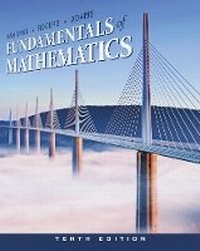
Fundamentals of Mathematics
10th Edition
Published on 1. January 2011
Book
Paperback/Softback
720 pages
978-0-538-49797-8 (ISBN)
Description
The FUNDAMENTALS OF MATHEMATICS, Tenth Edition, offers a comprehensive and objectives-based review of all basic mathematics concepts. The author helps learners by addressing three important needs: 1) establishing good study habits and overcoming math anxiety, 2) making the connections between mathematics and their modern, day-to-day activities, and 3) being paced and challenged according to their individual level of understanding.
The clear exposition and the consistency of presentation make learning arithmetic accessible for all. Key concepts presented in section objectives-and further defined within the context of How and Why-provide a strong foundation for learning and lasting comprehension. With a predominant emphasis on problem-solving skills, concepts, and applications based on "real world" data (with some introductory algebra integrated throughout), this book is suitable for individual study or for a variety of course formats: lab, self-paced, lecture, group, or combined formats.
The clear exposition and the consistency of presentation make learning arithmetic accessible for all. Key concepts presented in section objectives-and further defined within the context of How and Why-provide a strong foundation for learning and lasting comprehension. With a predominant emphasis on problem-solving skills, concepts, and applications based on "real world" data (with some introductory algebra integrated throughout), this book is suitable for individual study or for a variety of course formats: lab, self-paced, lecture, group, or combined formats.
Reviews / Votes
1. Structure and Process of Supervision. 2. Supervision Models: Psychotherapy-based Non-Psychotherapy-based. 3. Effective Supervision. 4. Supervisor. Gender and Perceived Stereotypes. Theoretical Orientation, Interaction and Learning Styles. BTI Types. Negative-Harmful Supervision. 5. Supervisee. Attachment Style. Self-presentation and Self-disclosure. Interaction and Learning Styles. Theoretical Orientation. Gender & Perceived Stereotypes. 6. Assessment of the Trainee. Knowledge and Skills. Personal Dynamics. Formal Assessment Tools. 7. Supervision Ethics. 8. Legal Aspects of Supervision in Psychotherapy. 9. Impacts of Culture and Diversity on the Supervisory Relationship and Process.More details
Edition
10th edition
Language
English
Place of publication
CA
United States
Publishing group
Cengage Learning, Inc
Target group
College/higher education
Dimensions
Height: 276 mm
Width: 215 mm
Thickness: 25 mm
Weight
1270 gr
ISBN-13
978-0-538-49797-8 (9780538497978)
Copyright in bibliographic data and cover images is held by Nielsen Book Services Limited or by the publishers or by their respective licensors: all rights reserved.
Schweitzer Classification
Persons
Hollis Adams teaches mathematics at Portland Community College, a position she has been in for nearly 20 years. She is the co-author of two mathematics textbooks, including Fundamentals of Mathematics, published by Cengage Learning. James Rogers has been teaching high school and college-level mathematics courses for more than 30 years. Though retired, he currently teaches part-time at Portland Community College. He is the co-author of nine mathematics textbooks, including Fundamentals of Mathematics, published by Cengage Learning. James Van Dyke has been an instructor of mathematics for over 30 years, teaching courses at both the high school and college levels. He is the co-author of eight different mathematics textbooks, including Fundamentals of Mathematics, published by Cengage Learning.
Content
1. WHOLE NUMBERS.
Whole Numbers and Tables: Writing, Rounding, and Inequalities. Adding and Subtracting Whole Numbers. Multiplying Whole Numbers. Dividing Whole Numbers. Whole-Number Exponents and Powers of 10. Order of Operations. Average, Median, and Mode. Drawing and Interpreting Graphs.
2. PRIMES AND MULTIPLES.
Divisibility Tests. Multiples. Divisors and Factors. Primes and Composites. Prime Factorization. Least Common Multiple.
3. FRACTIONS AND MIXED NUMBERS.
Proper and Improper Fractions; Mixed Numbers. Simplifying Fractions. Multiplying and Dividing Fractions. Multiplying and Dividing Mixed Numbers. Building Fractions; Listing in Order; Inequalities. Adding Fractions. Adding Mixed Numbers. Subtracting Fractions. Subtracting Mixed Numbers. Order of Operations; Average.
CUMULATIVE REVIEW CHAPTERS 1-3.
4. DECIMALS.
Decimals: Reading, Writing, and Rounding. Changing Decimals to Fractions; Listing in Order. Adding and Subtracting Decimals. Multiplying Decimals. Multiplying and Dividing by Powers of 10; Scientific Notation. Dividing Decimals; Average, Median, and Mode. Changing Fractions to Decimals. Order of Operations; Estimating.
5. RATIO AND PROPORTION.
Ratio and Rate. Solving Proportions. Applications of Proportions.
CUMULATIVE REVIEW CHAPTERS 1-5.
6. PERCENT.
The Meaning of Percent. Changing Decimals to Percents and Percents to Decimals. Changing Fractions to Percents and Percents to Fractions. Fractions, Decimals, Percents: A Review. Solving Percent Problems. Applications of Percents. Sales Tax, Discounts, and Commissions. Interest on Loans.
7. MEASUREMENT AND GEOMETRY.
Measuring Length. Measuring Capacity, Weight, and Temperature. Perimeter. Area. Volume. Square Roots and the Pythagorean Theorem.
CUMULATIVE REVIEW CHAPTERS 1-7.
8. ALGEBRA PREVIEW; SIGNED NUMBERS.
Opposites and Absolute Value. Adding Signed Numbers. Subtracting Signed Numbers. Multiplying Signed Numbers. Dividing Signed Numbers. Order of Operations: A Review. Solving Equations.
APPENDIX A Calculators.
APPENDIX B Prime Factors of Numbers 1 through 100.
APPENDIX C Squares and Square Roots (0 to 99).
APPENDIX D Compound Interest Table (Factors).
MIDTERM EXAMINATION Chapters 1-4.
FINAL EXAMINATION Chapters 1-8.
ANSWERS.
INDEX.
INDEX OF APPLICATIONS.
Whole Numbers and Tables: Writing, Rounding, and Inequalities. Adding and Subtracting Whole Numbers. Multiplying Whole Numbers. Dividing Whole Numbers. Whole-Number Exponents and Powers of 10. Order of Operations. Average, Median, and Mode. Drawing and Interpreting Graphs.
2. PRIMES AND MULTIPLES.
Divisibility Tests. Multiples. Divisors and Factors. Primes and Composites. Prime Factorization. Least Common Multiple.
3. FRACTIONS AND MIXED NUMBERS.
Proper and Improper Fractions; Mixed Numbers. Simplifying Fractions. Multiplying and Dividing Fractions. Multiplying and Dividing Mixed Numbers. Building Fractions; Listing in Order; Inequalities. Adding Fractions. Adding Mixed Numbers. Subtracting Fractions. Subtracting Mixed Numbers. Order of Operations; Average.
CUMULATIVE REVIEW CHAPTERS 1-3.
4. DECIMALS.
Decimals: Reading, Writing, and Rounding. Changing Decimals to Fractions; Listing in Order. Adding and Subtracting Decimals. Multiplying Decimals. Multiplying and Dividing by Powers of 10; Scientific Notation. Dividing Decimals; Average, Median, and Mode. Changing Fractions to Decimals. Order of Operations; Estimating.
5. RATIO AND PROPORTION.
Ratio and Rate. Solving Proportions. Applications of Proportions.
CUMULATIVE REVIEW CHAPTERS 1-5.
6. PERCENT.
The Meaning of Percent. Changing Decimals to Percents and Percents to Decimals. Changing Fractions to Percents and Percents to Fractions. Fractions, Decimals, Percents: A Review. Solving Percent Problems. Applications of Percents. Sales Tax, Discounts, and Commissions. Interest on Loans.
7. MEASUREMENT AND GEOMETRY.
Measuring Length. Measuring Capacity, Weight, and Temperature. Perimeter. Area. Volume. Square Roots and the Pythagorean Theorem.
CUMULATIVE REVIEW CHAPTERS 1-7.
8. ALGEBRA PREVIEW; SIGNED NUMBERS.
Opposites and Absolute Value. Adding Signed Numbers. Subtracting Signed Numbers. Multiplying Signed Numbers. Dividing Signed Numbers. Order of Operations: A Review. Solving Equations.
APPENDIX A Calculators.
APPENDIX B Prime Factors of Numbers 1 through 100.
APPENDIX C Squares and Square Roots (0 to 99).
APPENDIX D Compound Interest Table (Factors).
MIDTERM EXAMINATION Chapters 1-4.
FINAL EXAMINATION Chapters 1-8.
ANSWERS.
INDEX.
INDEX OF APPLICATIONS.