

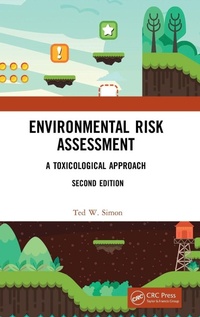
Environmental Risk Assessment
A Toxicological Approach
2nd Edition
Published on 9. December 2019
Book
Hardback
520 pages
978-0-367-25097-3 (ISBN)
Description
The purpose of risk assessment is to support science-based decisions about how to solve complex societal problems. Indeed, the problems humankind faces in the 21st century have many social, political, and technical complexities. Environmental risk assessment in particular is of increasing importance as health and safety regulations grow and become more complicated.
Environmental Risk Assessment: A Toxicological Approach, 2nd Edition looks at various factors relating to exposure and toxicity, human health, and risk. In addition to the original chapters being updated and expanded upon, four new chapters discuss current software and platforms that have recently been developed and provide examples of risk characterizations and scenarios.
Features:
Introduces the science of risk assessment-past, present, and future
Provides environmental sampling data for conducting practice risk assessments
Considers how bias and conflict of interest affect science-based decisions in the 21st century
Includes fully worked examples, case studies, discussion questions, and suggestions for additional reading
Discusses new software and computational platforms that have developed since the first edition
Aimed at the next generation of risk assessors and students who need to know more about developing, conducting, and interpreting risk assessments, the book delivers a comprehensive view of the field, complete with sufficient background to enable readers to probe for themselves the science underlying the key issues in environmental risk.
Environmental Risk Assessment: A Toxicological Approach, 2nd Edition looks at various factors relating to exposure and toxicity, human health, and risk. In addition to the original chapters being updated and expanded upon, four new chapters discuss current software and platforms that have recently been developed and provide examples of risk characterizations and scenarios.
Features:
Introduces the science of risk assessment-past, present, and future
Provides environmental sampling data for conducting practice risk assessments
Considers how bias and conflict of interest affect science-based decisions in the 21st century
Includes fully worked examples, case studies, discussion questions, and suggestions for additional reading
Discusses new software and computational platforms that have developed since the first edition
Aimed at the next generation of risk assessors and students who need to know more about developing, conducting, and interpreting risk assessments, the book delivers a comprehensive view of the field, complete with sufficient background to enable readers to probe for themselves the science underlying the key issues in environmental risk.
Reviews / Votes
**Description**This second edition is a rather concise 500-page description of environmental
risk assessment written from a toxicological perspective. Useful new features
include sections devoted to software and platforms as well as actual examples.
**Purpose**
The book aims to provide a reference to enable those interested in risk
assessment to gain confidence regarding their knowledge of the subject.
**Audience**
The audience for this book and its electronic enhancements includes both human
and wildlife risk assessors, risk communicators, and a broader range of public
health decision makers.
**Features**
The book chapters include introduction to risk assessment; perception, planning,
and scoping; risk analyst's toolbox; exposure assessment; hazard
characterization and dose response assessment; risk characterization; ecologic
risk assessment(s); bias, conflict of interest, ignorance, and uncertainty; and
emerging risks and final thoughts.
**Assessment**
Bridging the modern range of risk assessment guides and tutorials, this second
edition begins in the old days with the "Red Book," advances through Silver
and, most importantly, provides us with what the author describes as a
"comprehensive review of the field" for the next generation of risk assessors.
In the book's foreword, Dr. Richard A. Becker describes author Ted Simon's risk
communication and assessment skills in this edition as "stellar" in terms of
its explanations and illustrations. I concur.
-----------------------------------------------------------
Weighted Numerical Score: 97 - 5 Stars!
-- John T. Pierce, MBBS(MD) PhD(Navy Environmental Health Center)
More details
Edition
2nd edition
Language
English
Place of publication
London
United Kingdom
Publishing group
Taylor & Francis Ltd
Target group
College/higher education
Edition type
New edition
Product notice
sewn/stitched
Cloth over boards
Illustrations
68 s/w Tabellen, 31 s/w Abbildungen
68 Tables, black and white; 31 Illustrations, black and white
Dimensions
Height: 234 mm
Width: 156 mm
Thickness: 29 mm
Weight
903 gr
ISBN-13
978-0-367-25097-3 (9780367250973)
Copyright in bibliographic data and cover images is held by Nielsen Book Services Limited or by the publishers or by their respective licensors: all rights reserved.
Schweitzer Classification
Other editions
Additional editions
E-Book
12/2019
2nd Edition
CRC Press
€264.99
Available for download
E-Book
12/2019
2nd Edition
CRC Press
€264.99
Available for download
Previous edition
Book
02/2014
1st Edition
CRC Press
€178.27
Article exhausted; check for reprint
Person
Ted Simon, DABT earned advanced degrees in biology, including a Ph.D from Georgia State University, Atlanta, USA. After college, he held post-doctoral and teaching positions before serving as senior toxicologist in the Waste Management Division at the Environmental Protection Agency (EPA), Region 4, Atlanta, Georgia, USA. His critically successful novel, A Lost Gun, was published under the nom de plume Wix Simon. He is currently working on another crime novel featuring an environmental poisoning situation inspired by his twelve years at the EPA. He also provides toxicology consulting and scientific support as principal/owner of Ted Simon LLC, Winston, Georgia, USA.
Content
Chapter 1 An Introduction to Risk Assessment with a Nod to History Chapter 2 Perception, Planning, and Scoping, Problem Formulation, and Hazard Identification: All Parts of Risk Assessment Chapter 3 A Risk Analyst's Toolbox Chapter 4 Exposure Assessment Chapter 5 Hazard Characterization and Dose-Response Assessment Chapter 6 Risk Characterization Chapter 7 Ecological Risk Assessment Chapter 8 Bias, Conflict of Interest, Ignorance, and Uncertainty: Where Are We Heading? Chapter 9 Emerging Risks and Final Thoughts