

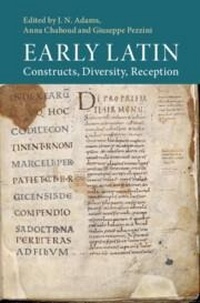
Early Latin
Constructs, Diversity, Reception
Published on 17. August 2023
Book
Hardback
900 pages
978-1-108-47658-4 (ISBN)
Description
This is the most detailed and comprehensive study to date of early Latin language, literary and non-literary, featuring twenty-nine chapters by an international team of scholars. 'Early Latin' is interpreted liberally as extending from the period of early inscriptions through to the first quarter of the first century BC. Classical Latin features significantly in the volume, although in a restricted sense. In the classical period there were writers who imitated the Latin of an earlier age, and there were also interpreters of early Latin. Later authors and views on early Latin language are also examined as some of these are relevant to the establishment of the text of earlier writers. A major aim of the book is to define linguistic features of different literary genres, and to address problems such as the limits of periodisation and the definition of the very concept of 'early Latin'.
Reviews / Votes
'It is a great achievement, and I expect it both to be a foundation stone for much further research in this area, and to make a significant intervention into our definition of, and thinking about, Early Latin.' Nicholas Zair, Bryn Mawr Classical Review '... one can only congratulate the editors for making this book, full of erudition and sound judgment, available to specialists.' Javier Uria, Exemplaria ClassicaMore details
Language
English
Place of publication
Cambridge
United Kingdom
Target group
College/higher education
Edition type
New edition
Product notice
sewn/stitched
Cloth over boards
Illustrations
Worked examples or Exercises
Dimensions
Height: 234 mm
Width: 154 mm
Thickness: 42 mm
Weight
1066 gr
ISBN-13
978-1-108-47658-4 (9781108476584)
Copyright in bibliographic data and cover images is held by Nielsen Book Services Limited or by the publishers or by their respective licensors: all rights reserved.
Schweitzer Classification
Other editions
Additional editions
E-Book
08/2023
Cambridge University Press
€172.99
Available for download
Persons
J. N. Aadams CBE, FBA was the author of many books and articles on the Latin language, including The Latin Sexual Vocabulary (1982) and Bilingualism and the Latin Language (2003). He was awarded the Kenyon Medal of the British Academy in 2009. Anna Chahoud, FTCD is Professor of Latin at Trinity College Dublin. She is the author of C. Lucili Reliquiarum Concordantiae (1998) and various articles on Republican Latin and on the grammatical tradition, and has co-edited, with E. Dickey, Colloquial and Literary Latin (Cambridge, 2010). G. Pezzini is Fellow and Tutor in Latin at Corpus Christi College, Oxford. He has published extensively on early Latin language and literature, Roman comedy, ancient philosophy of language and fiction theory, including Terence and the Verb to-be in Latin (2015) and a forthcoming commentary on Terence's Heautontimorumenos.
Content
1. Introduction: What is early Latin? Giuseppe Pezzini and Anna Chahoud; Part I. General (Morphology, Syntax, Lexicon and Metre): 2. Alphabet, epigraphy, and literacy in central Italy in the 7th /5th c. BC Rex Wallace; 3. Identifying Latin in early inscriptions Simona Marchesini; 4. The Egadi Rostra, a linguistic analysis Wolfgang D. C. de Melo; 5. Morphology and syntax in early Latin Wolfgang D. C. de Melo; 6. Early Latin metre Wolfgang D. C. de Melo and Giuseppe Pezzini; 7. Greek Loanwords in early Latin James Clackson; 8. Latin edepol 'by Pollux': background of a Latin aduerbium iuratiuum Brent Vine; 9. Indirect questions in early Latin Peter Barrios-Lech; 10. Ecquis in early Latin: aspects of questions Colette Bodelot; Part II. Authors and Genres: 11. Support verb constructions in Plautus and Terence Jose Miguel Banos; 12. Early Latin prayers and aspects of coordination James Adams and Veronika Nikitina; 13. 'Early Latin' lexicon in Terence (and Plautus) Giuseppe Pezzini; 14. Early Latin and the fragments of Atellana Comedy Costas Panayotakis; 15. A comparison of the language of comedy and tragedy in early Latin drama Robert Maltby; 16. The language of early Latin epic Sander Goldberg; 17. How 'early Latin' is Lucilius? Anna Chahoud; 18. Repetition in the fragmentary orators: from Cato to C. Gracchus Christa Gray; 19. Greek influences on Cato's Latin Neil O'Sullivan; 20. Some syntactic features of Latin legal texts Olga Spevak; Part III. Reception: 21. Lucretius and early Latin Barnaby Taylor; 22. Cicero and early dramatic Latin Gesine Manuwald; 23. Early Latin texts in Livy John Briscoe; 24. Pliny rewrites Cato Cynthia Damon; 25. Gellius' appreciation and understanding of early Latin Leofranc Holford-Strevens; 26. Views on early Latin in grammatical texts Alessandro Garcea; 27. Nonius Marcellus and the shape of early Latin Jarrett Welsh; 28. Early Latin to Neo-Latin: Festus and Scaliger Anna Chahoud; Conclusions: 29. Early Latin as a Concept James Adams.