

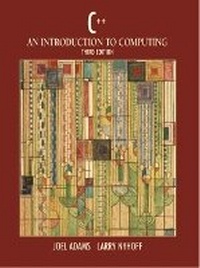
C++
An Introduction to Computing
3rd Edition
Published on 5. September 2002
Book
Paperback/Softback
996 pages
978-0-13-091426-2 (ISBN)
Description
Appropriate for introductory Computer Science courses using C++ (CS1 with C++) and other introductory programming courses using C++.
The authors introduce key ideas behind computing with C++ and object-oriented programming in an intuitive and non-intimidating way. This text not only teaches text-based programming, but also graphical/internet programming. In addition, this text provides an introduction to computer science as a discipline.
The authors introduce key ideas behind computing with C++ and object-oriented programming in an intuitive and non-intimidating way. This text not only teaches text-based programming, but also graphical/internet programming. In addition, this text provides an introduction to computer science as a discipline.
More details
Edition
3rd edition
Language
English
Place of publication
United States
Publishing group
Pearson Education (US)
Target group
College/higher education
Dimensions
Height: 175 mm
Width: 234 mm
Thickness: 36 mm
Weight
1601 gr
ISBN-13
978-0-13-091426-2 (9780130914262)
Copyright in bibliographic data and cover images is held by Nielsen Book Services Limited or by the publishers or by their respective licensors: all rights reserved.
Schweitzer Classification
Other editions
Previous edition

Book
09/1997
2nd Edition
Pearson
€47.03
Article exhausted; check for reprint
Persons
Joel C. Adams received two B.S. degrees in Psychology and Computer Science in 1980 and 1984 from Geneva College. He continued his study of Computer Science at the University of Pittsburgh, where he received his M.S. in 1986 and his Ph.D. in 1988. Since 1989, Joel has taught at Calvin College, where he is a Professor of Computer Science. He has also been a visiting faculty member at North Carolina State University and a Fulbright Scholar at the University of Mauritus. He is co-author of the widely used book C++: An Introduction to Computing.
Larry R. Nyhoff earned his A.B. in Mathematics in 1960 from Calvin College and his M.S. in 1961 from the University of Michigan. Larry continued his study of Mathematics and received his Ph.D. in 1969 from Michigan State University. Hi is in his 37th year as a Professor at Calvin College and has aided in the development of the school's computer science curriculum since its inception. In addition to authoring and co-authoring over 27 textbooks used worldwide, Larry is a professional member of ACM and SIGCSE.
Larry R. Nyhoff earned his A.B. in Mathematics in 1960 from Calvin College and his M.S. in 1961 from the University of Michigan. Larry continued his study of Mathematics and received his Ph.D. in 1969 from Michigan State University. Hi is in his 37th year as a Professor at Calvin College and has aided in the development of the school's computer science curriculum since its inception. In addition to authoring and co-authoring over 27 textbooks used worldwide, Larry is a professional member of ACM and SIGCSE.
Content
(NOTE: Each chapter concludes with Chapter Summary, Programming Pointers, and Programming Problems.)
0. Beginning Snapshots.
PART OF THE PICTURE: What Is Computer Science? PART OF THE PICTURE: The History of Computing. PART OF THE PICTURE: Introduction to Computer Systems.
1. Problem Solving and Software Engineering.
Welcome to the World of C++. Problem Solving through Software Engineering. Case Study: Revenue Calculation. OBJECTive Thinking: Spheres As Objects. PART OF THE PICTURE: Ethics and Issues.
2. Types.
Introductory Example: Computing Student Pay. Types and Declarations. PART OF THE PICTURE: Data Representation. OBJECTive Thinking: Attribute Variables.
3. Operations and Expressions.
Introductory Example: Einstein's Equation. Numeric Expressions. Boolean Expressions. Character Expressions. Assignment Expressions. Input/Output Expressions. Example: Truck Fleet Accounting. OBJECTive Thinking: Initialization and Constructors.
4. Functions.
Introductory Example: Temperature Conversion with Expressions. Introductory Example: Temperature Conversion with Functions. Functions That Use Selection. Functions That Use Repetition. PART OF THE PICTURE: Computability Theory. Case Study: An 8-Function Calculator. An Introduction to Libraries. OBJECTive Thinking: Class Methods.
5. Using Classes.
Introductory Example: "The Farmer in the Dell." Introduction to Classes. The istream and ostream Classes. Computing with string Objects. Case Study: Decoding Phone Numbers. PART OF THE PICTURE: Simulation. OBJECTive Thinking: Instance Methods.
6. Selection.
Introductory Example: School Mascots. Selection: The if Statement. Selection: The switch Statement. Example: Computing Letter Grades. Selection: Conditional Expressions. PART OF THE PICTURE: Boolean Logic and Digital Design. PART OF THE PICTURE: Computer Architecture. OBJECTive Thinking: Mutator Methods.
7. Repetition.
Introductory Example: The Punishment of Gauss. Repetition: The for Loop. Repetition: The while Loop. Repetition: The do Loop. Input Loops. Choosing the Right Loop. Case Study: Calculating Depreciation. PART OF THE PICTURE: Introduction to Algorithm Analysis. OBJECTive Thinking: Code. Reuse Through Inheritance.
8. Functions in Depth.
Introductory Example: One-Step Integer Division. Parameters in Depth. Examples of Parameter Usage. Inline Functions. Scope, Overloading, and Templates. A Brief Introduction to Recursion. PART OF THE PICTURE: Numerical Methods. OBJECTive Thinking: Class Variables, Instance Variables, and Scope.
9. Files and Streams.
Introductory Example: Weather Data Analysis. ifstream and ofstream Objects. Example: Scanning for a Virus. Additional Stream Features. PART OF THE PICTURE: Database Systems. OBJECTive Thinking: Objects and Streams.
10. Arrays and Vector "T"s.
Introductory Example: Quality Control. C-Style Arrays. Sorting. Searching. Example: Processing Employee Information. The vector"T" Class Template. Example: Processing Test Scores. OBJECTive Thinking: Objects and Sequences.
11. Building Classes.
Introductory Example: Modeling Temperatures. Designing a Class. Implementing Class. Attributes. Implementing Class Operations. Example: Retrieving Student Information. OBJECTive Thinking: Operator Overloading and Friends.
12. Enumerations.
Introductory Example: Wavelengths of Colors. C-Style Enumerations. Object-Oriented Enumerations. Example: Geological Classification. PART OF THE PICTURE: The C++ Type Hierarchy. OBJECTive Thinking: Inheritance and Polymorphism.
13. Multidimensional Arrays.
Introductory Example: Mileage between Cities. C-Style Multidimensional Arrays. Multidimensional vector"T" Objects. A vector "T"-Based Matrix Library. PART OF THE PICTURE: Computer Graphics. OBJECTive Thinking: The Matrix Class Revisited.
14. Pointers and Run-Time Allocation.
Introduction to Pointer Variables. Run-Time Allocation Using new and delete. The STL list Class Template. Pointers and Command-Line Arguments. PART OF THE PICTURE: Algorithm Efficiency. OBJECTive Thinking: Pointers and Polymorphism.
15. Data Structures.
Introductory Example: The Binary Representation of Integers. The Queue Container. Recursion Revisited. An Introduction to Trees. Trees in STL. PART OF THE PICTURE: Expert Systems.
0. Beginning Snapshots.
PART OF THE PICTURE: What Is Computer Science? PART OF THE PICTURE: The History of Computing. PART OF THE PICTURE: Introduction to Computer Systems.
1. Problem Solving and Software Engineering.
Welcome to the World of C++. Problem Solving through Software Engineering. Case Study: Revenue Calculation. OBJECTive Thinking: Spheres As Objects. PART OF THE PICTURE: Ethics and Issues.
2. Types.
Introductory Example: Computing Student Pay. Types and Declarations. PART OF THE PICTURE: Data Representation. OBJECTive Thinking: Attribute Variables.
3. Operations and Expressions.
Introductory Example: Einstein's Equation. Numeric Expressions. Boolean Expressions. Character Expressions. Assignment Expressions. Input/Output Expressions. Example: Truck Fleet Accounting. OBJECTive Thinking: Initialization and Constructors.
4. Functions.
Introductory Example: Temperature Conversion with Expressions. Introductory Example: Temperature Conversion with Functions. Functions That Use Selection. Functions That Use Repetition. PART OF THE PICTURE: Computability Theory. Case Study: An 8-Function Calculator. An Introduction to Libraries. OBJECTive Thinking: Class Methods.
5. Using Classes.
Introductory Example: "The Farmer in the Dell." Introduction to Classes. The istream and ostream Classes. Computing with string Objects. Case Study: Decoding Phone Numbers. PART OF THE PICTURE: Simulation. OBJECTive Thinking: Instance Methods.
6. Selection.
Introductory Example: School Mascots. Selection: The if Statement. Selection: The switch Statement. Example: Computing Letter Grades. Selection: Conditional Expressions. PART OF THE PICTURE: Boolean Logic and Digital Design. PART OF THE PICTURE: Computer Architecture. OBJECTive Thinking: Mutator Methods.
7. Repetition.
Introductory Example: The Punishment of Gauss. Repetition: The for Loop. Repetition: The while Loop. Repetition: The do Loop. Input Loops. Choosing the Right Loop. Case Study: Calculating Depreciation. PART OF THE PICTURE: Introduction to Algorithm Analysis. OBJECTive Thinking: Code. Reuse Through Inheritance.
8. Functions in Depth.
Introductory Example: One-Step Integer Division. Parameters in Depth. Examples of Parameter Usage. Inline Functions. Scope, Overloading, and Templates. A Brief Introduction to Recursion. PART OF THE PICTURE: Numerical Methods. OBJECTive Thinking: Class Variables, Instance Variables, and Scope.
9. Files and Streams.
Introductory Example: Weather Data Analysis. ifstream and ofstream Objects. Example: Scanning for a Virus. Additional Stream Features. PART OF THE PICTURE: Database Systems. OBJECTive Thinking: Objects and Streams.
10. Arrays and Vector "T"s.
Introductory Example: Quality Control. C-Style Arrays. Sorting. Searching. Example: Processing Employee Information. The vector"T" Class Template. Example: Processing Test Scores. OBJECTive Thinking: Objects and Sequences.
11. Building Classes.
Introductory Example: Modeling Temperatures. Designing a Class. Implementing Class. Attributes. Implementing Class Operations. Example: Retrieving Student Information. OBJECTive Thinking: Operator Overloading and Friends.
12. Enumerations.
Introductory Example: Wavelengths of Colors. C-Style Enumerations. Object-Oriented Enumerations. Example: Geological Classification. PART OF THE PICTURE: The C++ Type Hierarchy. OBJECTive Thinking: Inheritance and Polymorphism.
13. Multidimensional Arrays.
Introductory Example: Mileage between Cities. C-Style Multidimensional Arrays. Multidimensional vector"T" Objects. A vector "T"-Based Matrix Library. PART OF THE PICTURE: Computer Graphics. OBJECTive Thinking: The Matrix Class Revisited.
14. Pointers and Run-Time Allocation.
Introduction to Pointer Variables. Run-Time Allocation Using new and delete. The STL list Class Template. Pointers and Command-Line Arguments. PART OF THE PICTURE: Algorithm Efficiency. OBJECTive Thinking: Pointers and Polymorphism.
15. Data Structures.
Introductory Example: The Binary Representation of Integers. The Queue Container. Recursion Revisited. An Introduction to Trees. Trees in STL. PART OF THE PICTURE: Expert Systems.