

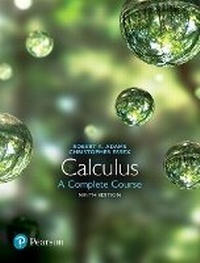
Calculus
A Complete Course Plus MyLab Math with Pearson eText -- Access Card Package
9th Edition
Published on 8. June 2017
Book
Mixed media product
1168 pages
978-0-13-458867-4 (ISBN)
Description
NOTE: Before purchasing, check with your instructor to ensure you select the correct ISBN. Several versions of Pearson's MyLab & Mastering products exist for each title, and registrations are not transferable. To register for and use Pearson's MyLab & Mastering products, you may also need a Course ID, which your instructor will provide.
Used books, rentals, and purchases made outside of Pearson
If purchasing or renting from companies other than Pearson, the access codes for Pearson's MyLab & Mastering products may not be included, may be incorrect, or may be previously redeemed. Check with the seller before completing your purchase.
Proven in North America and abroad, this classic text has earned a reputation for excellent accuracy and mathematical rigour. Previous editions have been praised for providing complete and precise statements of theorems, using geometric reasoning in applied problems, and for offering a range of applications across the sciences. Written in a clear, coherent, and readable form, Calculus: A Complete Course makes student comprehension a clear priority.
0134588673 / 9780134588674 Calculus: A Complete Course Plus MyMathLab with Pearson eText -- Access Card Package
Package consists of:
0134154363 / 9780134154367 Calculus: A Complete Course
0134528727 / 9780134528724 MyMathLab with Pearson eText -- Standalone Access Card -- for Calculus: A Complete Course
Used books, rentals, and purchases made outside of Pearson
If purchasing or renting from companies other than Pearson, the access codes for Pearson's MyLab & Mastering products may not be included, may be incorrect, or may be previously redeemed. Check with the seller before completing your purchase.
Proven in North America and abroad, this classic text has earned a reputation for excellent accuracy and mathematical rigour. Previous editions have been praised for providing complete and precise statements of theorems, using geometric reasoning in applied problems, and for offering a range of applications across the sciences. Written in a clear, coherent, and readable form, Calculus: A Complete Course makes student comprehension a clear priority.
0134588673 / 9780134588674 Calculus: A Complete Course Plus MyMathLab with Pearson eText -- Access Card Package
Package consists of:
0134154363 / 9780134154367 Calculus: A Complete Course
0134528727 / 9780134528724 MyMathLab with Pearson eText -- Standalone Access Card -- for Calculus: A Complete Course
More details
Edition
9th edition
Language
English
Place of publication
United States
Publishing group
Pearson Education (US)
Target group
College/higher education
Dimensions
Height: 282 mm
Width: 216 mm
Thickness: 41 mm
Weight
2540 gr
ISBN-13
978-0-13-458867-4 (9780134588674)
Copyright in bibliographic data is held by Nielsen Book Services Limited or its licensors: all rights reserved.
Schweitzer Classification
Other editions
New editions
Robert Adams | Christopher Essex
Calculus
A Complete Course + MyLab Mathematics with Pearson eText (Package)
Book
07/2021
10th Edition
Addison Wesley
€93.72
Shipment within 15-20 days
Previous edition

Robert A. Adams
Calculus: A Complete Course 8e with MyMathLab Global
Book
04/2017
8th Edition
Prentice-Hall (Canada)
€99.68
Article exhausted; check for reprint
Persons
Robert Adams joined the Mathematics Department at the University of British Columbia in 1966 after completing a Ph.D. in Mathematics at the University of Toronto. His research interests in analysis led to the 1975 publication of a monograph, Sobolev Spaces, by Academic Press. It remained in print for 23 years. A second edition, joint with his colleague Professor John Fournier, was published in 2003. Professor Adams's teaching interests led to the 1982 publication of the first of his many calculus texts by Addison Wesley. These texts are now used worldwide. With a keen interest in computers, mathematical typesetting, and illustration, in 1984 Professor Adams became the first Canadian author to typeset his own textbooks using TeX on a personal computer. Since then he has also done all the illustrations for his books using the MG software program that he developed with his colleague, Professor Robert Israel. Now retired from UBC, Professor Adams is currently pursuing his interest in the Linux operating system.
Dr. Christopher Essex is Professor and Associate Chair in the Department of Applied Mathematics at the University of Western Ontario. He is a former director of its Theoretical Physics Program. He is an award-winning teacher and author. In 2012-13 Chris has become the first ever Phi Beta Kappa Visiting Scholar from a Canadian university.
Dr. Essex did pioneering work on the thermodynamics of photon and neutrino radiation. Among many international invitations to speak on this topic, he has taught at the UNESCO advanced school in Udine, Italy, and in 2011 his work was featured at the Joint European Thermodynamics Conference held in Chemnitz, Germany. Professor Essex is also co-discoverer of the entropy production paradox of anomalous superdiffusion. He also discovered, while a guest of the Vatican, modern mathematics (Sierpinski triangles) embedded in the ancient floor tiles of the Sistine Chapel and elsewhere in the Vatican museum.
Professor Essex held an NSERC (Natural Sciences and Engineering Research Council of Canada) postdoctoral fellowship at the Canadian Climate Centre to work on its big climate model. He was first appointed to the governing council of NSERC in 2006 and reappointed in 2009.
His work also includes applications of dynamical systems theory, such as chaos cryptography, and recently the limits of modelling and computation, among other applications of mathematics.
Dr. Christopher Essex is Professor and Associate Chair in the Department of Applied Mathematics at the University of Western Ontario. He is a former director of its Theoretical Physics Program. He is an award-winning teacher and author. In 2012-13 Chris has become the first ever Phi Beta Kappa Visiting Scholar from a Canadian university.
Dr. Essex did pioneering work on the thermodynamics of photon and neutrino radiation. Among many international invitations to speak on this topic, he has taught at the UNESCO advanced school in Udine, Italy, and in 2011 his work was featured at the Joint European Thermodynamics Conference held in Chemnitz, Germany. Professor Essex is also co-discoverer of the entropy production paradox of anomalous superdiffusion. He also discovered, while a guest of the Vatican, modern mathematics (Sierpinski triangles) embedded in the ancient floor tiles of the Sistine Chapel and elsewhere in the Vatican museum.
Professor Essex held an NSERC (Natural Sciences and Engineering Research Council of Canada) postdoctoral fellowship at the Canadian Climate Centre to work on its big climate model. He was first appointed to the governing council of NSERC in 2006 and reappointed in 2009.
His work also includes applications of dynamical systems theory, such as chaos cryptography, and recently the limits of modelling and computation, among other applications of mathematics.
Content
Front Matter
Chapter P: Preliminaries
Chapter 1: Limits and Continuity
Chapter 2: Differentiation
Chapter 3: Transcendental Functions
Chapter 4: More Applications of Differentiation
Chapter 5: Integration
Chapter 6: Techniques of Integration
Chapter 7: Applications of Integration
Chapter 8: Conics, Parametric Curves, and Polar Curves
Chapter 9: Sequence, Series, and Power Series
Chapter 10: Vectors and Coordinate Geometry in 3-Space
Chapter 11: Vector Functions and Curves
Chapter 12: Partial Differentiation
Chapter 13: Applications of Partial Derivatives
Chapter 14: Multiple Integration
Chapter 15: Vector Fields
Chapter 16: Vector Calculus
Chapter 17: Differential forms and Exterior Calculus
Chapter 18: Ordinary Differential Equations
Appendix 1
Appendix 2
Appendix 3
Appendix 4
Appendix 5
Answers to Odd Numbered Exercises
Index
Chapter P: Preliminaries
Chapter 1: Limits and Continuity
Chapter 2: Differentiation
Chapter 3: Transcendental Functions
Chapter 4: More Applications of Differentiation
Chapter 5: Integration
Chapter 6: Techniques of Integration
Chapter 7: Applications of Integration
Chapter 8: Conics, Parametric Curves, and Polar Curves
Chapter 9: Sequence, Series, and Power Series
Chapter 10: Vectors and Coordinate Geometry in 3-Space
Chapter 11: Vector Functions and Curves
Chapter 12: Partial Differentiation
Chapter 13: Applications of Partial Derivatives
Chapter 14: Multiple Integration
Chapter 15: Vector Fields
Chapter 16: Vector Calculus
Chapter 17: Differential forms and Exterior Calculus
Chapter 18: Ordinary Differential Equations
Appendix 1
Appendix 2
Appendix 3
Appendix 4
Appendix 5
Answers to Odd Numbered Exercises
Index