


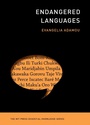
Endangered Languages
Published on 6. August 2024
Book
Paperback/Softback
264 pages
978-0-262-54870-0 (ISBN)
Description
A concise, accessible introduction to language endangerment and why it is one of the most urgent challenges of our times.
58% of the world’s languages—or, approximately 4,000 languages—are endangered. When we break this figure down, we realize that roughly ten percent of languages have fewer than ten language keepers. And, if one language stops being used every three months, this means that in the next 100 years, if we do nothing, 400 more languages will become dormant. In Endangered Languages, Evangelia Adamou, a specialist of endangered languages and a learner of her own community language, Nashta, offers a sobering look at language endangerment and what is truly lost when a language disappears from usage.
Combining recent advances from the Western scientific tradition—from the fields of linguistics, psycholinguistics, neurolinguistics, language attrition, population genetics, and natural language processing—and insights from Indigenous epistemology, theory, and ethics, Adamou examines a wealth of issues surrounding endangered languages. She discusses where endangered languages are found, including how they are faring in a digital world, why these languages are no longer used, and how communities can reclaim languages and keep them strong. Adamou also explains the impact of language continuity on community and individual health and well-being, the importance of language transmission in cultural transmission, and why language rights are essentially human rights.
Drawing on varied examples from the Wampanoag Nation to Wales, Endangered Languages offers a powerful reminder of the crucial role every language has in the vitality and well-being of individuals, communities, and our world.
58% of the world’s languages—or, approximately 4,000 languages—are endangered. When we break this figure down, we realize that roughly ten percent of languages have fewer than ten language keepers. And, if one language stops being used every three months, this means that in the next 100 years, if we do nothing, 400 more languages will become dormant. In Endangered Languages, Evangelia Adamou, a specialist of endangered languages and a learner of her own community language, Nashta, offers a sobering look at language endangerment and what is truly lost when a language disappears from usage.
Combining recent advances from the Western scientific tradition—from the fields of linguistics, psycholinguistics, neurolinguistics, language attrition, population genetics, and natural language processing—and insights from Indigenous epistemology, theory, and ethics, Adamou examines a wealth of issues surrounding endangered languages. She discusses where endangered languages are found, including how they are faring in a digital world, why these languages are no longer used, and how communities can reclaim languages and keep them strong. Adamou also explains the impact of language continuity on community and individual health and well-being, the importance of language transmission in cultural transmission, and why language rights are essentially human rights.
Drawing on varied examples from the Wampanoag Nation to Wales, Endangered Languages offers a powerful reminder of the crucial role every language has in the vitality and well-being of individuals, communities, and our world.
More details
Language
English
Place of publication
Cambridge (Massachusetts)
United States
Publishing group
MIT Press Ltd
Product notice
Paperback (trade)
Unsewn / adhesive bound
Illustrations
3 BLACK AND WHITE ILLUS.
Dimensions
Height: 175 mm
Width: 126 mm
Thickness: 20 mm
Weight
212 gr
ISBN-13
978-0-262-54870-0 (9780262548700)
Copyright in bibliographic data and cover images is held by Nielsen Book Services Limited or by the publishers or by their respective licensors: all rights reserved.
Schweitzer Classification
Other editions
Additional editions
Person
Evangelia Adamou
Content
Contents
Preface
Writing conventions
Chapter 1. Introduction: What we mean when we talk about endangered languages
Chapter 2. Where are endangered languages found?
Africa, Eurasia, Australia, Oceania, North America and Mesoamerica, South America
Chapter 3. When is a language no longer used by a community?
Chapter 4. Why does it matter if a language is no longer used?
Chapter 5. How do communities and governments support endangered languages?
Chapter 6. When linguists and language practitioners study endangered languages
Chapter 7. Endangered languages in a digital world
Chapter 8. Multilingualism as resolution
Conclusion: Tips to promote language diversity
Acknowledgments
Glossary
Further reading
Index
Author bio
Preface
Writing conventions
Chapter 1. Introduction: What we mean when we talk about endangered languages
Chapter 2. Where are endangered languages found?
Africa, Eurasia, Australia, Oceania, North America and Mesoamerica, South America
Chapter 3. When is a language no longer used by a community?
Chapter 4. Why does it matter if a language is no longer used?
Chapter 5. How do communities and governments support endangered languages?
Chapter 6. When linguists and language practitioners study endangered languages
Chapter 7. Endangered languages in a digital world
Chapter 8. Multilingualism as resolution
Conclusion: Tips to promote language diversity
Acknowledgments
Glossary
Further reading
Index
Author bio