

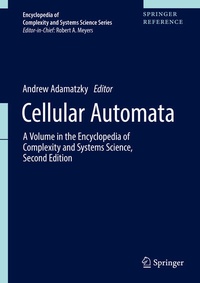
Cellular Automata
A Volume in the Encyclopedia of Complexity and Systems Science, Second Edition
Published on 28. November 2018
Book
Hardback
XXV, 760 pages
978-1-4939-8699-6 (ISBN)
Description
This volume of the
Encyclopedia of Complexity and Systems Science, Second Edition
, provides an authoritative introduction and overview of the latest research in cellular automata (CA) models of physical systems, emergent phenomena, computational universality, chaos, growth phenomena, phase transitions, self-organised criticality, reaction-diffusion systems, self-replications, parallel computation, and more. Fundamental topics of algorithmic complexity, algebraic groups, language theory, evolving CA, ergodic theory, synchronisation, tiling problems and undecidability and topological dynamics of CA are addressed. Cellular automata are regular uniform networks of locally-connected finite-state machines, and represent discrete systems with non-trivial behavior, including waves, patterns and travelling localisations. CA are ubiquitous: they are mathematical models of computation and computer models of natural systems. Classes of CA presented in this book include additive CA, automatain hyperbolic spaces and non-compact spaces, CA in triangular, pentagonal and hexagonal tessellations, automata with memory, quantum and reversible automata, structurally-dynamic CA, and asynchronous automata. Topics added to the second edition include: asynchronous cellular automata, stochastic cellular automata as models of reaction-diffusion processes, cellular automata hardware implementation, cellular automata basins of attraction, orbits of Bernoulli measures in cellular automata, and graphs related to reversibility and complexity in cellular. This state-of-the-art reference is unique in bringing together unequalled expertise of interdisciplinary studies at the edge of mathematics, computer science, and physics.
Reviews / Votes
"The volume is an important collection of high-quality works and an excellent reference for researchers in fields related to cellular automata as well as for newcomers to the subject. It is an important addition to the scientific library of any academic institution." (Silvio Capobianco, zbMATH 1484.68001, 2022)More details
Series
Edition
2018 ed.
Language
English
Place of publication
New York
United States
Target group
Professional and scholarly
Illustrations
235 s/w Abbildungen, 190 farbige Abbildungen
XXV, 760 p. 425 illus., 190 illus. in color.
Dimensions
Height: 260 mm
Width: 183 mm
Thickness: 45 mm
Weight
1829 gr
ISBN-13
978-1-4939-8699-6 (9781493986996)
DOI
10.1007/978-1-4939-8700-9
Schweitzer Classification
Other editions
Additional editions
Andrew Adamatzky
Cellular Automata
A Volume in the Encyclopedia of Complexity and Systems Science, Second Edition
Book
11/2018
Springer
€802.49
Article exhausted; check different version
Person
Andrew Adamatzky is a Professor in the department of Computer Science and Creative Technologies and Director of the Unconventional Computing Centre, University of the West of England. He has published extensively in theory of computation, cellular automata and mathematical machines, parallel computing, living technologies, organic electronics, and bio-inspired computing. He has authored several books, including
Identification of Cellular Automata
,
Computing in Nonlinear Media
,
Reaction Diffusion Computers
,
Dynamics of Crowded Minds
,
Physarum Machines
and edited over 25 collections of chapters. He is founding editor-in-chief of the
Journal of Cellular Automata
and
Journal of Unconventional Computing
and editor-in-chief of the
International Journal of Parallel, Emergent and Distributed Systems
, and
Parallel Processing Letters
.
Content
Additive Cellular Automata.- Algorithmic Complexity and Cellular Automata.- Asymptotic Behaviour and a Formalization of Wolfram's Classes.- Asynchronous Cellular Automata.- Basins of Attraction of Cellular Automata and Discrete Dynamical Networks.- Cellular Automata and Groups.- Cellular Automata and Language Theory.- Cellular Automata as Models of Parallel Computation.- Cellular Automata Hardware Implementation.- Cellular Automata in Hyperbolic Spaces.- Cellular Automata in Triangular, Pentagonal and Hexagonal Tessellations.- Cellular Automata Modeling of Physical Systems.- Cellular Automata with Memory.- Classification of Cellular Automata.- Emergent Phenomena in Cellular Automata.- Universality of Cellular Automata.- Chaotic Behavior of Cellular Automata.- Dynamics of Cellular Automata in Non-compact Spaces.- Ergodic Theory of Cellular Automata.- Evolving Cellular Automata.- Firing Squad Synchronization Problem in Cellular Automata.- Gliders in Cellular Automata.- Graphs Related to Reversibility and Complexity in Cellular Automata.- Growth Phenomena in Cellular Automata.- Identification of Cellular Automata.- Introduction to Mathematical Basis of Cellular Automata.- Orbits of Bernoulli Measures in Cellular Automata.- Phase Transitions in Cellular Automata.- Quantum Cellular Automata.- Reversible Cellular Automata.- Self-Organized Criticality and Cellular Automata.- Self-Replication and Cellular Automata.- Stochastic Cellular Automata as models of Reaction-Diffusion processes.- Structurally Dynamic Cellular Automata.- Tiling Problem and Undecidability in Cellular Automata.- Topological Dynamics of Cellular Automata.