

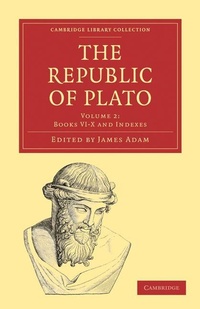
The Republic of Plato
Published on 20. May 2010
Book
Paperback/Softback
544 pages
978-1-108-01192-1 (ISBN)
Description
James Adam (1860-1907) was a Scottish classics scholar who taught at Emmanuel College, Cambridge. A strong defender of the importance of Greek philosophy in a well-rounded education, Adam published a number of Plato's works including Protagoras and Crito. This two-volume critical edition of the Republic (1902) was another major contribution to the field. Though his preface claims 'an editor cannot pretend to have exhausted its significance by means of a commentary,' Adam's depth of knowledge and erudite analysis of the Greek text ensured that his edition remained the standard reference for decades to follow, and it remains a thought-provoking evaluation of one of the great works of Western thought. Volume 2 examines Books 6-10, which discuss the place of the philosopher and questions of governance.
More details
Series
Language
Other
Place of publication
Cambridge
United Kingdom
Target group
College/higher education
Product notice
Paperback (trade)
Illustrations
Worked examples or Exercises
Dimensions
Height: 216 mm
Width: 140 mm
Thickness: 32 mm
Weight
759 gr
ISBN-13
978-1-108-01192-1 (9781108011921)
Copyright in bibliographic data and cover images is held by Nielsen Book Services Limited or by the publishers or by their respective licensors: all rights reserved.
Schweitzer Classification
Person
Plato was an ancient Greek philosopher born in Athens during the Classical period in Ancient Greece. In Athens, Plato founded the Academy, a philosophical school where he taught the philosophical doctrines that would later become known as Platonism. Plato (or Platon) was a pen name derived, apparently, from the nickname given to him by his wrestling coach - allegedly a reference to his physical broadness. According to Alexander of Miletus quoted by Diogenes of Sinope his actual name was Aristocles, son of Ariston, of the deme Collytus (Collytus being a district of Athens).Plato was an innovator of the written dialogue and dialectic forms in philosophy. He raised problems for what later became all the major areas of both theoretical philosophy and practical philosophy. His most famous contribution is the Theory of forms, which has been interpreted as advancing a solution to what is now known as the problem of universals. He is also the namesake of Platonic love and the Platonic solids.
Content
Book VI; Appendices to Book VI; Book VII; Appendices to Book VII; Book VIII; Appendices to Book VIII; Book IX; Appendices to Book IX; Book X; Appendices to Book X; Additions and corrections; Indexes.