

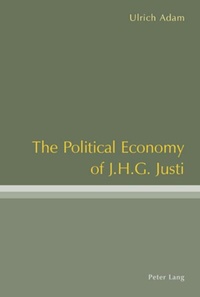
The Political Economy of J.H.G. Justi
Published on 10. July 2006
Book
Paperback/Softback
318 pages
978-3-03910-278-5 (ISBN)
Description
This study provides a first comprehensive introduction to the political and economic thought of Johann Heinrich Gottlob von Justi (1717-1771). While previous scholarship saw Justi as quintessentially a German thinker, this analysis argues that his thought was a by-product of the broader European intellectual discourse on the political implications of modern trade.
Writing between the conclusion of the War of the Austrian Succession (1748) and the end of the Seven Years War (1763) - when competition among European powers was sharply on the increase - Justi's aim was to create modern commercial monarchies in the larger states of the Holy Roman Empire that could equal the military strength, political standing and economic performance of England and France. Shedding fresh light on Justi's tortuous biography and complex oeuvre this study unveils the critical impact that French thinkers such as Fénelon, Saint-Pierre, d'Argenson and Montesquieu exerted on Justi's ideas and demonstrates that his economic thought was part and parcel of an innovative and comprehensive political reform plan for the entire European state system.
More details
Edition
New edition
Language
English
Place of publication
Oxford
United Kingdom
Publishing group
Peter Lang Group AG, International Academic Publishers
Edition type
New edition
Dimensions
Height: 220 mm
Width: 150 mm
Thickness: 18 mm
Weight
439 gr
ISBN-13
978-3-03910-278-5 (9783039102785)
Schweitzer Classification
Person
The Author: Ulrich Adam taught History of Political Thought at Cambridge University.
Content
Contents: Justi¿s Life and Oeuvre ¿ The European Power Struggle of the 1750s ¿ Warfare, Empire, and Foreign Trade ¿ Justi as a Critic of Montesquieu ¿ Justi¿s `Third-Way¿ Model of Modern Monarchy ¿ Ministerial Despotism and Personal Monarchical Rule ¿ Administrative Reforms ¿ Economic Policy (Polizei) ¿ Luxury and Sumptuary Laws ¿ Market Reform ¿ Agricultural Reform ¿ Taxation.