

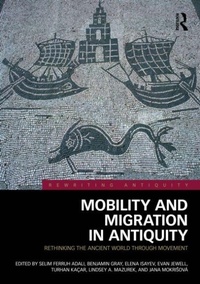
Mobility and Migration in Antiquity
Rethinking the Ancient World through Movement
1st Edition
Will be published approx. on 31. December 2026
Book
Hardback
712 pages
978-1-032-27178-1 (ISBN)
Description
Mobility and Migration in Antiquity investigates human movement in the context of the ancient world from the Iberian Peninsula to the Indian Ocean, addressing small-scale, everyday mobility as well as movement that engenders major socio-political change.
The volume's fundamental concern is to interrogate how historical transformations in Antiquity may be better understood once movement is recognised as a pervasive phenomenon. The chapters span a wide chronological and geographical range, collectively providing openings for a new history of societal change that takes movement as its starting point - in its myriad of forms - from personal to community, from local to long-distance, from temporary to permanent, from voluntary to forced. It is organised in seven sections: borders and boundaries; environmental adaptions; cosmopolitanism; forced mobility and displacement; trade, craft, and labour; journeys and pilgrimages; and sedentism, gender, and immobility. The final part of the volume pivots towards the future of these disciplines in their approach to mobility. Each of these sections is united by an overarching theme and focus while also addressing larger historical questions associated with mobility in the ancient world and explicitly placing approaches from classical literature, history and archaeological sciences side by side.
Mobility and Migration in Antiquity is an invaluable resource for anyone working on mobility and migration in the ancient Mediterranean world, as well as those interested in theories of migration across history, and societal change more broadly.
The volume's fundamental concern is to interrogate how historical transformations in Antiquity may be better understood once movement is recognised as a pervasive phenomenon. The chapters span a wide chronological and geographical range, collectively providing openings for a new history of societal change that takes movement as its starting point - in its myriad of forms - from personal to community, from local to long-distance, from temporary to permanent, from voluntary to forced. It is organised in seven sections: borders and boundaries; environmental adaptions; cosmopolitanism; forced mobility and displacement; trade, craft, and labour; journeys and pilgrimages; and sedentism, gender, and immobility. The final part of the volume pivots towards the future of these disciplines in their approach to mobility. Each of these sections is united by an overarching theme and focus while also addressing larger historical questions associated with mobility in the ancient world and explicitly placing approaches from classical literature, history and archaeological sciences side by side.
Mobility and Migration in Antiquity is an invaluable resource for anyone working on mobility and migration in the ancient Mediterranean world, as well as those interested in theories of migration across history, and societal change more broadly.
More details
Series
Language
English
Place of publication
London
United Kingdom
Publishing group
Taylor & Francis Ltd
Target group
College/higher education
Postgraduate and Undergraduate Advanced
Illustrations
78 s/w Photographien bzw. Rasterbilder, 17 s/w Zeichnungen, 14 s/w Tabellen, 95 s/w Abbildungen
14 Tables, black and white; 17 Line drawings, black and white; 78 Halftones, black and white; 95 Illustrations, black and white
Dimensions
Height: 246 mm
Width: 174 mm
Weight
453 gr
ISBN-13
978-1-032-27178-1 (9781032271781)
Copyright in bibliographic data and cover images is held by Nielsen Book Services Limited or by the publishers or by their respective licensors: all rights reserved.
Schweitzer Classification
Persons
Selim Ferruh Adali is Professor of Ancient History at Social Sciences University of Ankara, Tuerkiye.
Benjamin Gray is Assistant Professor in Classics at the University of Cambridge, UK.
Elena Isayev is Professor of Ancient History and Place at University of Exeter, UK.
Evan Jewell is currently Assistant Professor of History at Rutgers University - Camden, USA.
Turhan Kacar is Professor of Ancient History at Mugla Sitki Kocman University, Tuerkiye.
Lindsey A. Mazurek is Associate Professor of Roman Archaeology and Director of the Program in Ancient Studies at Indiana University, Bloomington, USA.
Jana Mokrisova is Assistant Professor of Archaeology of the Ancient Greek World at Brown University, USA.
Benjamin Gray is Assistant Professor in Classics at the University of Cambridge, UK.
Elena Isayev is Professor of Ancient History and Place at University of Exeter, UK.
Evan Jewell is currently Assistant Professor of History at Rutgers University - Camden, USA.
Turhan Kacar is Professor of Ancient History at Mugla Sitki Kocman University, Tuerkiye.
Lindsey A. Mazurek is Associate Professor of Roman Archaeology and Director of the Program in Ancient Studies at Indiana University, Bloomington, USA.
Jana Mokrisova is Assistant Professor of Archaeology of the Ancient Greek World at Brown University, USA.
Content
INTRODUCTION - Jana Mokrisova, Benjamin Gray, Elena Isayev, Selim Ferruh Adali, Evan Jewell, Turhan Kacar, and Lindsey A. Mazurek; SECTION 1: A borderless world? Rethinking boundaries, edges, and borderlands through movement; 1. Archaeogenetics and modes of mobility in the ancient Mediterranean - Hannah M. Moots and Mehmet Somel; 2. Mobility and borderlands in Hittite Anatolia - N. Ilgi Gercek; 3. Religion and mobility: a Phoenician case study from the western Mediterranean - Megan Daniels; 4. Creating borders: early Greek mobilities in Ionia and Cilicia = Naoise Mac Sweeney and Jana Mokrisova; 5. Who can stay? Wrongful presence, inutility and expulsion of citizens in the Roman Empire - Elena Isayev; 6. People in motion: rethinking Mediterranean mobility in the Byzantine period using bioarchaeological data - Efthymia Nikita; SECTION 2: Environmental adaptations: rethinking lifeways and climatic change through movement; 7. How close is a neighbor? Demography, maritime networks and disaster in the Bronze Age Cyclades (Greece) - Katherine Jarriel; 8. The grass is (almost) always greener in Egypt: Libyans, Sea Peoples and climate migration at the end of the Late Bronze Age - Ellen Morris; 9. Processes of colonial migration in the Iron Age: economic and environmental considerations - Adam W. Schneider; 10. Should I stay or should I go? Some considerations on mobility and sedentism in (pre-)Roman Italy - Christian Heitz; 11. Mosquito colonizers versus human colonizers: the environmental-epidemiological inflections of Roman colonial mobility in Republican-era Italy - Evan Jewell; SECTION 3: Cosmopolitanism: rethinking regimes of belonging through movement; 12. Mobility and the making of Greek political thought: Aristotle Politics III in context - Benjamin Gray; 13. The almost citizens: Plataeans between metoikia and citizenship - Tim Shea and Rebecca Futo Kennedy; 14. Patterns of migration in the eastern Mediterranean c. 400 BCE - c. 100 CE - Christian A. Thomsen, Kira L. Larsen and Maja Rechendorff Moller; 15. What's a woman got to do with it? Migration to the Aegean islands in the Hellenistic and early Imperial periods - Julietta Steinhauer; 16. Citizenship and mobility in the city of Rome - Olivia Elder; 17. The Piazzale delle Corporazioni as a space of diaspora in Roman Ostia - Lindsey A. Mazurek; SECTION 4: Forced mobility and displacement: rethinking imperialism and violence through movement; 18. War captives and mass deportations in the Urartian kingdom: an overview - Ali Cifci; 19. "Forced" migration: people on the move between Ionia and the Black Sea - Veronika Sossau; 20. Between "evacuation" and "being kicked out": mapping the ancient terminology of forcible population expulsions onto lived experience in the ancient Greek world - James Hua; 21. Imperial ideology, destruction, enslavement and deportation: comparative perspectives on forced migration in Hellenistic Greece - Ryan Boehm; 22. Exile in later Greek discourse and the pseudonymous letters of Themistocles - Zilong Guo; 23. Geographic mobility in the Familia Caesaris - Rose MacLean; SECTION 5: Trade, craft, and labour: rethinking technology and knowledge through movement; 24. Craft mobility and the Mycenaean palaces: travelling masons, labourers and metalsmiths? - Nicholas Blackwell; 25. The local(e) jokes of Plautine comedy - Hans Bork; 26. Human mobility and technological transfer in the mining industry of the Iberian peninsula - Linda R. Gosner and Claire Holleran; 27. Controlled mobility, controlled trade: institutional and physical management of commercial shipping in Roman ports during the High Empire - Emilia Mataix Ferrandiz; SECTION 6: Journeys and pilgrimages: rethinking religion and networks through movement; 28. Murderous migrants in Homer - Eunice Kim; 29. Souvenirs as products and agents of mobility in the Roman Empire - Maggie L. Popkin; 30. Ecclesiastical mobility in Late Antiquity - Turhan Kacar; 31. Pilgrim's progress: the bioarchaeology of Byzantine monasticism and pilgrimage to the Holy Land - Lesley A. Gregoricka, Susan G. Sheridan and Margaret A. Judd; 32. Religious institutions and human movement across the Indian Ocean - Jeremy Simmons and Suchandra Ghosh; SECTION 7: Who does not move in the Near East? Rethinking paradigms of sedentism and gender through movement; 33. Women's sedentary lifestyle in the ancient Near East between myth and reality: the case of the Assyrian women in the nineteenth century BCE - Cecile Michel; 34. A woman's place is in the house? Perspectives on women's mobility in Sumerian didactic literature - Jana Matuszak; 35. Intersectional approaches to women's mobility in Old Babylonian Mesopotamia - Nancy Highcock; 36. Residential mobility in Mesopotamia's Old Babylonian period - Seth Richardson; 37. Immobility in Iron Age ideologies: the case of Assyria in the ancient Near East - Selim Ferruh Adali; EPILOGUE; 38. Anchored mobilities? (Dis)connecting the Mediterranean on a 14-m wooden boat - Elizabeth S. Greene and Justin Leidwanger; 39. Migrations and the Non-Human. Ecologies in the Year of the Locust - Dan-el Padilla Peralta.