

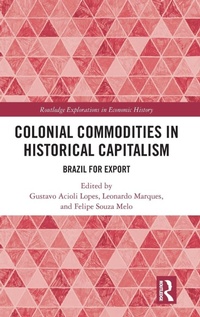
Colonial Commodities in Historical Capitalism
Brazil for Export
1st Edition
Will be published approx. on 6. February 2026
Book
Hardback
288 pages
978-1-032-80317-3 (ISBN)
Description
From the role of sugar in the early history of the colonial era to coffee in the long nineteenth century, commodities have played a crucial role in the development of the Brazilian economy.
Drawing on the history of commodities approach, this book explores both the external and internal commodity markets since the time that Portuguese settlers established new commodity frontiers to supply global markets based on the coerced labor of the native population and of millions of enslaved Africans and their descendants. The essays in this book each focus on a specific commodity - including cotton, leather, timber, soy and more - that have shaped not only the history of Brazil but also of the wider world. Each contributor outlines how a particular export sector integrated Brazil to global circuits of trade, thus contributing to the making of the modern capitalist economy. This approach also allows for the exploration of different aspects of the extraction and production of these goods, including the various labor regimes employed and the environmental conditions and impacts that accompanied them.
The book will be of interest to all readers in economic history, especially in its intersections with social, political, cultural, and environmental processes and in the broader context of the development of global capitalism.
Drawing on the history of commodities approach, this book explores both the external and internal commodity markets since the time that Portuguese settlers established new commodity frontiers to supply global markets based on the coerced labor of the native population and of millions of enslaved Africans and their descendants. The essays in this book each focus on a specific commodity - including cotton, leather, timber, soy and more - that have shaped not only the history of Brazil but also of the wider world. Each contributor outlines how a particular export sector integrated Brazil to global circuits of trade, thus contributing to the making of the modern capitalist economy. This approach also allows for the exploration of different aspects of the extraction and production of these goods, including the various labor regimes employed and the environmental conditions and impacts that accompanied them.
The book will be of interest to all readers in economic history, especially in its intersections with social, political, cultural, and environmental processes and in the broader context of the development of global capitalism.
More details
Series
Language
English
Place of publication
London
United Kingdom
Publishing group
Taylor & Francis Ltd
Target group
College/higher education
Postgraduate
Illustrations
25 s/w Tabellen, 8 s/w Zeichnungen, 16 s/w Photographien bzw. Rasterbilder, 24 s/w Abbildungen
25 Tables, black and white; 8 Line drawings, black and white; 16 Halftones, black and white; 24 Illustrations, black and white
Dimensions
Height: 240 mm
Width: 161 mm
Thickness: 21 mm
Weight
614 gr
ISBN-13
978-1-032-80317-3 (9781032803173)
Copyright in bibliographic data and cover images is held by Nielsen Book Services Limited or by the publishers or by their respective licensors: all rights reserved.
Schweitzer Classification
Other editions
Additional editions
Gustavo Acioli Lopes | Leonardo Marques | Felipe Souza Melo
Colonial Commodities in Historical Capitalism
Brazil for Export
E-Book
02/2026
Routledge
€60.49
Available for download
Gustavo Acioli Lopes | Leonardo Marques | Felipe Souza Melo
Colonial Commodities in Historical Capitalism
Brazil for Export
E-Book
02/2026
Routledge
€60.49
Available for download
Persons
Gustavo Acioli Lopes is Professor of Economic History in the Department of History at Federal Rural University of Pernambuco (Brazil).
Leonardo Marques is Professor of Colonial American History at the Universidade Federal Fluminense, Rio de Janeiro, Brazil.
Felipe Souza Melo is a post-doctoral researcher at the Paul Bairoch Institute of Economic History (University of Geneva).
Leonardo Marques is Professor of Colonial American History at the Universidade Federal Fluminense, Rio de Janeiro, Brazil.
Felipe Souza Melo is a post-doctoral researcher at the Paul Bairoch Institute of Economic History (University of Geneva).
Content
Towards an economic history of Brazil's commodity chains: the environment and the development of historical capitalism GUSTAVO ACIOLI LOPES AND FELIPE SOUZA MELO 1 Brazilwood and dyeing: a global history THIAGO ALVES DIAS 2 Tapping the forest: the timber export economy in late-colonial Rio de Janeiro DIOGO DE CARVALHO CABRAL, CAROLINA TORRES AND VERONICA MAIOLI 3 Brazilian Sugar's Persistence in Global Context, 1500-1900 THOMAS D. ROGERS 4 From holy herb to pleasant commodity: Brazilian tobacco and the global Atlantic GUSTAVO ACIOLI LOPES 5 Brazil and the Atlantic Leather Market: Production, Circulation, and Consumption (18th and 19th centuries) JONAS MOREIRA VARGAS 6 Cacao and the drogas do sertao in the Luso-Brazilian Amazon region (seventeenth to nineteenth century) RAFAEL CHAMBOULEYRON AND JOSE MAIA BEZERRA NETO 7 The Nature of Money: Brazilian Gold and the Environmental Foundations of Historical Capitalism CAROLINA MAROTTA CAPANEMA AND LEONARDO MARQUES 8 The Political Economy of Brazilian Cotton in the Age of Industrial Capitalism RAFAEL DE BIVAR MARQUESE AND MARCELO ROSANOVA FERRARO 9 Rice in southeastern Brazil: the case of the Ribeira Valley, 1801-1836 AGNALDO VALENTIN 10 The coffee economy in Imperial Brazil (c.1800-c.1850) BRENO APARECIDO SERVIDONE MORENO AND GABRIEL GONZALEZ STERMAN 11 The International Trade in Whale Commodities during the Rise of the Whaling South Atlantic, 1750-1850 WELLINGTON CASTELLUCCI JUNIOR Brazil in the Global Circuits of Commodification from the 16th to the 21st Century LEONARDO MARQUES