

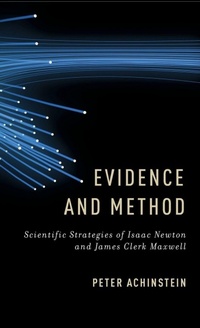
Evidence and Method
Scientific Strategies of Isaac Newton and James Clerk Maxwell
Published on 11. April 2013
Book
Hardback
192 pages
978-0-19-992185-0 (ISBN)
Description
What is meant by scientific evidence, and how can a definition of this concept be applied in the sciences to determine whether observed facts constitute evidence that a given theory is true?
In this book, Peter Achinstein proposes and defends several objective concepts of evidence. He then explores the question of whether a scientific method, such as that represented in the four "Rules for the Study of Natural Philosophy" that Isaac Newton invoked in proving his law of gravity, can be employed in demonstrating how the proposed definitions of evidence are to be applied to real scientific cases. In answering this question, he offers a new interpretation of Newton's controversial rules. Contrary to what many methodologists assume, whether the rules, so interpreted, can be used to determine whether observed phenomena provide evidence for a theory is an empirical question, not an a priori one. Finally, in order to deal with numerous cases in which evidence is insufficient to establish a theory, or where no theory is even available, Achinstein describes and defends three scientific methods proposed by the 19th century theoretical physicist James Clerk Maxwell, in the course of developing his electrical and molecular theories.
In this book, Peter Achinstein proposes and defends several objective concepts of evidence. He then explores the question of whether a scientific method, such as that represented in the four "Rules for the Study of Natural Philosophy" that Isaac Newton invoked in proving his law of gravity, can be employed in demonstrating how the proposed definitions of evidence are to be applied to real scientific cases. In answering this question, he offers a new interpretation of Newton's controversial rules. Contrary to what many methodologists assume, whether the rules, so interpreted, can be used to determine whether observed phenomena provide evidence for a theory is an empirical question, not an a priori one. Finally, in order to deal with numerous cases in which evidence is insufficient to establish a theory, or where no theory is even available, Achinstein describes and defends three scientific methods proposed by the 19th century theoretical physicist James Clerk Maxwell, in the course of developing his electrical and molecular theories.
Reviews / Votes
[T]he renowned philosopher of science Peter Achinstein focuses on the question whether observed phenomena constitute evidence that a theory is true. ...The book is clearly written, aims at a general audience and provides valuable insights into the works of these two icons of modern science. Thus, it is warmly recommended for the readers of Science & Education. * Science & Education * a significant contribution to what philosophers of science can learn from the methodologies of Newton and Maxwell. * William L. Harper, Metascience *More details
Language
English
Place of publication
New York
United States
Target group
College/higher education
Dimensions
Height: 222 mm
Width: 145 mm
Thickness: 14 mm
Weight
382 gr
ISBN-13
978-0-19-992185-0 (9780199921850)
Copyright in bibliographic data and cover images is held by Nielsen Book Services Limited or by the publishers or by their respective licensors: all rights reserved.
Schweitzer Classification
Other editions
Additional editions
E-Book
03/2013
1st Edition
OUP eBook
€24.99
Available for download
Person
Peter Achinstein is Professor of Philosophy at Johns Hopkins University, Director of the Johns Hopkins Center for History and Philosophy of Science, and Jay and Jeannie Schottenstein University Professor at Yeshiva University. He is the author of six books in the philosophy of science, including Particles and Waves, which received the Lakatos Award in 1993. A festschrift in his honor, Philosophy of Science Matters: The Philosophy of Peter Achinstein was published by Oxford University Press in 2011.
Content
Preface ; Chapter 1: A Problem about Evidence ; Chapter 2: Newton's Rules ; Chapter 3: Newtonian Extensions, a Rival, Justifying Induction, and Evidence ; Chapter 4: What to Do If You Cannot Establish a Theory: Maxwell's Three Methods