

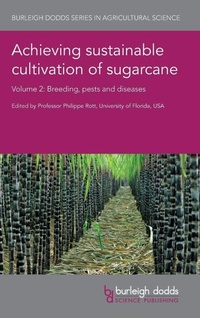
Achieving Sustainable Cultivation of Sugarcane Volume 2
Breeding, Pests and Diseases
Burleigh Dodds Science Publishing Limited
Published on 5. March 2018
Book
Hardback
470 pages
978-1-78676-148-4 (ISBN)
Description
Sugarcane is the source of over three quarters of the world's sugar, and is grown widely in the tropics and sub-tropics. Despite rising demand, average yields have not increased significantly, partly because of continued vulnerability to pests and diseases. In addition, cultivation has been seen as damaging biodiversity and soil health with a negative effect on both yields and the environment. This volume summarises the wealth of research addressing these challenges.
Volume 2 reviews advances in breeding and the management of pests and diseases. Part 1 assesses the latest research on sugarcane genetics, physiology and genetic diversity, and how this is informing advances in conventional, marker-assisted and transgenic breeding techniques. Part 2 discusses progress in understanding bacterial, fungal and viral diseases and their management, as well as the management of insect and nematode pests as well as weeds.
With its distinguished editor and international team of expert authors, this will be a standard reference for sugarcane scientists, growers, government and non-governmental agencies responsible for supporting and monitoring the impact of sugarcane cultivation. It is accompanied by a companion volume reviewing cultivation and sustainability issues.
Volume 2 reviews advances in breeding and the management of pests and diseases. Part 1 assesses the latest research on sugarcane genetics, physiology and genetic diversity, and how this is informing advances in conventional, marker-assisted and transgenic breeding techniques. Part 2 discusses progress in understanding bacterial, fungal and viral diseases and their management, as well as the management of insect and nematode pests as well as weeds.
With its distinguished editor and international team of expert authors, this will be a standard reference for sugarcane scientists, growers, government and non-governmental agencies responsible for supporting and monitoring the impact of sugarcane cultivation. It is accompanied by a companion volume reviewing cultivation and sustainability issues.
More details
Series
Language
English
Place of publication
Cambridge
United Kingdom
Target group
Professional and scholarly
Academics researching sugarcane; sugarcane growers; government and non-governmental agencies supporting or monitoring the impact of sugarcane cultivation
Product notice
Paper over boards
Illustrations
Color tables, photos and figures
Dimensions
Height: 235 mm
Width: 157 mm
Thickness: 30 mm
Weight
826 gr
ISBN-13
978-1-78676-148-4 (9781786761484)
DOI
10.19103/AS.2017.0035.2
Copyright in bibliographic data and cover images is held by Nielsen Book Services Limited or by the publishers or by their respective licensors: all rights reserved.
Schweitzer Classification
Other editions
Additional editions
E-Book
06/2018
Burleigh Dodds Science Publishing Limited
€218.99
Available for download
Persons
Dr Philippe Rott is Professor of Plant Pathology in the Everglades Research and Education Center at the University of Florida. He previously conducted research at CIRAD (the French Agricultural Research Center for International Development) for over three decades. Professor Rott is currently Chair of the Executive Committee of the International Society of Sugarcane Technologists. He has written widely on sugarcane diseases.
Content
Part 1 Plant physiology and breeding
1.Sugarcane genome sequencing and genetic mapping: Xiping Yang and Ramkrishna Kandel, University of Florida (Gainesville), USA; Jian Song, University of Florida (Gainesville), USA and Dezhou University, China; Qian You, University of Florida (Gainesville), USA and Fujian Agriculture and Forestry University, China; Mengjuan Wang, Fujian Agriculture and Forestry University, China; Jianping Wang, University of Florida (Gainesville), USA and Fujian Agriculture and Forestry University, China;
2.Advances in understanding of sugarcane plant growth and physiology: Frederik C. Botha, Sugar Research Australia and the University of Queensland, Australia;
3.Ensuring and exploiting the genetic diversity of sugarcane: Anna Hale, USDA-ARS, USA; Phillip Jackson, CSIRO, Australia; and James R. Todd, USDA-ARS, USA;
4.Advances in conventional sugarcane breeding programmes: Phillip Jackson, CSIRO, Australia;
5.Advances in marker-assisted breeding of sugarcane: Per McCord, USDA-ARS, USA;
6.Genetic improvement of sugarcane by transgenic, intragenic and genome editing technologies: Fredy Altpeter and Ratna Karan, University of Florida, USA;
Part 2 Progress in understanding and managing diseases, pests and weeds
7.Ensuring biosecurity in sugarcane cultivation: Nicole Thompson, Sugar Research Australia (SRA), Australia;
8.Viral metagenomics and sugarcane pathogens: Philippe Roumagnac, Jean-Heinrich Daugrois and Denis Filloux, CIRAD, France; and Dimitre Mollov, USDA-ARS, USA;
9.Progress in understanding fungal diseases affecting sugarcane: red rot: R. Viswanathan, A. Ramesh Sundar, R. Selvakumar and P. Malathi, ICAR-Sugarcane Breeding Institute, India;
10.Progress in understanding fungal diseases affecting sugarcane: smut: Claudia B. Monteiro Vitorello, Patricia Dayane Carvalho Schaker, Juliana Benevenuto, Natalia de Sousa Teixeira e Silva and Sintia Silva de Almeida, University of Sao Paulo, Brazil;
11.Progress in understanding fungal diseases affecting sugarcane: rusts: R. Stuart Rutherford, South African Sugarcane Research Institute (SASRI) and University of KwaZulu-Natal, South Africa;
12.Progress in understanding viruses affecting sugarcane: Kathy Braithwaite, Sugar Research Australia (SRA), Australia;
13.Recent progress in understanding three major bacterial diseases of sugarcane: gumming, leaf scald and ratoon stunting: Monique Royer, Isabelle Pieretti, and Stephane Cociancich, CIRAD, France; and Philippe Rott, University of Florida, USA;
14.Managing the soil biological community to improve soil health and reduce losses from nematode pests: Graham R. Stirling, Biological Crop Protection Pty Ltd, Australia;
15.Progress in understanding and managing insect pests affecting sugarcane: Francois-Regis Goebel, CIRAD, France; Julien M. Beuzelin, University of Florida, USA; and Mike J. Way, South African Sugarcane Research Institute (SASRI), South Africa;
16.Integrated disease management strategies in sugarcane cultivation: Jack C. Comstock and Sushma G. Sood, USDA-ARS, USA;
17.Integrated weed management in sugarcane cultivation: Calvin Odero, University of Florida, USA;
1.Sugarcane genome sequencing and genetic mapping: Xiping Yang and Ramkrishna Kandel, University of Florida (Gainesville), USA; Jian Song, University of Florida (Gainesville), USA and Dezhou University, China; Qian You, University of Florida (Gainesville), USA and Fujian Agriculture and Forestry University, China; Mengjuan Wang, Fujian Agriculture and Forestry University, China; Jianping Wang, University of Florida (Gainesville), USA and Fujian Agriculture and Forestry University, China;
2.Advances in understanding of sugarcane plant growth and physiology: Frederik C. Botha, Sugar Research Australia and the University of Queensland, Australia;
3.Ensuring and exploiting the genetic diversity of sugarcane: Anna Hale, USDA-ARS, USA; Phillip Jackson, CSIRO, Australia; and James R. Todd, USDA-ARS, USA;
4.Advances in conventional sugarcane breeding programmes: Phillip Jackson, CSIRO, Australia;
5.Advances in marker-assisted breeding of sugarcane: Per McCord, USDA-ARS, USA;
6.Genetic improvement of sugarcane by transgenic, intragenic and genome editing technologies: Fredy Altpeter and Ratna Karan, University of Florida, USA;
Part 2 Progress in understanding and managing diseases, pests and weeds
7.Ensuring biosecurity in sugarcane cultivation: Nicole Thompson, Sugar Research Australia (SRA), Australia;
8.Viral metagenomics and sugarcane pathogens: Philippe Roumagnac, Jean-Heinrich Daugrois and Denis Filloux, CIRAD, France; and Dimitre Mollov, USDA-ARS, USA;
9.Progress in understanding fungal diseases affecting sugarcane: red rot: R. Viswanathan, A. Ramesh Sundar, R. Selvakumar and P. Malathi, ICAR-Sugarcane Breeding Institute, India;
10.Progress in understanding fungal diseases affecting sugarcane: smut: Claudia B. Monteiro Vitorello, Patricia Dayane Carvalho Schaker, Juliana Benevenuto, Natalia de Sousa Teixeira e Silva and Sintia Silva de Almeida, University of Sao Paulo, Brazil;
11.Progress in understanding fungal diseases affecting sugarcane: rusts: R. Stuart Rutherford, South African Sugarcane Research Institute (SASRI) and University of KwaZulu-Natal, South Africa;
12.Progress in understanding viruses affecting sugarcane: Kathy Braithwaite, Sugar Research Australia (SRA), Australia;
13.Recent progress in understanding three major bacterial diseases of sugarcane: gumming, leaf scald and ratoon stunting: Monique Royer, Isabelle Pieretti, and Stephane Cociancich, CIRAD, France; and Philippe Rott, University of Florida, USA;
14.Managing the soil biological community to improve soil health and reduce losses from nematode pests: Graham R. Stirling, Biological Crop Protection Pty Ltd, Australia;
15.Progress in understanding and managing insect pests affecting sugarcane: Francois-Regis Goebel, CIRAD, France; Julien M. Beuzelin, University of Florida, USA; and Mike J. Way, South African Sugarcane Research Institute (SASRI), South Africa;
16.Integrated disease management strategies in sugarcane cultivation: Jack C. Comstock and Sushma G. Sood, USDA-ARS, USA;
17.Integrated weed management in sugarcane cultivation: Calvin Odero, University of Florida, USA;