

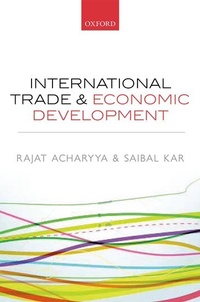
International Trade and Economic Development
Published on 17. July 2014
Book
Hardback
334 pages
978-0-19-967285-1 (ISBN)
Description
This graduate textbook offers advanced and contemporary readings in international trade and economic development and provides an overview of the fundamental topics in this area. It brings together many of the issues that are considered staple reading for a course in trade and development and it offers a systematic coverage of the relevant and state of the art research on various aspects of the subject. This includes detailed analysis of important sub-topics such as: trade and labour market, trade and public economics, the theory of the second best, foreign aid, factor mobility, and regional and global welfare. It also covers international trade and labour standards, the informal labour market, and TRIPS.
Aimed at post-graduate students interested in trade theory and applications in development issues, this book should also prove a valuable resource for practicing economists, policy makers, and advanced undergraduate students studying international trade. The text balances extensive coverage of available literature in the area with substantive inclusions from new research published in leading journals and volumes. It aims to fill the gap in the teaching resources and should promote further theoretical and empirical research in the subject.
Aimed at post-graduate students interested in trade theory and applications in development issues, this book should also prove a valuable resource for practicing economists, policy makers, and advanced undergraduate students studying international trade. The text balances extensive coverage of available literature in the area with substantive inclusions from new research published in leading journals and volumes. It aims to fill the gap in the teaching resources and should promote further theoretical and empirical research in the subject.
Reviews / Votes
The title of this new book by Acharyya and Kar says a lot by suggesting that the process of growth and development for most countries is closely linked to the extent of their involvement in international trade. The basic Ricardian concept of comparative advantage shows how all countries can in many ways make use of trade with other countries to support higher rates of growth and development. International trade allows a country to focus on producing not the entire range of commodities consumed, but instead to concentrate on producing the commodities in which it is relatively efficient in production, and all countries have such possibilities. The authors provide ample examples of how countries have raised living standards by taking such advantages provided by globalization. [continued below] Their discussion leads up to the present state of trade in which fragmentation of the production process offers the possibility of a much finer division of labor, opening up a sizable gain when parts and components are themselves tradeable, allowing ever greater gains from trade based on the Ricardian conception. The reader is carefully led through historys gains based on more open capital markets and the re-alignments suggested by comparative advantage. For countries anxious to develop, more open international trade is the basic route to obtain such gains. * Ronald Jones, Xerox Professor of Economics, Economics Department, University of Rochester * This is a magnificent text which fills a real gap with a very lucid and insightful treatment. I recommend it most highly both to all students interested in trade and development and also to the faculty charged with teaching them. * Wilfred J. Ethier, Professor Emeritus of Economics, University of Pennsylvania * The structure of the book differs from that of a typical textbook on international trade. The reader is offered an analysis of the theoretical issues in international trade and economic development in an interconnected way, that is, how global markets affect the countrys economic growth and pattern of development. This is a novel approach, and combined with a rigorous analysis of the topics covered, it will appeal to readers interested in the theoretical aspects of globalisation and development. * Tatyana Chesnokova, Economic Record *More details
Language
English
Place of publication
Oxford
United Kingdom
Target group
College/higher education
Professional and scholarly
Illustrations
28 Figures, 5 Tables
Dimensions
Height: 235 mm
Width: 161 mm
Thickness: 25 mm
Weight
604 gr
ISBN-13
978-0-19-967285-1 (9780199672851)
Copyright in bibliographic data and cover images is held by Nielsen Book Services Limited or by the publishers or by their respective licensors: all rights reserved.
Schweitzer Classification
Other editions
Additional editions
Rajat Acharyya | Saibal Kar
International Trade and Economic Development
E-Book
07/2014
1st Edition
OUP eBook
€52.49
Available for download
Persons
Rajat Acharyya is Professor of Economics, and Dean, Faculty of Arts, Jadavpur University, Kolkata. He has taught international economics at various institutes and universities in India and abroad for over two decades and has published extensively in the area. He received the EXIM Bank International Trade Research Award in 1997, the Global Development Network (Washington D.C.) Research Medal in 2003, and the Mahalanobis Memorial Medal Award in 2006. He has held visiting positions at Rochester University (USA), University of Kent at Canterbury (UK) and Utrecht School of Economics (The Netherlands). His research focuses on international trade, product quality and growth, regional trading blocs, and TRIPS and innovation in health care markets.
Saibal Kar is Associate Professor of Economics at the Centre for Studies in Social Sciences, Calcutta (CSSSC). He is a Research Fellow of the Institute for the Study of Labor (IZA) Bonn. He was a Research Fellow of the Alexander von Humboldt Foundation (2008-09) and is a guest lecturer at the Department of Economics, Calcutta University and Presidency University. Saibal has held visiting positions at Amsterdam School of Economics, Santa Fe Institute, HWWI Hamburg, UNU-WIDER, University of East Anglia, and Edith Cowan University. In recent years his research work in the areas of labour economics, international economics, and development economics, with emphasis on international labour migration. have been published in well known international journals. His book The Outsiders: Economic Reform and Informal Labour in a Developing Economy (with S. Marjit) was published by Oxford University Press in 2011.
Saibal Kar is Associate Professor of Economics at the Centre for Studies in Social Sciences, Calcutta (CSSSC). He is a Research Fellow of the Institute for the Study of Labor (IZA) Bonn. He was a Research Fellow of the Alexander von Humboldt Foundation (2008-09) and is a guest lecturer at the Department of Economics, Calcutta University and Presidency University. Saibal has held visiting positions at Amsterdam School of Economics, Santa Fe Institute, HWWI Hamburg, UNU-WIDER, University of East Anglia, and Edith Cowan University. In recent years his research work in the areas of labour economics, international economics, and development economics, with emphasis on international labour migration. have been published in well known international journals. His book The Outsiders: Economic Reform and Informal Labour in a Developing Economy (with S. Marjit) was published by Oxford University Press in 2011.
Author
Professor of Economics; DeanProfessor of Economics; Dean, Department of Economics, Jadavpur University; Faculty of Arts, Jadavpur University
Associate Professor of Economics; Research FellowAssociate Professor of Economics; Research Fellow, Centre for Studies in Social Sciences, Calcutta;Institute for the Study of Labor (IZA), Bonn
Content
Introduction ; 1. International Trade and Development Paradigms ; 2. Problems of Trade in Primary Commodities ; 3. Trade, Factors of Production and Growth ; 4. Foreign Direct Investment and Multinational Firms ; 5. International Labour Mobility and Welfare ; 6. Information, Labour Migration, and Occupation ; 7. Trade, Foreign Aid, and Welfare ; 8. Trade, Poverty, and Readjustments ; 9. Regional Trading Arrangements as Development Strategy ; 10. TRIPS, Product Standards and the Developing Economies ; 11. International Outsourcing, Off-shoring and Industrialization Strategies ; 12. Contagion of Crisis and Concluding Remarks