

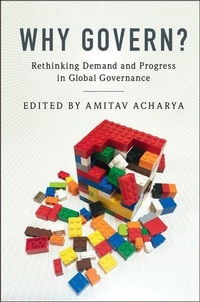
Why Govern?
Rethinking Demand and Progress in Global Governance
Published on 1. September 2016
Book
Hardback
350 pages
978-1-107-17081-0 (ISBN)
Description
The system of international cooperation built after World War II around the UN is facing unprecedented challenges. Globalization has magnified the impact of security threats, human rights abuses, mass atrocities, climate change, refugee, trade and financial flows, pandemics and cyberspace traffic. No single nation, however powerful, can solve them on its own. International cooperation is necessary, yet difficult to build and sustain. Rising powers such as China, India, and Brazil seek greater leadership in international institutions, whose authority and legitimacy are also challenged by a growing number of civil society networks, private entities, and other non-state actors. Against this backdrop, what is the future of global governance? In this book, a group of the leading scholars in the field provide a detailed analysis of the challenges and opportunities facing global cooperation. The book offers a comprehensive and authoritative guide for scholars and practitioners interested in multilateralism and global order.
More details
Language
English
Place of publication
Cambridge
United Kingdom
Target group
Professional and scholarly
Dimensions
Height: 235 mm
Width: 157 mm
Thickness: 23 mm
Weight
661 gr
ISBN-13
978-1-107-17081-0 (9781107170810)
Copyright in bibliographic data and cover images is held by Nielsen Book Services Limited or by the publishers or by their respective licensors: all rights reserved.
Schweitzer Classification
Other editions
Additional editions

E-Book
08/2016
Cambridge University Press
€26.99
Available for download

Book
08/2016
Cambridge University Press
€47.60
Shipment within 15-20 days

E-Book
08/2016
Cambridge University Press
€32.49
Available for download
Person
Amitav Acharya is the UNESCO Chair in Transnational Challenges and Governance, School of International Service, American University, Washington DC. His recent publications include The End of American World Order (2014), Rethinking Power, Institutions and Ideas in World Politics: Whose IR? (2013), and Whose Ideas Matter: Agency and Power in Asian Regionalism (2009).
Content
1. Rethinking demand, purpose and progress in global governance: an introduction Amitav Acharya; 2. The great descent: 'global governance' in historical and theoretical perspective Daniel Deudney; 3. Who is liberal now? Rising powers and global norms Miles Kahler; 4. The social purposes of global governance Rodney Bruce Hall; 5. Conflicts and security Andrew Mack; 6. Human rights Kathryn Sikkink; 7. Atrocity crimes Ramesh Thakur; 8. Trade Susan Sell; 9. Finance Eric Helleiner; 10. Climate Sikina Jinnah; 11. Refugees Alexander Betts; 12. Health David P. Fidler; 13. Cyberspace and social media Derrick Cogburn; 14. The contested quest for global governance: conclusions and directions for further research Amitav Acharya.