

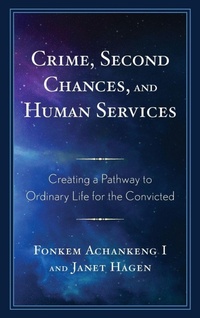
Crime, Second Chances, and Human Services
Creating a Pathway to Ordinary Life for the Convicted
Published on 3. April 2019
Book
Hardback
232 pages
978-1-4985-9588-9 (ISBN)
Description
This book promotes the notion of second chances and the importance of human services within the communities most affected by crime and the criminal justice system. Recognition of the fallibility of humans and the necessity of redemption is the first step to change our attitude toward guilt and punishment. Barring citizens with criminal records from obtaining housing, employment, education, and public benefits like Medicaid and food stamps is not only unjust but unproductive for a human society. The contributors to this volume argue that second chances are a foundational principle of the human services field.
Reviews / Votes
This book is a manual of compassion and restoration for human renewal in vulnerable communities. It makes an excellent and compelling case for why Human Service is more than ever before relevant in current societies that are affected by challenges that threaten daily human conditions. This book could not come at a better time for human service practitioners working in communities affected by crime and trauma. Every human service practitioner should read and treasure this book. Faculty in Human Service programs should ensure that their students reflect on this book. -- Emmanuel Jean-Francois, Ohio UniversityMore details
Language
English
Place of publication
United States
Publishing group
Bloomsbury Publishing Plc
Target group
Professional and scholarly
Product notice
sewn/stitched
Cloth over boards
With dust jacket
Dimensions
Height: 235 mm
Width: 157 mm
Thickness: 18 mm
Weight
537 gr
ISBN-13
978-1-4985-9588-9 (9781498595889)
Copyright in bibliographic data and cover images is held by Nielsen Book Services Limited or by the publishers or by their respective licensors: all rights reserved.
Schweitzer Classification
Other editions
Additional editions
Crime, Second Chances, and Human Services
Creating a Pathway to Ordinary Life for the Convicted
E-Book
04/2019
1st Edition
Lexington Books
€35.49
Available for download
Persons
Fonkem Achankeng I, is associate professor at the University of Wisconsin Oshkosh.
Janet Hagen, is chair of the Human Services Leadership Department at the University of Wisconsin Oshkosh.
Janet Hagen, is chair of the Human Services Leadership Department at the University of Wisconsin Oshkosh.
Content
Incarceration & American Society: An Introduction by Fonkem Achankeng
Chapter One: Second Chances, Human Services, Crime and Redemption by Fonkem Achankeng
Chapter Two: Changing the Trajectory of Life by Diane McMillen & Melinda Kline
Chapter Three: The Blooming Lotus: Wounded Healers & Their Aspirations to Give Back by John Paulson, Kevin Groves & Leslie A. Hagedorn
Chapter Four: People Can Change: Experiences of Formerly Incarcerated Leaders by Mark Rice
Chapter Five: From Retribution to Health: How Communities are Changing the Conversation about Incarceration by David Liners
Chapter Six: Passion and Freedom in Human Services by Alfred T. Kisubi
Chapter Seven: Crime, Justice, Drugs & Deviance: A Human Services Perspective by Derek Dich
Chapter Eight: Step Industries and Its Origins by Anonymous
Chapter Nine: STEP Industries and Me by Michelle Devine Giese
Chapter Ten: STEP Industries & the Minimum Wage Debate by Kendra Green
Chapter Eleven: Drug Use, Abuse & Addiction: A Personal Experience by Pearl Wright
Chapter Twelve: Getting a Second Chance and Giving Second Chances to Others
A Personal Journey by Patricia McCourt
Chapter Thirteen: Redemption, Restorative Justice and Rebuilding Communities by Lynne M. Woehrle
Chapter Fourteen: Transfiguration by Alfred T. Kisubi
Chapter One: Second Chances, Human Services, Crime and Redemption by Fonkem Achankeng
Chapter Two: Changing the Trajectory of Life by Diane McMillen & Melinda Kline
Chapter Three: The Blooming Lotus: Wounded Healers & Their Aspirations to Give Back by John Paulson, Kevin Groves & Leslie A. Hagedorn
Chapter Four: People Can Change: Experiences of Formerly Incarcerated Leaders by Mark Rice
Chapter Five: From Retribution to Health: How Communities are Changing the Conversation about Incarceration by David Liners
Chapter Six: Passion and Freedom in Human Services by Alfred T. Kisubi
Chapter Seven: Crime, Justice, Drugs & Deviance: A Human Services Perspective by Derek Dich
Chapter Eight: Step Industries and Its Origins by Anonymous
Chapter Nine: STEP Industries and Me by Michelle Devine Giese
Chapter Ten: STEP Industries & the Minimum Wage Debate by Kendra Green
Chapter Eleven: Drug Use, Abuse & Addiction: A Personal Experience by Pearl Wright
Chapter Twelve: Getting a Second Chance and Giving Second Chances to Others
A Personal Journey by Patricia McCourt
Chapter Thirteen: Redemption, Restorative Justice and Rebuilding Communities by Lynne M. Woehrle
Chapter Fourteen: Transfiguration by Alfred T. Kisubi