

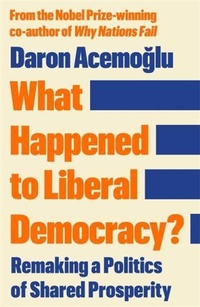
What Happened to Liberal Democracy?
Remaking a Politics of Shared Prosperity - FROM THE WINNER OF THE NOBEL PRIZE IN ECONOMICS
Will be published approx. on 20. August 2026
Book
Hardback
416 pages
978-1-80522-864-6 (ISBN)
Description
'A very important work and a must-read' THOMAS PIKETTY, author of Capital in the Twenty-First Century
'A thoughtful proposed solution to the most important question of modern democracy' JARED DIAMOND, author of Guns, Germs, and Steel
'Brilliant and insightful, a tour de force that left me feeling more optimistic about the future than I have in a long time' STEVEN LEVITT, author of Freakonomics
From its inception, liberalism offered a glittering promise of shared prosperity, equality, democratic values and the free pursuit of knowledge. At first, it flourished. And then it faltered. Once a tantalising beacon of hope, it began to erode and decay at the hands of elitism, intolerance and rising autocracy.
One could say that liberalism is broken. So what comes next?
Nobel prize-winning co-author of Why Nations Fail Daron Acemoglu charts the rise and fall of liberal democracy, and offers hope for a way forward: a new theory that lays the groundwork for how we can - and must - remake liberalism before it's too late.
'A thoughtful proposed solution to the most important question of modern democracy' JARED DIAMOND, author of Guns, Germs, and Steel
'Brilliant and insightful, a tour de force that left me feeling more optimistic about the future than I have in a long time' STEVEN LEVITT, author of Freakonomics
From its inception, liberalism offered a glittering promise of shared prosperity, equality, democratic values and the free pursuit of knowledge. At first, it flourished. And then it faltered. Once a tantalising beacon of hope, it began to erode and decay at the hands of elitism, intolerance and rising autocracy.
One could say that liberalism is broken. So what comes next?
Nobel prize-winning co-author of Why Nations Fail Daron Acemoglu charts the rise and fall of liberal democracy, and offers hope for a way forward: a new theory that lays the groundwork for how we can - and must - remake liberalism before it's too late.
Reviews / Votes
This book makes a powerful case for rebuilding Roosevelt-like "working-class liberalism". A very important work and a must-read -- Thomas Piketty, bestselling author of CAPITAL IN THE TWENTY-FIRST CENTURY Millions of readers will treasure Acemoglu's thoughtful proposed solution to the most important question of modern democracy -- Jared Diamond, Pulitzer Prize-winning author of GUNS, GERMS, AND STEEL This urgent book reminds us that the path charted by technology is not destiny, it is a moral and political choice. In these unsettled times, Acemoglu forces us to reckon with our very human responsibility to stand up for (and with) the less powerful -- Esther Duflo, 2019 Nobel laureate in Economics and author of POOR ECONOMICS Brilliant and insightful. Acemoglu pinpoints what is going wrong in the modern world, and charts a reasonable path to something much better. A tour de force that left me feeling more optimistic about the future than I have in a long time -- Steven Levitt, bestselling author of FREAKONOMICS The title of this book poses the key question of governance for our era. We desperately need coherent visions for a liberal democracy of the twenty-first century, and in these pages Acemoglu lays one out with clarity, conviction, and nuance -- Steven Pinker, Johnstone Professor of Psychology, Harvard University and bestselling author of ENLIGHTENMENT NOW A sharp, unsentimental diagnosis of the structural failures destabilising liberal democracy today. This is a necessary and precise roadmap for navigating the institutional crises ahead. Acemoglu clearly shows the future that begins after 'the end of history' -- Ece Temelkuran, author of HOW TO LOSE A COUNTRY This book is a major paradigm shift -- James Robinson, 2024 Nobel laureate in Economics and co-author of WHY NATIONS FAIL One of the most creative economists of our time, Acemoglu argues that the direction of new technologies is not a fact of nature but a question for democratic citizens to decide. His "working-class liberalism" would recall liberalism from its technocratic tendencies and make it an energizing force for solidarity and freedom -- Michael Sandel, author of THE TYRANNY OF MERIT Combining economic, historical and philosophical perspectives, Daron Acemoglu not only gives us an outstanding analysis of why the liberal democratic dream has faded; he also offers an energizing account of how the vision can be recruited in support of a shared prosperity. This is a book, perhaps the book, for our time -- Philip Pettit, L.S. Rockefeller University Professor of Human Values, Princeton University and Distinguished University Professor of Philosophy at the Australian National University Acemoglu is arguably the greatest economist of our generation and his call for a "working-class liberalism" is a needed shot in the arm -- Ro Khanna, author of PROGRESSIVE CAPITALISM One of the best economists of our age takes a close and penetrating look at the political crisis of liberal democracies. As thought-provoking as it is insightful, informed and incisive, this book is essential reading for anyone concerned about politics, power and populism in the twenty-first century -- Joel Mokyr, 2025 Nobel laureate in Economics and author of A CULTURE OF GROWTH A must read for anyone interested in technology, economics, politics, sociology, and the future of the world -- Simon Johnson, 2024 Nobel laureate in Economics and Former Chief Economist, IMF In this elegant and deeply informed book, Daron Acemoglu explains why liberalism is worth saving despite today's widespread skepticism. The argument is both necessary and inspiring -- Angus Deaton, 2015 Nobel laureate in Economics Praise for WHY NATIONS FAIL and POWER AND PROGRESS * : * An important book * New York Times * A must-read. Acemoglu and Robinson are intellectual heavyweights of the first rank * Guardian * An intellectually rich book that develops an important thesis with verve * Financial Times * Two of the world's leading experts on development explain why it is not geography, disease, or culture which explains why some nations are rich and some poor, but rather a matter of institutions and politics. This highly accessible book provides welcome insight to specialists and general readers alike -- Francis Fukuyama, author of The End of History and The Last Man A vital work for these times * Wall Street Journal * A must-read. Acemoglu and Robinson are intellectual heavyweights of the first rank ... they have done you the courtesy of writing a book that while at the intellectual cutting edge is not just readable but engrossing ... erudite and fascinating * Observer * Truly an awesome book. Acemoglu and Robinson tackle one of the most important problems in the social sciences - a question that has bedevilled leading thinkers for centuries - and offer an answer that is brilliant in its simplicity and power. A wonderfully readable mix of history, political science, and economics, this book will change the way we think about economic development. Why Nations Fail is a must read book -- Steven Levitt, author of FreakonomicsMore details
Edition
Main
Language
English
Place of publication
London
United Kingdom
Target group
College/higher education
Professional and scholarly
Product notice
Trade binding
Dimensions
Height: 234 mm
Width: 153 mm
ISBN-13
978-1-80522-864-6 (9781805228646)
Copyright in bibliographic data and cover images is held by Nielsen Book Services Limited or by the publishers or by their respective licensors: all rights reserved.
Schweitzer Classification
Other editions
Additional editions
Book
approx. 08/2026
Profile Books
€21.50
Not yet published
Person
DARON ACEMOGLU is an institute professor at MIT and Faculty Co-Director of MIT's Shaping the Future of Work Initiative. He has been awarded, among others, the John Bates Clark Medal, the Nemmers Prize, the Global Economy Prize and the Nobel Prize in Economics. He is the co-author of Why Nations Fail.