

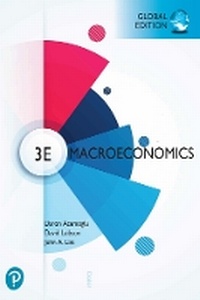
Macroeconomics, Global Edition + MyLab Economics with Pearson eText (Package)
3rd Edition
Published on 8. April 2022
Book
Mixed media product
978-1-292-41206-1 (ISBN)
Description
For courses in the principles of macroeconomics.
An evidence-basedapproach to economics
Throughout Macroeconomics,3rd Edition, authors Daron Acemoglu, David Laibson, and John List usereal economic questions and data to help students learn about the world aroundthem. Taking a fresh approach, they use the themes of optimization,equilibrium, and empiricism to not only illustrate the power of simple economicideas, but also to explain and predict what's happening in today's society.Each chapter begins with an empirical question that is relevant to the life ofa student and is later answered using data in the Evidence-Based Economicsfeature. As a result of the text's practical emphasis, students learn to applyeconomic principles to guide the decisions they make in their own daily lives
An evidence-basedapproach to economics
Throughout Macroeconomics,3rd Edition, authors Daron Acemoglu, David Laibson, and John List usereal economic questions and data to help students learn about the world aroundthem. Taking a fresh approach, they use the themes of optimization,equilibrium, and empiricism to not only illustrate the power of simple economicideas, but also to explain and predict what's happening in today's society.Each chapter begins with an empirical question that is relevant to the life ofa student and is later answered using data in the Evidence-Based Economicsfeature. As a result of the text's practical emphasis, students learn to applyeconomic principles to guide the decisions they make in their own daily lives
More details
Edition
3rd edition
Language
English
Place of publication
Harlow
United Kingdom
Target group
College/higher education
Dimensions
Height: 370 mm
Width: 260 mm
Thickness: 20 mm
Weight
1100 gr
ISBN-13
978-1-292-41206-1 (9781292412061)
Copyright in bibliographic data and cover images is held by Nielsen Book Services Limited or by the publishers or by their respective licensors: all rights reserved.
Schweitzer Classification
Other editions
New editions
Daron Acemoglu | David Laibson | John A. List
Macroeconomics, Global Edition
Book
09/2021
3rd Edition
Pearson Education Limited
€99.49
Available immediately
Previous edition
Daron Acemoglu | David Laibson | John List
Macroeconomics plus Pearson MyLab Economics with Pearson eText, Global Edition
Book
10/2018
2nd Edition
Pearson Education Limited
€117.79
Shipment within 10-20 days
Persons
Daron Acemoglu is the Elizabeth and James Killian Professor of Economics in the Department of Economics at the Massachusetts Institute of Technology. He has received a BA in economics from the University of York, an MSc in mathematical economics and econometrics from the London School of Economics, and a PhD in economics from the London School of Economics.
He is an elected fellow of the National Academy of Sciences, the American Academy of Arts and Sciences, the Econometric Society, the European Economic Association, and the Society of Labor Economists. He has received numerous awards and fellowships, including the inaugural T. W. Schultz Prize from the University of Chicago in 2004, the inaugural Sherwin Rosen Award for outstanding contribution to labor economics in 2004, the Distinguished Science Award from the Turkish Sciences Association in 2006, and the John von Neumann Award, Rajk College, Budapest, in 2007.
He was also the recipient of the John Bates Clark Medal in 2005, awarded every two years to the best economist in the US under the age of 40 by the American Economic Association, and the Erwin Plein Nemmers Prize, awarded every two years for work of lasting significance in economics. He holds honorary doctorates from the University of Utrecht and Bosporus University.
His research interests include political economy, economic development and growth, human capital theory, growth theory, innovation, search theory, network economics, and learning.
His books include Economic Origins of Dictatorship and Democracy (jointly with James A. Robinson), which was awarded the Woodrow Wilson and the William Riker prizes, Introduction to Modern Economic Growth, and Why Nations Fail: The Origins of Power, Prosperity, and Poverty (jointly with James A. Robinson), which has become a New York Times bestseller.
David Laibson is the Chair of the Harvard Economics Department and the Robert I. Goldman Professor of Economics at Harvard University. He holds degrees from Harvard University (AB in economics), the London School of Economics (MSc in econometrics and mathematical economics), and the Massachusetts Institute of Technology (PhD in economics).
He is also a member of the National Bureau of Economic Research, where he is Research Associate in the Asset Pricing, Economic Fluctuations, and Aging Working Groups. His research focuses on the topics of behavioural economics, intertemporal choice, macroeconomics, and household finance, and he leads Harvard University's Foundations of Human Behavior Initiative.
He serves on several editorial boards, as well as the Pension Research Council (Wharton), Harvard's Pension Investment Committee, and the Board of the Russell Sage Foundation. He has previously served on the boards of the Health and Retirement Study (National Institutes of Health) and the Academic Research Council of the Consumer Financial Protection Bureau.
He is a recipient of a Marshall Scholarship and a Fellow of the Econometric Society and the American Academy of Arts and Sciences. He is also a recipient of the T. W. Schultz Prize from the University of Chicago and the TIAA-CREF Paul A. Samuelson Award for Outstanding Scholarly Writing on Lifelong Financial Security. In recognition of his teaching excellence, he has been awarded Harvard's Phi Beta Kappa Prize and a Harvard College Professorship.
John A. List is the Kenneth C. Griffin Distinguished Service Professor in Economics at the University of Chicago, and Chairman of the Department of Economics. He received his BS in economics from the University of Wisconsin-Stevens Point and his PhD in economics from the University of Wyoming. Before joining the University of Chicago in 2005, he was a professor at the University of Central Florida, University of Arizona, and University of Maryland. He also served in the White House on the Council of Economic Advisers from 2002-2003, and is a Research Associate at the NBER.
He is an elected fellow of the National Academy of Sciences, the American Academy of Arts and Sciences, the Econometric Society, the European Economic Association, and the Society of Labor Economists. He has received numerous awards and fellowships, including the inaugural T. W. Schultz Prize from the University of Chicago in 2004, the inaugural Sherwin Rosen Award for outstanding contribution to labor economics in 2004, the Distinguished Science Award from the Turkish Sciences Association in 2006, and the John von Neumann Award, Rajk College, Budapest, in 2007.
He was also the recipient of the John Bates Clark Medal in 2005, awarded every two years to the best economist in the US under the age of 40 by the American Economic Association, and the Erwin Plein Nemmers Prize, awarded every two years for work of lasting significance in economics. He holds honorary doctorates from the University of Utrecht and Bosporus University.
His research interests include political economy, economic development and growth, human capital theory, growth theory, innovation, search theory, network economics, and learning.
His books include Economic Origins of Dictatorship and Democracy (jointly with James A. Robinson), which was awarded the Woodrow Wilson and the William Riker prizes, Introduction to Modern Economic Growth, and Why Nations Fail: The Origins of Power, Prosperity, and Poverty (jointly with James A. Robinson), which has become a New York Times bestseller.
David Laibson is the Chair of the Harvard Economics Department and the Robert I. Goldman Professor of Economics at Harvard University. He holds degrees from Harvard University (AB in economics), the London School of Economics (MSc in econometrics and mathematical economics), and the Massachusetts Institute of Technology (PhD in economics).
He is also a member of the National Bureau of Economic Research, where he is Research Associate in the Asset Pricing, Economic Fluctuations, and Aging Working Groups. His research focuses on the topics of behavioural economics, intertemporal choice, macroeconomics, and household finance, and he leads Harvard University's Foundations of Human Behavior Initiative.
He serves on several editorial boards, as well as the Pension Research Council (Wharton), Harvard's Pension Investment Committee, and the Board of the Russell Sage Foundation. He has previously served on the boards of the Health and Retirement Study (National Institutes of Health) and the Academic Research Council of the Consumer Financial Protection Bureau.
He is a recipient of a Marshall Scholarship and a Fellow of the Econometric Society and the American Academy of Arts and Sciences. He is also a recipient of the T. W. Schultz Prize from the University of Chicago and the TIAA-CREF Paul A. Samuelson Award for Outstanding Scholarly Writing on Lifelong Financial Security. In recognition of his teaching excellence, he has been awarded Harvard's Phi Beta Kappa Prize and a Harvard College Professorship.
John A. List is the Kenneth C. Griffin Distinguished Service Professor in Economics at the University of Chicago, and Chairman of the Department of Economics. He received his BS in economics from the University of Wisconsin-Stevens Point and his PhD in economics from the University of Wyoming. Before joining the University of Chicago in 2005, he was a professor at the University of Central Florida, University of Arizona, and University of Maryland. He also served in the White House on the Council of Economic Advisers from 2002-2003, and is a Research Associate at the NBER.
Content
1 The Principles and Practice of Economics
2 Economic Science: Using Data and Models to Understand the World
3 Optimization: Doing the Best You Can
4 Demand, Supply, and Equilibrium
5 The Wealth of Nations: Defining and Measuring Macroeconomic Aggregates
6 Aggregate Incomes
7 Economic Growth
8 Why Isn't the Whole World Developed?
9 Employment and Unemployment
10 Credit Markets
11 The Monetary System
12 Short-Run Fluctuations
13 Countercyclical Macroeconomic Policy
14 Macroeconomics and International Trade
15 Open Economy Macroeconomics
2 Economic Science: Using Data and Models to Understand the World
3 Optimization: Doing the Best You Can
4 Demand, Supply, and Equilibrium
5 The Wealth of Nations: Defining and Measuring Macroeconomic Aggregates
6 Aggregate Incomes
7 Economic Growth
8 Why Isn't the Whole World Developed?
9 Employment and Unemployment
10 Credit Markets
11 The Monetary System
12 Short-Run Fluctuations
13 Countercyclical Macroeconomic Policy
14 Macroeconomics and International Trade
15 Open Economy Macroeconomics