

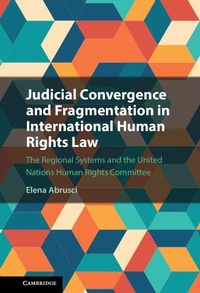
Judicial Convergence and Fragmentation in International Human Rights Law
The Regional Systems and the United Nations Human Rights Committee
Published on 5. January 2023
Book
Hardback
306 pages
978-1-316-51481-8 (ISBN)
Description
This book provides an innovative analysis of the complex issue of judicial convergence and fragmentation in international human rights law, moving the conversation forward from the assessment of the two phenomena and investigating their triggering factors. With a wide geographical focus that include the most up-to-date case-law from the three main regional systems (the African, European and Inter-American) and the UN Human Rights Committee, the book confirms the predominant judicial convergence across international human rights law. On this basis, the book engages with an interdisciplinary investigation into the legal and non-legal factors that could explain both convergence and fragmentation, ranging from the use of judicial dialogue and the notions of necessity and proportionality to the composition of the courts and the role of NGOs. The aim is to provide the tools to understand the dynamics between human rights adjudicatory bodies and possibly foresee future instances of judicial fragmentation.
Reviews / Votes
'Abrusci presents a very thorough conceptual and empirical groundwork, relevant to any discussion on the potential fragmentation of international law and the multiplication of international judicial and quasi-judicial bodies. ... As she always provides the reader with all the information necessary on the institutional landscape or the procedural rules to know, the book is accessible regardless of where the reader academically comes from. It will be a valuable addition to researchers of any field interested in legal pluralism and the fragmentation of international law.' Audrey M. Plan, Human Rights Law Review '... does a stellar job in providing a doctrinal analysis of the emerging case law in the HRC and the regional human rights systems through a comparative lens. It reveals patterns and provides empirical insights into the workings of these adjudicatory bodies. Abrusci is undoubtedly a careful researcher, sharp analyst, and a measured and lucid writer.' Rashmi Venkatesan, The Law & Practice of International Courts and TribunalsMore details
Language
English
Place of publication
Cambridge
United Kingdom
Product notice
sewn/stitched
Cloth over boards
Illustrations
Worked examples or Exercises
Dimensions
Height: 229 mm
Width: 152 mm
Thickness: 19 mm
Weight
576 gr
ISBN-13
978-1-316-51481-8 (9781316514818)
Copyright in bibliographic data and cover images is held by Nielsen Book Services Limited or by the publishers or by their respective licensors: all rights reserved.
Schweitzer Classification
Other editions
Additional editions
Elena Abrusci
Judicial Convergence and Fragmentation in International Human Rights Law
The Regional Systems and the United Nations Human Rights Committee
E-Book
12/2022
Cambridge University Press
€105.99
Available for download
Elena Abrusci
Judicial Convergence and Fragmentation in International Human Rights Law
The Regional Systems and the United Nations Human Rights Committee
E-Book
12/2022
Cambridge University Press
€105.99
Available for download
Person
Elena Abrusci is Lecturer in Law at Brunel University London. She has an interdisciplinary background in law and politics and she has served as a policy advisor to the UK government and as a consultant to several UN agencies. Her current research focuses on regional human rights systems and emerging technologies.
Content
Part I. Introducing and Assessing Fragmentation and Convergence in International Human Rights Law: 1. Fragmentation and convergence: context and definitions; 2. Assessing and exploring judicial fragmentation in international human rights law; Part II. Factors Explaining Judicial Convergence and Fragmentation: 3. The theory of treaty interpretation and judicial dialogue; 4. The composition of the courts and other adjudicative bodies and the role of their secretariats; 5. Calibrating judicial scrutiny: the notions of necessity and proportionality; 6. Deference, subsidiarity and regional consensus: the margin of appreciation doctrine; 7. Outside the courtroom: the role of NGOs and the obstacles to litigation.