

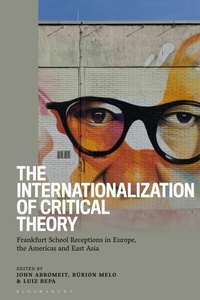
The Internationalization of Critical Theory
Frankfurt School Receptions in Europe, the Americas and East Asia
Will be published approx. on 20. August 2026
Book
Hardback
376 pages
978-1-350-49898-3 (ISBN)
Description
From Walter Benjamin in Argentina to Theodor Adorno in Japan, this collection brings together leading scholars of Critical Theory to examine the impact of the Frankfurt School across global histories of the 20th century.
Featuring essays on Critical Theory's role in Brazil during dictatorship and redemocratization; the influence of Herbert Marcuse in Pinochet's Chile; the politics of Critical Theory in South Korea and intellectual relationships across Yugoslavia, Germany and the United States, the chapters in this volume consider how social, political, historical and intellectual conditions shaped local receptions of the Frankfurt School, and how the School's key thinkers in turn helped to transform these conditions.
Guided by Max Horkheimer's seminal distinction between critical and traditional theory, in which Critical Theory is distinguished by its self-reflexivity and awareness of its location within a larger social totality, The Internationalization of Critical Theory offers a groundbreaking reflection on Critical Theory at an international scale. Tracing the legacy of the Frankfurt School across Latin America, East Asia, Europe and North America, this volume offers new insights into the intellectual histories of both Critical Theory and global politics.
Featuring essays on Critical Theory's role in Brazil during dictatorship and redemocratization; the influence of Herbert Marcuse in Pinochet's Chile; the politics of Critical Theory in South Korea and intellectual relationships across Yugoslavia, Germany and the United States, the chapters in this volume consider how social, political, historical and intellectual conditions shaped local receptions of the Frankfurt School, and how the School's key thinkers in turn helped to transform these conditions.
Guided by Max Horkheimer's seminal distinction between critical and traditional theory, in which Critical Theory is distinguished by its self-reflexivity and awareness of its location within a larger social totality, The Internationalization of Critical Theory offers a groundbreaking reflection on Critical Theory at an international scale. Tracing the legacy of the Frankfurt School across Latin America, East Asia, Europe and North America, this volume offers new insights into the intellectual histories of both Critical Theory and global politics.
Reviews / Votes
This collection of essays fills a huge gap in Frankfurt School scholarship. Focusing on the reception of the Frankfurt School outside of Germany, it provides a long-awaited supplement to Martin Jay's path-breaking study of the School's early history, appropriately ending with Jay's own retrospective glance backward at the School's emergence as a global phenomenon. Given the impact that the Frankfurt School has had on diverse national and regional audiences, the contributors to this volume emphatically testify to the multifaceted international and intersectional power of this intellectual tradition. * David Ingram, Professor of Philosophy, University of Loyola, Chicago, USA * The Internationalization of Critical Theory is sure to prove to be indispensable reading for all serious students of Critical Theory. Demonstrating the wrong-headedness of the charge of narrow and irredeemable Eurocentrism increasingly levelled at the Frankfurt School, this extraordinary volume is comprised of scrupulously researched essays on its reception under strikingly divergent social, economic, cultural and political conditions in societies as complex and diverse as Mexico, Brazil, Chile Argentina, South Korea, Japan and China as well as several European countries. It concludes with a scintillating interview conducted by John Abromeit with Martin Jay--the foremost intellectual historian of our age who, amongst other things, has made countless unrivalled contributions to our understanding of the history of the Frankfurt School. * Samir Gandesha, Full Professor and Director, Institute for the Humanities and Co-editor of the Journal of Adorno Studies, Simon Fraser University, Vancouver, Canada *More details
Language
English
Place of publication
London
United Kingdom
Publishing group
Bloomsbury Publishing PLC
Target group
Professional and scholarly
Product notice
Laminated cover
Dimensions
Height: 234 mm
Width: 156 mm
Thickness: 19 mm
Weight
454 gr
ISBN-13
978-1-350-49898-3 (9781350498983)
Copyright in bibliographic data and cover images is held by Nielsen Book Services Limited or by the publishers or by their respective licensors: all rights reserved.
Schweitzer Classification
Persons
John Abromeit is Associate Professor in the Department of History at SUNY, Buffalo State, USA.
Luiz Repa is Professor of Philosophy at the University of Sao Paulo, Brazil.
Rurion Melo is Professor of Political Science at the University of Sao Paulo, Brazil.
Luiz Repa is Professor of Philosophy at the University of Sao Paulo, Brazil.
Rurion Melo is Professor of Political Science at the University of Sao Paulo, Brazil.
Content
Editors' Introduction, John Abromeit, Rurion Melo, and Luiz Repa
Part One: Latin America
1. The Reception of Critical Theory in Brazil: From Dictatorship to Redemocratization, Luiz Repa and Rurion Melo
2. Frankfurt's Critical Theory in Chile: Process and Generations, Mauro Basaure
3. Translation, Exception: Walter Benjamin in Argentina, Luis Ignacio Garcia
4. Critical Theory on Mexican Ground, Lissette Silva
Part Two: East Asia
5. The Politics of Critical Theory: The Translation of the Frankfurt School in South Korea, Jaeho Kang
6. The Reception of the Frankfurt School in China from 1978 to the Present, Li Qiankun
7. The Reception and Development of Frankfurt Critical Theory in Japan, Masao Higurashi
Part Three: Europe
8. Critical Theory in Spain: A Reception in the Shadow of Habermas, Jose M. Romero
9. The Paths of Marcuse and Adorno in France, Isabelle Aubert
10. Critical Theory in Italy, 1954-2000, Stefano Petrucciani
11. Productive Tensions: The Development of Feminist Critical Theory in Germany, Karin Stoegner
12. From Inspiring Ally to Ideological Enemy ... and Back Again?: Twists and Turns in the Reception of Critical Theory in State Socialist Czechoslovakia 1956-1989 ... and after, Jiri Ruzicka
13. Found in Translation: On the Infrastructure of the Transfer of Ideas Between Critical Theory in Yugoslavia and West Germany, Nenad Stefanov
14. Belated Reception: Critical Theory in Greece from the Mid-1970s to the Present, Konstantinos Kavoulakos
Part Four: The United States
15. From Western Marxism and Frankfurt School Critical Theory to Right-Wing Populism: The Intellectual and Political Trajectory of the Journal Telos, 1968 - 1995, John Abromeit
16. Interview with Martin Jay on the Reception of the Frankfurt School in the United States,
Notes
Bibliography
Index
Part One: Latin America
1. The Reception of Critical Theory in Brazil: From Dictatorship to Redemocratization, Luiz Repa and Rurion Melo
2. Frankfurt's Critical Theory in Chile: Process and Generations, Mauro Basaure
3. Translation, Exception: Walter Benjamin in Argentina, Luis Ignacio Garcia
4. Critical Theory on Mexican Ground, Lissette Silva
Part Two: East Asia
5. The Politics of Critical Theory: The Translation of the Frankfurt School in South Korea, Jaeho Kang
6. The Reception of the Frankfurt School in China from 1978 to the Present, Li Qiankun
7. The Reception and Development of Frankfurt Critical Theory in Japan, Masao Higurashi
Part Three: Europe
8. Critical Theory in Spain: A Reception in the Shadow of Habermas, Jose M. Romero
9. The Paths of Marcuse and Adorno in France, Isabelle Aubert
10. Critical Theory in Italy, 1954-2000, Stefano Petrucciani
11. Productive Tensions: The Development of Feminist Critical Theory in Germany, Karin Stoegner
12. From Inspiring Ally to Ideological Enemy ... and Back Again?: Twists and Turns in the Reception of Critical Theory in State Socialist Czechoslovakia 1956-1989 ... and after, Jiri Ruzicka
13. Found in Translation: On the Infrastructure of the Transfer of Ideas Between Critical Theory in Yugoslavia and West Germany, Nenad Stefanov
14. Belated Reception: Critical Theory in Greece from the Mid-1970s to the Present, Konstantinos Kavoulakos
Part Four: The United States
15. From Western Marxism and Frankfurt School Critical Theory to Right-Wing Populism: The Intellectual and Political Trajectory of the Journal Telos, 1968 - 1995, John Abromeit
16. Interview with Martin Jay on the Reception of the Frankfurt School in the United States,
Notes
Bibliography
Index