

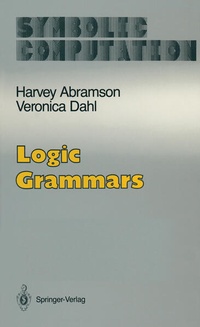
Logic Grammars
Published on 20. October 2013
Book
Paperback/Softback
XIV, 234 pages
978-1-4612-8188-7 (ISBN)
Description
Logic grammars have found wide application both in natural language processing and in formal applications such as compiler writing. This book introduces the main concepts involving natural and formal language processing in logic programming, and discusses typical problems which the reader may encounter, proposing various methods for solving them. The basic material is presented in depth; advanced material, involving new logic grammar formalisms and applications, is presented with a view towards breadth. Major sections of the book include: grammars for formal language and linguistic research, writing a simple logic grammar, different types of logic grammars, applications, and logic grammars and concurrency. This book is intended for those interested in logic programming, artificial intelligence, computational linguistics, Fifth Generation computing, formal languages and compiling techniques. It may be read profitably by upper-level undergraduates, post-graduate students, and active researchers on the above-named areas. Some familiarity with Prolog and logic programming would be helpful; the authors, however, briefly describe Prolog and its relation to logic grammars. After reading Logic Grammars, the reader will be able to cope with the ever-increasing literature of this new and exciting field.
More details
Series
Edition
1989 ed.
Language
English
Place of publication
New York
United States
Target group
Professional and scholarly
Research
Illustrations
XIV, 234 p.
Dimensions
Height: 235 mm
Width: 155 mm
Thickness: 14 mm
Weight
388 gr
ISBN-13
978-1-4612-8188-7 (9781461281887)
DOI
10.1007/978-1-4612-3640-5
Schweitzer Classification
Other editions
Additional editions
Harvey Abramson | Veronica Dahl
Logic Grammars
Book
03/1989
Springer
€93.08
Article exhausted; check different version
Persons
Content
0. Introduction and Historic Overview.- I. Grammars for Formal Languages and Linguistic Research.- 1. What are Logic Grammars.- 2. Relation of Logic Grammars to Prolog.- II. Getting Started: How to Write a Simple Logic Grammar.- 3. Step-by-Step Development of a Natural Language Analyser.- 4. Choosing Internal Representations for Natural Language.- 5. Developing a Logic Grammar for a Formal Application.- III. Different Types of Logic Grammars - What Each Is Useful For.- 6. Basic Types of Logic Grammars.- 7. Building Structure.- 8. Modifier Structure Grammars.- 9. Definite Clause Translation Grammars and their Applications.- 10. Further Expressive Power - Discontinuous Grammars.- IV. Other Applications.- 11. Other Formalisms.- 12. Bottom Up Parsing.- V. Logic Grammars and Concurrency.- 13. Parsing with Committment.- Appendices.- I. Input/Output in Logic Grammars.- 1. Input of a Sentence.- II. Implementation of Logic Grammar Formalisms.- 1. SYNAL: Compiling Disc. Grammars to Prolog.- 2. A Short Interpreter for Static Discontinuity Grammars.- 3. Implementations of DCTGs.- 3.1. An Interpreter for Definite Clause Translation Grammars.- 3.2. Compiling Definite Clause Translation Grammars to Prolog.- 3.3. Typing DCTGs.- Literature.