

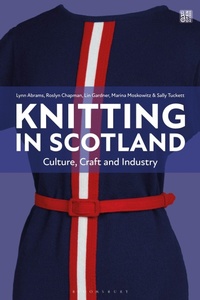
Knitting in Scotland
Culture, Craft and Industry
Will be published approx. on 11. June 2026
Book
Hardback
344 pages
978-1-350-36171-3 (ISBN)
Description
The story of Scottish knitting: the first critical history and analysis of a local craft turned international icon.
From Fair Isle patterning to Pringle jumpers, Scottish knitwear is internationally renowned and instantly recognizable. This open access study unpicks the distinctive place of knitting in the Scottish landscape, economy, and culture from the 19th century to today.
Recent reappraisals of the industrial revolution and traditional craft economies, and the recent revival of hobby knitting during the Covid-19 pandemic, have raised new questions about the roles of social communities, sustainability and women's domestic work in the textile industries. Tracing its story from raw material to final product, from home-spun clothes and crafts to luxury markets and industrial-scale production, Knitting in Scotland investigates the Scottish knitting trade's remarkable survival across two centuries of economic and cultural modernization.
The ebook editions of this book are available open access under a CC BY-NC-ND 4.0 licence on bloomsburycollections.com. Open access was funded by UKRI.
From Fair Isle patterning to Pringle jumpers, Scottish knitwear is internationally renowned and instantly recognizable. This open access study unpicks the distinctive place of knitting in the Scottish landscape, economy, and culture from the 19th century to today.
Recent reappraisals of the industrial revolution and traditional craft economies, and the recent revival of hobby knitting during the Covid-19 pandemic, have raised new questions about the roles of social communities, sustainability and women's domestic work in the textile industries. Tracing its story from raw material to final product, from home-spun clothes and crafts to luxury markets and industrial-scale production, Knitting in Scotland investigates the Scottish knitting trade's remarkable survival across two centuries of economic and cultural modernization.
The ebook editions of this book are available open access under a CC BY-NC-ND 4.0 licence on bloomsburycollections.com. Open access was funded by UKRI.
Reviews / Votes
The product of extraordinary collaboration and expert research. Makes a compelling intervention, positioning domestic and industrial knitting as central to the histories of textiles, craft, and women's labor and leisure. * Lauren Downing Peters, Columbia College Chicago, USA * Vital for anyone seeking to understand how Scotland has shaped knitting and knitting has shaped Scotland. A rigorous and readable account that sheds light on everyday concerns and practices of makers and workers, especially women, and builds a multi-layered picture of the significance of knit textiles in Scottish culture and international influence. * Siun Carden, University of rhe Highlands and Islands (UHI Shetland), UK *More details
Language
English
Place of publication
London
United Kingdom
Publishing group
Bloomsbury Publishing PLC
Target group
Professional and scholarly
Product notice
Laminated cover
Illustrations
34 colour and 35 bw illus
Dimensions
Height: 234 mm
Width: 156 mm
Thickness: 14 mm
Weight
387 gr
ISBN-13
978-1-350-36171-3 (9781350361713)
Copyright in bibliographic data and cover images is held by Nielsen Book Services Limited or by the publishers or by their respective licensors: all rights reserved.
Schweitzer Classification
Persons
Lynn Abrams is Professor of Modern History at the University of Glasgow, UK and principal investigator of the AHRC-funded project 'Fleece to Fashion: Economies and Cultures of Knitting in Scotland'.
Sally Tuckett is Senior Lecturer in Art History at the University of Glasgow, UK. She is co-investigator on the Fleece to Fashion project.
Marina Moskowitz is the Lynn and Gary Mecklenburg Chair in Textiles, Material Culture, and Design at the University of Madison-Wisconsin, USA. She is international co-investigator on the Fleece to Fashion project and an editor of Textile History.
Roslyn Chapman was a Research Associate at the University of Glasgow, UK and on the Fleece to Fashion project.
Lin Gardner was a Research Assistant at the University of Glasgow, UK and on the Fleece to Fashion project.
Sally Tuckett is Senior Lecturer in Art History at the University of Glasgow, UK. She is co-investigator on the Fleece to Fashion project.
Marina Moskowitz is the Lynn and Gary Mecklenburg Chair in Textiles, Material Culture, and Design at the University of Madison-Wisconsin, USA. She is international co-investigator on the Fleece to Fashion project and an editor of Textile History.
Roslyn Chapman was a Research Associate at the University of Glasgow, UK and on the Fleece to Fashion project.
Lin Gardner was a Research Assistant at the University of Glasgow, UK and on the Fleece to Fashion project.
Content
Preface and acknowledgements
About the Authors
List of Figures
List of Tables
List of Abbreviations
Glossary
1. Introduction: Stories, objects, histories
Pre-cursors of modern Scottish knitting
The modern knitwear industry
Histories of Scottish knitting
Researching knitting and knitwear
2. Geography
A Scottish tour of knitwear production
Knitting traditions and place
3. Organization
Charity in the community
Educating the workforce
Business structures
4. Fibre
Wool: provenance and supply
Cashmere: luxury and heritage
Synthetic fibres: novelty and opportunity
5. Technology
Plain knitting and shaping by machine
Pattern and texture
Electronic machines and computer aided design
Shima Seiki
The pivotal role of programming
6. Making
The making process
Locations of labour
Skill: specialisation and flexibility
Gendered divisions of labour
Gendered remuneration for labour
7. Marketing
Local products, global competition
The work of selling knitwear
Competing for markets: the tale of Twomax
The power of retail contracts: the Marks & Spencer effect
Trading on tradition: Shetland producers
8. Design
The vagaries of fashion
Forecasting fashion: Pringle
Consolidating classics: Peter Scott
Design-led interventions in Scottish knitting
9. Communities
Factory communities: 'like a family'
Mutuality in an island community
A community of practice
10. The Usable Past of Scottish Knitting
Natural histories
Heritage of craftsmanship
Knitting as Scottish Heritage
Bibliography
Index
About the Authors
List of Figures
List of Tables
List of Abbreviations
Glossary
1. Introduction: Stories, objects, histories
Pre-cursors of modern Scottish knitting
The modern knitwear industry
Histories of Scottish knitting
Researching knitting and knitwear
2. Geography
A Scottish tour of knitwear production
Knitting traditions and place
3. Organization
Charity in the community
Educating the workforce
Business structures
4. Fibre
Wool: provenance and supply
Cashmere: luxury and heritage
Synthetic fibres: novelty and opportunity
5. Technology
Plain knitting and shaping by machine
Pattern and texture
Electronic machines and computer aided design
Shima Seiki
The pivotal role of programming
6. Making
The making process
Locations of labour
Skill: specialisation and flexibility
Gendered divisions of labour
Gendered remuneration for labour
7. Marketing
Local products, global competition
The work of selling knitwear
Competing for markets: the tale of Twomax
The power of retail contracts: the Marks & Spencer effect
Trading on tradition: Shetland producers
8. Design
The vagaries of fashion
Forecasting fashion: Pringle
Consolidating classics: Peter Scott
Design-led interventions in Scottish knitting
9. Communities
Factory communities: 'like a family'
Mutuality in an island community
A community of practice
10. The Usable Past of Scottish Knitting
Natural histories
Heritage of craftsmanship
Knitting as Scottish Heritage
Bibliography
Index