

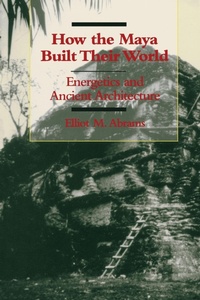
How the Maya Built Their World
Energetics and Ancient Architecture
Published on 1. September 1994
Book
Paperback/Softback
192 pages
978-0-292-70462-6 (ISBN)
Description
Maya architecture is often described as "massive" and "monumental," but experiments at Copan, Honduras, convinced Elliot Abrams that 300 people could have built one of the large palaces there in only 100 days.
In this groundbreaking work, Abrams explicates his theory of architectural energetics, which involves translating structures into volumes of raw and manufactured materials that are then multiplied by the time required for their production and assembly to determine the labor costs of past construction efforts. Applying this method to residential structures of the Late Classic period (A.D. 700-900) at Copan leads Abrams to posit a six-tiered hierarchic social structure of political decision making, ranging from a stratified elite to low-ranking commoners. By comparing the labor costs of construction and other economic activities, he also prompts a reconsideration of the effects of royal construction demands on commoners.
How the Maya Built Their World will interest a wide audience in New and Old World anthropology, archaeology, architecture, and engineering.
In this groundbreaking work, Abrams explicates his theory of architectural energetics, which involves translating structures into volumes of raw and manufactured materials that are then multiplied by the time required for their production and assembly to determine the labor costs of past construction efforts. Applying this method to residential structures of the Late Classic period (A.D. 700-900) at Copan leads Abrams to posit a six-tiered hierarchic social structure of political decision making, ranging from a stratified elite to low-ranking commoners. By comparing the labor costs of construction and other economic activities, he also prompts a reconsideration of the effects of royal construction demands on commoners.
How the Maya Built Their World will interest a wide audience in New and Old World anthropology, archaeology, architecture, and engineering.
Reviews / Votes
"Abrams is proposing what I think is a very useful and potentially powerful tool; personally, I would even hope it becomes a standard archaeological analysis for ancient architecture, with concomitant development of site-specific analogues." - Wendy Ashmore, associate professor of anthropology, University of PennsylvaniaMore details
Language
English
Place of publication
Austin, TX
United States
Target group
College/higher education
Professional and scholarly
Product notice
Paperback (trade)
Dimensions
Height: 226 mm
Width: 152 mm
Thickness: 15 mm
Weight
310 gr
ISBN-13
978-0-292-70462-6 (9780292704626)
Copyright in bibliographic data and cover images is held by Nielsen Book Services Limited or by the publishers or by their respective licensors: all rights reserved.
Schweitzer Classification
Person
Elliot M. Abrams is an associate professor of anthropology at Ohio University.
Content
List of Figures
List of Tables
Preface
1. Introduction
2. Background to Architectural Energetics at Copan
3. Maya Architectural Forms
4. The Energetics of Construction
5. Costs and the Construction Process
6. Energetics and the Hierarchy of Social Power
7. The Organization of Construction Labor
8. Architecture and Economics
9. Conclusions
Appendix A. Costs per Task per Structure
Appendix B. Reuse Savings
References
Index
List of Tables
Preface
1. Introduction
2. Background to Architectural Energetics at Copan
3. Maya Architectural Forms
4. The Energetics of Construction
5. Costs and the Construction Process
6. Energetics and the Hierarchy of Social Power
7. The Organization of Construction Labor
8. Architecture and Economics
9. Conclusions
Appendix A. Costs per Task per Structure
Appendix B. Reuse Savings
References
Index