

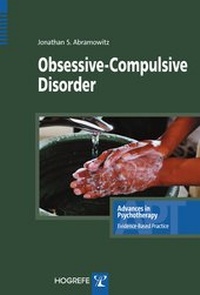
Obsessive-Compulsive Disorder
1st Edition
Published on 1. January 2006
Book
Paperback/Softback
104 pages
978-0-88937-316-7 (ISBN)
Description
This volume in the new series, Advances in Psychotherapy -- Evidence-Based Practice, provides therapists and students with practical and evidence-based guidance on diagnosis and treatment of obsessive-compulsive disorder -- and does so in a uniquely "reader-friendly" manner. The book is both a compact "how-to" reference, for use by professional clinicians in their daily work, as well as an ideal educational resource for students and for practice-oriented continuing education. The most important feature of the book is that it is practical and "reader-friendly." It has a similar structure to others in the series, and is a compact and easy-to-follow guide covering all aspects of practice that are relevant in real-life. Tables, boxed clinical "pearls," and marginal notes assist orientation, while checklists for copying and summary boxes provide tools for use in daily practice. The series has been developed and is edited with the support of the Society of Clinical Psychology (APA Division 12). The Society is planning a system of home study continuing education courses based on the series that an individual can complete on the web.
Reviews / Votes
"Dr. Abramowitz has done a remarkable job in taking difficult to understand concepts and making them easy to grasp. This is the most practical, user-friendly guide to date. It is a quick, but informative read by one of the premier thought leaders in the field of OCD. This is a must read for clinicians and students alike, and will be required reading for our staff and trainees." Bradley C. Riemann, PhD, Clinical Director, OCD Center at Rogers Memorial Hospital, Oconomowoc, WI "Dr. Jonathan Abramowitz is one of the world's leading experts on Obsessive Compulsive Disorder and has cumulated years of hands-on experience. In this very readable treatment program, he makes these strategies and his experience available to the therapist. Anyone treating patients with Obsessive Compulsive Disorder will want to have this resource." David H. Barlow, PhD, Professor of Psychology, Research Professor of Psychiatry, Director, Center for Anxiety and Related Disorders at Boston University "This book does a fine job of combining cognitive and behavioral interventions into an integrated program of therapy. Dr. Abramowitz' detailed attention to symptom subtypes is especially useful for therapists learning to apply CBT to the many varieties of obsessions and compulsions. The highlighting of clinical pearls, vignettes, and therapeutic dialog is particularly helpful and makes this manual very user-friendly." Gail Steketee, PhD, Professor, Boston University School of Social Work"All prices
More details
Series
Edition
1., Aufl.
Language
English
Place of publication
Toronto
Canada
Publishing group
Hogrefe Publishing
Target group
Professional and scholarly
For psychotherapists, clinical psychologists, psychiatrists, counselors/social workers, students and trainees
Illustrations
13 tables, 3 figures
Dimensions
Height: 25.4 cm
Width: 17.8 cm
ISBN-13
978-0-88937-316-7 (9780889373167)
Schweitzer Classification
Other editions
New editions
Jonathan S. Abramowitz | Ryan J. Jacoby
Obsessive-Compulsive Disorder in Adults
Advances in Psychotherapy - Evidence-Based Practice
Book
04/2015
1st Edition
Hogrefe & Huber
from
€24.95
Article exhausted; check for reprint
Content
1. Description of Obsessive-Compulsive Disorder (OCD); 1.1. Terminology; 1.2. Definition; 1.2.1 Insight; 1.3. Epidemiology; 1.4. Course and Prognosis; 1.5. Differential Diagnosis; 1.5.1 Generalized Anxiety Disorder; 1.5.2 Depression; 1.5.3 Tics and Tourette's Syndrome; 1.5.4 Delusional Disorders; 1.5.5 Impulse Control Disorders; 1.5.6 Obsessive Compulsive Personality Disorder; 1.5.7 Hypochondriasis; 1.5.8 Body Dysmorphic Disorder; 1.6. Comorbidities; 1.7. Diagnostic Procedures and Documentation; 1.7.1 Structured Diagnostic Interview; 1.7.2 Semi-Structured Symptom Interviews; 1.7.3 Self-Report Inventories; 1.7.4 Documenting Change in Symptom Levels; 2. Theories and Models of OCD; 2.1 Neuropsychiatric Theories; 2.1.1 Neurochemical Theories; 2.1.2 Neuroanatomical Theories; 2.2 Psychological Theories; 2.2.1 Learning Theory; 2.2.2 Cognitive Deficit Models; 2.2.3 Contemporary Cognitive-behavioral Models; 3. Diagnosis and Treatment Indications; 3.1 Form Versus Function; 3.2 The Diagnostic Assessment; 3.3 Identifying the Appropriate Treatment; 3.3.1 Empirically Supported Treatments for OCD; 3.4 Factors that Influence Treatment Decisions; 3.4.1 Age; 3.4.2 Gender; 3.4.3 Race; 3.4.4 Educational Level; 3.4.5 Patient Preference; 3.4.6 Social Support; 3.4.7 Clinical Presentation; 3.4.8 OCD Symptom theme; 3.4.9 Insight; 3.4.10 Comorbidity; 3.4.11 Treatment History; 3.5 Presenting the Recommendation for Cognitive-Behavioral Therapy (CBT); 4. Treatment; 4.1. Methods of Treatment; 4.1.1 Functional Assessment; 4.1.2 Self-Monitoring; 4.1.3 Psychoeducation; 4.1.4 Using Cognitive Therapy Techniques; 4.1.5 Planning for Exposure and Response Prevention; 4.1.6 Implementing Exposure and Response Prevention; 4.1.7 Ending Treatment; 4.2. Mechanisms of Action; 4.3. Efficacy and Prognosis; 4.4. Variations and Combinations of Methods; 4.4.1 Variants of CBT Treatment Procedures; 4.4.2 Combining Medication and CBT; 4.5. Problems in Carrying out the Treatments; 4.5.1 Negative Reactions to the CBT Model; 4.5.2 Nonadherence; 4.5.3 Arguments; 4.5.4 Therapist's Inclination to Challenge the Obsession; 4.5.5 When Cognitive Interventions Become Rituals; 4.5.6 Unbearable Anxiety Levels During Exposure; 4.5.7 Absence of Anxiety During Exposure; 4.5.8 Therapist Discomfort with Conducting Exposure Exercises; 5. Case Vignette; 6. Further Reading; 7. References; 8. Appendix: Tools and Resources.