


Topics in Mathematics for Elementary Teachers
A Technology-Enhanced Experiential Approach
Published on 31. March 2010
Book
Hardback
264 pages
978-1-60752-461-8 (ISBN)
Description
This book reflects the author's experience in teaching a mathematics content course for pre-service elementary teachers. The book addresses a number of recommendations of the Conference Board of the Mathematical Sciences for the preparation of teachers demonstrating how abstract mathematical concepts can be motivated by concrete activities. Such an approach, when enhanced by the use of technology, makes it easier for the teachers to grasp the meaning of generalization, formal proof, and the creation of an increasing number of concepts on higher levels of abstraction. A strong experiential component of the book made possible by the use of manipulative materials and digital technology such as spreadsheets, The Geometer's Sketchpad, Graphing Calculator 3.5 (produced by Pacific Tech), and Kid Pix Studio Deluxe makes it possible to balance informal and formal approaches to mathematics, allowing the teachers to learn how the two approaches complement each other. Classroom observations of the teachers' learning mathematics as a combination of theory and experiment confirm that this approach elevates one's mathematical understanding to a higher ground. The book not only shows the importance of mathematics content knowledge for teachers but better still, how this knowledge can be gradually developed in the context of exploring grade-appropriate activities and tasks and using computational and manipulative environments to support these explorations.
Most of the chapters are motivated by a problem/activity typically found in the elementary mathematics curricula and/or standards (either National or New York State - the context in which the author prepares teachers). By exploring such problems in depth, the teachers can learn fundamental mathematical concepts and ideas hidden within a seemingly mundane problem/activity. The need to have experience in going beyond traditional expectations for learning is due to the constructivist orientation of contemporary mathematics pedagogy that encourages students to ask questions about mathematics they study. Each chapter includes an activity set that can be used for the development of the variety of assignments for the teachers.
The material included in the book is original in terms of the approach used to teach mathematics to the teachers and it is based on a number of journal articles published by the author in the United States and elsewhere. Mathematics educators who are interested in integrating hands-on activities and digital technology into the teaching of mathematics will find this book useful. Mathematicians who teach mathematics to the teachers as part of their teaching load will be interested in the material included in the book as it connects childhood mathematics content and mathematics for the teachers.
Most of the chapters are motivated by a problem/activity typically found in the elementary mathematics curricula and/or standards (either National or New York State - the context in which the author prepares teachers). By exploring such problems in depth, the teachers can learn fundamental mathematical concepts and ideas hidden within a seemingly mundane problem/activity. The need to have experience in going beyond traditional expectations for learning is due to the constructivist orientation of contemporary mathematics pedagogy that encourages students to ask questions about mathematics they study. Each chapter includes an activity set that can be used for the development of the variety of assignments for the teachers.
The material included in the book is original in terms of the approach used to teach mathematics to the teachers and it is based on a number of journal articles published by the author in the United States and elsewhere. Mathematics educators who are interested in integrating hands-on activities and digital technology into the teaching of mathematics will find this book useful. Mathematicians who teach mathematics to the teachers as part of their teaching load will be interested in the material included in the book as it connects childhood mathematics content and mathematics for the teachers.
More details
Language
English
Place of publication
Charlotte
United States
Publishing group
Emerald Publishing Inc
Target group
Professional and scholarly
Dimensions
Height: 234 mm
Width: 156 mm
Thickness: 16 mm
Weight
548 gr
ISBN-13
978-1-60752-461-8 (9781607524618)
Copyright in bibliographic data and cover images is held by Nielsen Book Services Limited or by the publishers or by their respective licensors: all rights reserved.
Schweitzer Classification
Other editions
New editions
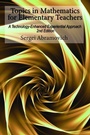
Sergei Abramovich
Topics in Mathematics For Elementary Teachers
A Technology-Enhanced Experiential Approach
Book
12/2023
2nd Edition
Information Age Publishing
€101.50
Shipment within 10-20 days
Content
Chapter 1. Partition of Whole Numbers: Reasoning with Manipulatives and Computational Experiments.
Chapter 2. Combinatorial Models: From Trial and Error to Theory.
Chapter 3. Early Algebra with Kid Pix.
Chapter 4. Hidden Mathematics of the Multiplication Table.
Chapter 5. Application of Unit Fractions to Tesselations.
Chapter 6. Divisibility and Prime Numbers.
Chapter 7. Fibonacci Numbers and the Golden Ratio.
Chapter 8. From Arithmetic Sequences to Polygonal Numbers.
Chapter 9. The Multiplication Table Revisited.
Chapter 10. Proof and Proving.
Chapter 11. Computational Problem-Solving and Modeling.
Chapter 12. Numbers and Operations in Different Bases.
Chapter 13. Programming Details.
References.
Appendix: Some Useful Formulas.
Chapter 2. Combinatorial Models: From Trial and Error to Theory.
Chapter 3. Early Algebra with Kid Pix.
Chapter 4. Hidden Mathematics of the Multiplication Table.
Chapter 5. Application of Unit Fractions to Tesselations.
Chapter 6. Divisibility and Prime Numbers.
Chapter 7. Fibonacci Numbers and the Golden Ratio.
Chapter 8. From Arithmetic Sequences to Polygonal Numbers.
Chapter 9. The Multiplication Table Revisited.
Chapter 10. Proof and Proving.
Chapter 11. Computational Problem-Solving and Modeling.
Chapter 12. Numbers and Operations in Different Bases.
Chapter 13. Programming Details.
References.
Appendix: Some Useful Formulas.