

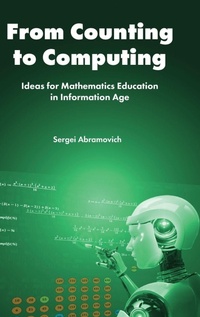
From Counting to Computing
Ideas for Mathematics Education in Information Age
Published on 3. November 2025
Book
Hardback
200 pages
978-1-83708-899-7 (ISBN)
Description
From Counting to Computing demonstrates the powerful integration of formal mathematical reasoning, hands-on educational experiments, and digital computation to solve problems. It focuses on numeric tables shaped as squares, equilateral and isosceles triangles, offering ample opportunities for algebraic generalization in the digital age. Activities are grounded in addition and multiplication tables, polygonal numbers, and Pascal's triangle. Based on the idea that counting objects arranged in geometric shapes leads to the development of numeric patterns, this book extends this concept to digital computing. Using technology-immune/technology-enabled didactical framework, it blends formal reasoning with digital computation in problem solving and provides a conceptual shortcut to achieving mathematically significant computational outcomes.
From Counting to Computing covers classic topics from arithmetic, number theory, combinatorics, and probability theory. Many historical and cultural origins of mathematical concepts are highlighted, featuring figures like Pythagoras, Aristotle, Heron of Alexandria, Theon, Fibonacci, Gersonides, Pacioli, Cardano, Galilei, Kepler, Descartes, Fermat, Pascal, Spinoza, Leibniz, Jacob Bernoulli, Binet, de Moivre, Lame, and Lucas.
The final chapter includes problems on the proof of divisibility of integer variable polynomials, motivated by digital computations. Ideal for mathematics teacher education programs and discrete mathematics courses, this book showcases the use of simple algorithms and tools like spreadsheets, Wolfram Alpha, Maple, and Graphing Calculator to achieve sophisticated computational results.
From Counting to Computing covers classic topics from arithmetic, number theory, combinatorics, and probability theory. Many historical and cultural origins of mathematical concepts are highlighted, featuring figures like Pythagoras, Aristotle, Heron of Alexandria, Theon, Fibonacci, Gersonides, Pacioli, Cardano, Galilei, Kepler, Descartes, Fermat, Pascal, Spinoza, Leibniz, Jacob Bernoulli, Binet, de Moivre, Lame, and Lucas.
The final chapter includes problems on the proof of divisibility of integer variable polynomials, motivated by digital computations. Ideal for mathematics teacher education programs and discrete mathematics courses, this book showcases the use of simple algorithms and tools like spreadsheets, Wolfram Alpha, Maple, and Graphing Calculator to achieve sophisticated computational results.
More details
Language
English
Place of publication
Bingley
United Kingdom
Target group
Professional and scholarly
Product notice
sewn/stitched
Cloth over boards
Dimensions
Height: 234 mm
Width: 156 mm
Thickness: 13 mm
Weight
458 gr
ISBN-13
978-1-83708-899-7 (9781837088997)
Copyright in bibliographic data and cover images is held by Nielsen Book Services Limited or by the publishers or by their respective licensors: all rights reserved.
Schweitzer Classification
Person
Sergei Abramovich (PhD, Mathematics) has over 30 years of experience teaching more than 4,000 prospective K-12 mathematics teachers and has published 13 books and around 250 journal articles, book chapters, and conference proceedings on mathematics education and mathematics.
Content
Chapter 1. From Concepts to Conceptual Shortcuts to the Use of Technology
Chapter 2. Exploring the Addition and the Multiplication Tables
Chapter 3. Exploring Equilateral Triangles Filled with Integers
Chapter 4. Exploring Isosceles Triangles Filled with Integers
Chapter 5. Exploring Squares Filled with Integers
Chapter 6. Pascal's Triangle as a Bridge from Combinatorics to Probability
Chapter 7. From Pascal's Triangle to Fibonacci-Like Polynomials
Chapter 8. Problems Motivated by Digital Computing
Chapter 2. Exploring the Addition and the Multiplication Tables
Chapter 3. Exploring Equilateral Triangles Filled with Integers
Chapter 4. Exploring Isosceles Triangles Filled with Integers
Chapter 5. Exploring Squares Filled with Integers
Chapter 6. Pascal's Triangle as a Bridge from Combinatorics to Probability
Chapter 7. From Pascal's Triangle to Fibonacci-Like Polynomials
Chapter 8. Problems Motivated by Digital Computing