

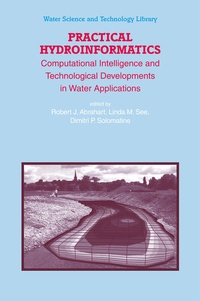
Practical Hydroinformatics
Computational Intelligence and Technological Developments in Water Applications
Published on 22. November 2010
Book
Paperback/Softback
XVI, 506 pages
978-3-642-09864-2 (ISBN)
Description
Hydroinformatics is an emerging subject that is expected to gather speed, momentum and critical mass throughout the forthcoming decades of the 21st century. This book provides a broad account of numerous advances in that field - a rapidly developing discipline covering the application of information and communication technologies, modelling and computational intelligence in aquatic environments. A systematic survey, classified according to the methods used (neural networks, fuzzy logic and evolutionary optimization, in particular) is offered, together with illustrated practical applications for solving various water-related issues. ...
More details
Series
Edition
Softcover reprint of hardcover 1st ed. 2008
Language
English
Place of publication
Berlin
Germany
Publishing group
Springer Berlin
Target group
Professional and scholarly
Research
Illustrations
238 s/w Abbildungen, 5 farbige Abbildungen
XVI, 506 p. 243 illus., 5 illus. in color.
Dimensions
Height: 235 mm
Width: 155 mm
Thickness: 29 mm
Weight
785 gr
ISBN-13
978-3-642-09864-2 (9783642098642)
DOI
10.1007/978-3-540-79881-1
Schweitzer Classification
Other editions
Additional editions
Robert J. Abrahart | Linda M. See | Dimitri P. Solomatine
Practical Hydroinformatics
Computational Intelligence and Technological Developments in Water Applications
Book
11/2008
Springer
€160.49
Shipment within 10-15 days
Content
Hydroinformatics: Integrating Data and Models.- Some Future Prospects in Hydroinformatics.- Data-Driven Modelling: Concepts, Approaches and Experiences.- Artificial Neural Network Models.- Neural Network Hydroinformatics: Maintaining Scientific Rigour.- Neural Network Solutions to Flood Estimation at Ungauged Sites.- Rainfall-Runoff Modelling: Integrating Available Data and Modern Techniques.- Dynamic Neural Networks for Nonstationary Hydrological Time Series Modeling.- Visualisation of Hidden Neuron Behaviour in a Neural Network Rainfall-Runoff Model.- Correction of Timing Errors of Artificial Neural Network Rainfall-Runoff Models.- Data-Driven Streamflow Simulation: The Influence of Exogenous Variables and Temporal Resolution.- Groundwater Table Estimation Using MODFLOW and Artificial Neural Networks.- Neural Network Estimation of Suspended Sediment: Potential Pitfalls and Future Directions.- Models Based on Fuzzy Logic.- Fuzzy Logic-Based Approaches in Water Resource System Modelling.- Fuzzy Rule-Based Flood Forecasting.- Development of Rainfall-Runoff Models Using Mamdani-Type Fuzzy Inference Systems.- Using an Adaptive Neuro-fuzzy Inference System in the Development of a Real-Time Expert System for Flood Forecasting.- Building Decision Support Systems based on Fuzzy Inference.- Global and Evolutionary Optimization.- Global and Evolutionary Optimization for Water Management Problems.- Conditional Estimation of Distributed Hydraulic Conductivity in Groundwater Inverse Modeling: Indicator-Generalized Parameterization and Natural Neighbors.- Fitting Hydrological Models on Multiple Responses Using the Multiobjective Evolutionary Annealing-Simplex Approach.- Evolutionary-based Meta-modelling: The Relevance of Using Approximate Models in Hydroinformatics.- Hydrologic Model Calibration Using Evolutionary Optimisation.- Randomised Search Optimisation Algorithms and Their Application in the Rehabilitation of Urban Drainage Systems.- Neural Network Hydrological Modelling:An Evolutionary Approach.- Emerging Technologies.- Combining Machine Learning and Domain Knowledge in Modular Modelling.- Precipitation Interception Modelling Using Machine Learning Methods - The Dragonja River Basin Case Study.- Real-Time Flood Stage Forecasting Using Support Vector Regression.- Learning Bayesian Networks from Deterministic Rainfall-Runoff Models and Monte Carlo Simulation.- Toward Bridging the Gap Between Data-Driven and Mechanistic Models: Cluster-Based Neural Networks for Hydrologic Processes.- Applications of Soft Computing to Environmental Hydroinformatics with Emphasis on Ecohydraulics Modelling.- Data-Driven Models for Projecting Ocean Temperature Profile from Sea Surface Temperature.- Model Integration.- Uncertainty Propagation in Ensemble Rainfall Prediction Systems used for Operational Real-Time Flood Forecasting.- OpenMI - Real Progress Towards Integrated Modelling.- Hydroinformatics - The Challenge for Curriculum and Research, and the "Social Calibration"of Models.- A New Systems Approach to Flood Management in the Yangtze River, China.- Open Model Integration in Flood Forecasting.