

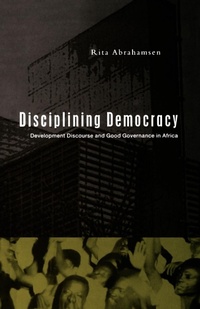
Disciplining Democracy
Development Discourse and Good Governance in Africa
Published on 16. December 2000
Book
Paperback/Softback
192 pages
978-1-85649-859-3 (ISBN)
Description
Not very long ago, authoritarian forms of government were widely regarded as necessary for rapid economic growth and development, and Western donors supported dictatorial regimes in every continent. Today the political mantra is democracy, and the World Bank and Western donors require it almost as a condition of assistance. This thought-provoking book argues not simply that the West's good governance agenda came into being with the demise of the Soviet Union. Much more importantly, it shows how this agenda comprises only very superficial democratic institutional forms that are compatible with continued structural adjustment. African governments, in particular, remain in a cleft stick - supposedly responsible to their electorates at home, in fact beholden to external creditors and donors. The result is the creation of fragile democracies unable to respond to the demands of the poor - who are in the great majority - for socio-economic improvements, and where the requirements of external actors frequently overrule the wishes of domestic constituencies.
Using the example of the good governance discourse, Rita Abrahamsen contributes powerfully to our understanding of development, not as some universally valid set of goals or procedures, but as a historically contingent form of knowledge intimately connected to prevailing structures and relations of power. Her book argues that a key effect of contemporary development discourse, despite all its proclamations in favour of democracy, is to help reproduce a world order that is essentially undemocratic.
Using the example of the good governance discourse, Rita Abrahamsen contributes powerfully to our understanding of development, not as some universally valid set of goals or procedures, but as a historically contingent form of knowledge intimately connected to prevailing structures and relations of power. Her book argues that a key effect of contemporary development discourse, despite all its proclamations in favour of democracy, is to help reproduce a world order that is essentially undemocratic.
Reviews / Votes
'Disciplining Democracy brings a fresh, unorthodox, and original new perspective to the topic of democracy and development in Africa?her work should be required reading?' - African Studies Review'Serious, ambitious and well-written, this energetically argued book is likely to be received by the scholarly community as a genuine contribution to a central and highly controversial area of policy debate, the interconnectedness of liberal structural adjustment and democratization.' - Professor Bjorn Beckman
'This book's greatest contribution is its ability to challenge the widely held assumption by the Western institutions and agencies over the relations between democracy and development'. - Frank Khachina Matanga, Journal of Third World Studies
'This book's greatest contribution is its ability to challenge the widely held assumption by the Western institutions and agencies over the relations between democracy and development. It successfully does so by providing empirical examples from African countries.' - IndustryWatch-YellowBrix
More details
Language
English
Place of publication
United Kingdom
Publishing group
Bloomsbury Publishing PLC
Target group
College/higher education
Dimensions
Height: 216 mm
Width: 140 mm
Thickness: 10 mm
Weight
245 gr
ISBN-13
978-1-85649-859-3 (9781856498593)
Copyright in bibliographic data and cover images is held by Nielsen Book Services Limited or by the publishers or by their respective licensors: all rights reserved.
Schweitzer Classification
Other editions
New editions

Rita Abrahamsen
Disciplining Democracy - Second Edition
Development Discourse and Good Governance in Africa
Book
Zed Books Ltd
€43.51
The article will not be published
Person
Rita Abrahamsen is a lecturer in the Department of International Politics at the University of Wales, Aberystwyth.
Content
Acknowledgments
Introduction
1. Democratisation and Development Discourse
2. New World Order, New Development Discourse
3. The Seductiveness of Good Governance
4. The Democratisation of Poverty
5. Whose Democracy?
6. Economic Liberalisation and Democratic Erosion
7. The Success of the Good Governance Discourse
Introduction
1. Democratisation and Development Discourse
2. New World Order, New Development Discourse
3. The Seductiveness of Good Governance
4. The Democratisation of Poverty
5. Whose Democracy?
6. Economic Liberalisation and Democratic Erosion
7. The Success of the Good Governance Discourse