

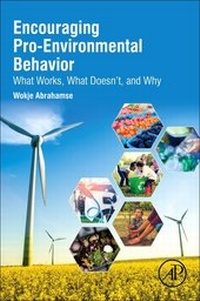
Encouraging Pro-Environmental Behaviour
What Works, What Doesn't, and Why
Published on 31. January 2019
Book
Paperback/Softback
184 pages
978-0-12-811359-2 (ISBN)
Description
Encouraging Pro-Environmental Behavior: What Works, What Doesn't, and Why examines the main drivers of human behavior related to environmental sustainability and how we can encourage environmental behavior change in humans. The book explores the underlying barriers and enablers of environmental behavior and outlines key theoretical advances from psychology to improve understanding. It then uses theory-based research in the development of behavior change interventions to critically evaluate empirical evidence on the effectiveness of those interventions. This book will help inform and improve the success of behavior change initiatives to mitigate climate change.
More details
Language
English
Place of publication
San Diego
United States
Publishing group
Elsevier Science Publishing Co Inc
Target group
College/higher education
Dimensions
Height: 229 mm
Width: 152 mm
Weight
270 gr
ISBN-13
978-0-12-811359-2 (9780128113592)
Copyright in bibliographic data and cover images is held by Nielsen Book Services Limited or by the publishers or by their respective licensors: all rights reserved.
Schweitzer Classification
Other editions
Additional editions
E-Book
01/2019
Academic Press
€51.99
Available for download
Person
Wokje Abrahamse is an internationally recognized scholar in environmental behavior change research. Her research focuses on the human dimensions of environmental change, applying psychological theories to better understand the barriers and enablers of engagement in environmentally friendly behaviors, such as attitudes, social norms, and habits. She also examines the effectiveness of interventions to encourage the adoption of environmentally friendly behaviors, such as energy conservation and travel mode choice.
Content
1. Environmental problems and human behaviour2. Determinants of domestic energy use3. Beyond information and incentives: interventions to reduce energy use at home4. Understanding travel mode choice5. Interventions to encouraging sustainable travel mode choice6. Determinants of domestic water use7. Reducing domestic water use8. Our food choices and the environment9. Changing food choices: an emerging area for behaviour change interventions10. Setting a research agenda for behaviour change research