

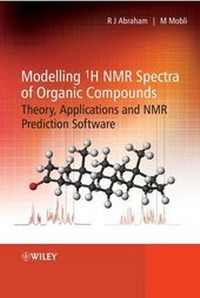
Modelling 1H NMR Spectra of Organic Compounds
Theory, Applications and NMR Prediction Software
1st Edition
Will be published approx. on 28. October 2008
Book
Hardback
392 pages
978-0-470-72301-2 (ISBN)
Description
* Provides a theoretical introduction to graduate scientists and industrial researchers towards the understanding of the assignment of 1H NMR spectra
* Discusses, and includes on enclosed CD, one of the best, the fastest and most applicable pieces of NMR prediction software available
* Allows students of organic chemistry to solve problems on 1H NMR with access to over 500 assigned spectra
More details
Product info
GB
Edition
1., Auflage
Language
English
Place of publication
New York
United States
Target group
Professional and scholarly
Product notice
Unsewn / adhesive bound
Paper over boards
Dimensions
Height: 249 mm
Width: 173 mm
Thickness: 25 mm
Weight
816 gr
ISBN-13
978-0-470-72301-2 (9780470723012)
Schweitzer Classification
Other editions
Additional editions
Raymond J. Abraham | Mehdi Mobli
Modelling 1H NMR Spectra of Organic Compounds
Theory, Applications and NMR Prediction Software
E-Book
11/2008
Wiley
€116.99
Available for download
Persons
Raymond Abraham was appointed lecturer in organic chemistry at the The University of Liverpool in 196. Since then he has remained at Liverpool, with two fellowships taken at the Mellon Institute and the University of Trondheim in 1966 and 1979 respectively, now holding the position of Emeritus Professor. His research interests include: Molecular modelling and Proton Chemical Shift Predictions; Non-bonded and Hydrogen bonding Interactions and Conformational Analysis; and Lanthanide Induced Shifts and Molecular Geometries. He has over 300 publications including three books and ten reviews.
Mehdi Mobli is currently a post-doctoral research fellow at Manchester University, having completed his B.Sc in chemical engineering at Chalmers University of Technology in Sweden and his Ph.D. with Professor Abraham at The University of Liverpool. He has published 10 papers mainly in conjunction with Professor Abraham, all focused on the topic of this text.
Mehdi Mobli is currently a post-doctoral research fellow at Manchester University, having completed his B.Sc in chemical engineering at Chalmers University of Technology in Sweden and his Ph.D. with Professor Abraham at The University of Liverpool. He has published 10 papers mainly in conjunction with Professor Abraham, all focused on the topic of this text.
Content
Preface.
Chapter 1: Introduction to 1H NMR.
1.1 Historical background.
1.2 Basic Theory.
1.3 The 1H chemical shift.
1.4. 1H Substituent chemical shifts (SCS).
1.5 Long range effects on 1H chemical shifts.
1.6.Tables of 1H Chemical Shifts of Common Cyclic Systems.
Chapter 2: Interpretation of 1H NMR coupling patterns.
2.1 Fine Structure due to HH coupling.
2.2 The Analysis of NMR Spectra.
2.3. The Mechanism of Spin-Spin Coupling.
2.4. HF Couplings.
Chapter 3: Methods of Predicting 1H Chemical Shifts.
3.1. Quantum mechanical calculations of 1H Chemical shifts.
3.2. The Data Base Approach, the Hose code.
3.3. Semi-empirical calculations,.
3.4. Theory of the CHARGE program,.
Chapter 4: Modelling 1H Chemical Shifts, Alkanes,Alkenes and Alkynes.
4.1. Alkanes.
a) Acyclic alkanes.
b) Cyclic Alkanes.
c) Methyl Cycloalkanes.
d) Androstane.
e) Chemical Shift contributions in Cyclohexane.
4.2 Alkenes.
a) Acyclic alkenes.
b) Monocyclic alkenes.
c) Aromatic alkenes.
d) Norbornenes and bicyclooctenes.
e) Pinenes.
f) Conclusions.
4.3.Alkynes.
4.4. Summary.
Chapter 5: MODELLING 1H CHEMICAL SHIFTS, Aromatics.
5.1 Aromatic Hydrocarbons.
a) Condensed aromatics.
b) Cyclophanes.
c)Substituted Benzenes.
5.2. Heteroaromatics.
a) Furans, thiophenes and pyrroles.
b) Indoles,quinolines ans isoquinolines.
c) Diazabenzenes and azoles.
5.3. Summary.
Chapter 6: MODELLING 1H CHEMICAL SHIFTS, Mono valent Substituents.
6.1. Flourocompounds.
6.2. Steric,Anisotropic and Electric Field Effects in Chloro,bromo and Iodo SCS.
6.3. Hydroxy Compounds.
6.4. Amines.
6.5. Cyanides.
6.6. Nitro Compounds.
6.7. Summary.
Chapter 7: MODELLING 1H CHEMICAL SHIFTS, Divalent Substituents.
7.1. Aldehydes and Ketones.
a) Observed vs Calculated shifts.
a). Keto-enol tautomerism in anthrone.
7.2. Esters.
7.3 Amides.
7.4. Ethers.
7.5. Sulfoxides, sulfones, sulphites.
7.6. Summary.
Chapter 8: 1H CHEMICAL SHIFTS AND STRUCTURAL CHEMISTRY.
8.1. Electronic Structure Calculations.
8.2. Molecular Mechanics Calculations.
8.3. Molecular Geometries and 1H Chemical Shifts.
8.4. Rate Processes and NMR Spectra.
8.5. Solvent Effects.
8.6. Summary.
Chapter 9: Strategies for 1H NMR prediction.
9.1. Calculating 1H NMR spectra.
9.2. Automated spectral prediction, NMRPredict.
Appendix 1. The observed vs calculated 1H NMR chemical shifts of ca 1000 spectra.
Appendix 2. The observed vs calculated 1H NMR chemical shifts of 113 Substituted Benzenes.
Appendix 3. The observed vs calculated 1H NMR chemical shifts of 65 Substituted Pyridines.