

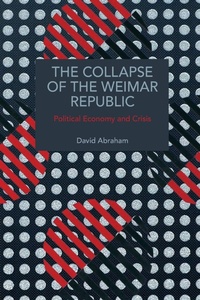
The Collapse of the Weimar Republic
Political Economy and Crisis
Will be published approx. on 16. June 2026
Book
Paperback/Softback
416 pages
979-8-88890-936-2 (ISBN)
Description
The Collapse of the Weimar Republic analyzes the complex political economy of inter-war Germany.
David Abraham examines how and why the country's economic and political leaders turned away from social democracy and international integration, choosing instead to support the Nazi party to preserve their dominance. Theoretically sophisticated within a Marxist tradition and deeply researched in both public and private archives, the book sets out to answer key questions about capitalism and democracy. How did Weimar Germany, one of the first modern welfare states, balance the interests of working people and economic elites? What leads elites to undermine democracy, and what happens when they do? And what, ultimately, enables a liberal democracy to survive in a capitalist society?
David Abraham examines how and why the country's economic and political leaders turned away from social democracy and international integration, choosing instead to support the Nazi party to preserve their dominance. Theoretically sophisticated within a Marxist tradition and deeply researched in both public and private archives, the book sets out to answer key questions about capitalism and democracy. How did Weimar Germany, one of the first modern welfare states, balance the interests of working people and economic elites? What leads elites to undermine democracy, and what happens when they do? And what, ultimately, enables a liberal democracy to survive in a capitalist society?
More details
Language
English
Place of publication
Chicago
United States
Product notice
Paperback (trade)
Unsewn / adhesive bound
Illustrations
Illustrations
Dimensions
Height: 229 mm
Width: 152 mm
Thickness: 23 mm
Weight
594 gr
ISBN-13
979-8-88890-936-2 (9798888909362)
Copyright in bibliographic data and cover images is held by Nielsen Book Services Limited or by the publishers or by their respective licensors: all rights reserved.
Schweitzer Classification
Person
David Abraham is Professor Emeritus of Law at the University of Miami. A historian and legal scholar, he has published extensively on the political economy of liberal democracy-its successes and failures-as well as on contemporary issues of immigration and social solidarity.
Content
Preface to the First Edition (1981)
Preface to the Second Edition
Foreword to the Third Edition
List of Figures
List of Tables
Abbreviations
Introduction to the First Edition
Introduction to the Second Edition
Introduction to the Third Edition
?Benjamin Carter Hett
1 The State and Classes: Theory and the Weimar Case
?1?State and Economy in Weimar
?2?State and Society in Weimar
?3?Stability in Weimar: Bloc 3 and Labour's Support
?4?Crisis and the End of Stability
2 Conflicts within the Agricultural Sector
?1?The Modes of Agricultural Production
?2?Estate-Owner Domination and the Bases of Rural Unity to 1924
?3?1925 to the Crisis: The Absence of Alternatives and Immanence of Conflict
?4?The Agricultural Crisis, Its Resolution and Contribution to the General Crisis
3 Conflicts within the Industrial Sector
?1?From Prewar Conflict to Post-inflation Equilibrium
?2?Industrial Politics in the Period of Stability
?3?Industrial Production
?4?Interindustrial Conflicts and Mechanisms: AVI, Tariffs, and Reparations
?5?Political Responses to the Crisis: Buergerblock, Brueningblock, and 'National Opposition'
?6?A Note on Industry and 'Work Creation'
4 Conflicts between Agriculture and Industry
?1?Dominant and Dependent Sectors
?2?Strategies for Sectoral Interaction after 1925
?3?The Economic Interaction of the Two Sectors
?4?Strategies 1 and 2: Exports versus Protection, 1925-1931
?5?Strategy 3: Modernisation, Conciliation, and Reform
?6?After Exports and Reform: Toward a New National Sammlung Bloc
?7?1932: Ontogeny Recapitulates Phylogeny
?8?Strategies 4 and 5: Cartelisation and Imperialism
5 The Reemergence of the Labour/Capital Conflict
?1?Social Compromise: Its Results and Its Limits
?2?The Politics of Sozialpolitik
?3?Implementing Industry's Program
6 In Search of a Viable Bloc
?1?Organised Capitalism, Fragmented Bourgeois Politics, and Extrasystemic Solutions
?2?Collapse of the Grand Coalition: End without a Beginning
?3?The Failure of Bruening's Crisis Strategy
?4?The Break between Representatives and Represented
?5?Toward the Extrasystemic Solution
?6?From New Base to New Coalition
Bibliography
Index
Preface to the Second Edition
Foreword to the Third Edition
List of Figures
List of Tables
Abbreviations
Introduction to the First Edition
Introduction to the Second Edition
Introduction to the Third Edition
?Benjamin Carter Hett
1 The State and Classes: Theory and the Weimar Case
?1?State and Economy in Weimar
?2?State and Society in Weimar
?3?Stability in Weimar: Bloc 3 and Labour's Support
?4?Crisis and the End of Stability
2 Conflicts within the Agricultural Sector
?1?The Modes of Agricultural Production
?2?Estate-Owner Domination and the Bases of Rural Unity to 1924
?3?1925 to the Crisis: The Absence of Alternatives and Immanence of Conflict
?4?The Agricultural Crisis, Its Resolution and Contribution to the General Crisis
3 Conflicts within the Industrial Sector
?1?From Prewar Conflict to Post-inflation Equilibrium
?2?Industrial Politics in the Period of Stability
?3?Industrial Production
?4?Interindustrial Conflicts and Mechanisms: AVI, Tariffs, and Reparations
?5?Political Responses to the Crisis: Buergerblock, Brueningblock, and 'National Opposition'
?6?A Note on Industry and 'Work Creation'
4 Conflicts between Agriculture and Industry
?1?Dominant and Dependent Sectors
?2?Strategies for Sectoral Interaction after 1925
?3?The Economic Interaction of the Two Sectors
?4?Strategies 1 and 2: Exports versus Protection, 1925-1931
?5?Strategy 3: Modernisation, Conciliation, and Reform
?6?After Exports and Reform: Toward a New National Sammlung Bloc
?7?1932: Ontogeny Recapitulates Phylogeny
?8?Strategies 4 and 5: Cartelisation and Imperialism
5 The Reemergence of the Labour/Capital Conflict
?1?Social Compromise: Its Results and Its Limits
?2?The Politics of Sozialpolitik
?3?Implementing Industry's Program
6 In Search of a Viable Bloc
?1?Organised Capitalism, Fragmented Bourgeois Politics, and Extrasystemic Solutions
?2?Collapse of the Grand Coalition: End without a Beginning
?3?The Failure of Bruening's Crisis Strategy
?4?The Break between Representatives and Represented
?5?Toward the Extrasystemic Solution
?6?From New Base to New Coalition
Bibliography
Index