

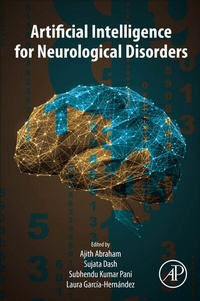
Artificial Intelligence for Neurological Disorders
Published on 22. September 2022
Book
Paperback/Softback
432 pages
978-0-323-90277-9 (ISBN)
Description
Artificial Intelligence for Neurological Disorders provides a comprehensive resource of state-of-the-art approaches for AI, big data analytics and machine learning-based neurological research. The book discusses many machine learning techniques to detect neurological diseases at the cellular level, as well as other applications such as image segmentation, classification and image indexing, neural networks and image processing methods. Chapters include AI techniques for the early detection of neurological disease and deep learning applications using brain imaging methods like EEG, MEG, fMRI, fNIRS and PET for seizure prediction or neuromuscular rehabilitation.
The goal of this book is to provide readers with broad coverage of these methods to encourage an even wider adoption of AI, Machine Learning and Big Data Analytics for problem-solving and stimulating neurological research and therapy advances.
The goal of this book is to provide readers with broad coverage of these methods to encourage an even wider adoption of AI, Machine Learning and Big Data Analytics for problem-solving and stimulating neurological research and therapy advances.
More details
Language
English
Place of publication
Oxford
United Kingdom
Publishing group
Elsevier Science & Technology
Target group
Professional and scholarly
Illustrations
100 illustrations (50 in full color); Illustrations
Dimensions
Height: 229 mm
Width: 152 mm
Weight
690 gr
ISBN-13
978-0-323-90277-9 (9780323902779)
Copyright in bibliographic data and cover images is held by Nielsen Book Services Limited or by the publishers or by their respective licensors: all rights reserved.
Schweitzer Classification
Other editions
Additional editions
Ajith Abraham | Sujata Dash | Subhendu Kumar Pani
Artificial Intelligence for Neurological Disorders
E-Book
09/2022
Academic Press
€175.00
Available for download
Persons
Dr. Ajith Abraham is the Pro Vice-Chancellor for Academics, Research, Incubation, and International Relations at Bennette University. He is also the Founding Director of Machine Intelligence Research Labs (MIR Labs), a global non-profit scientific network that connects academia and industry to support research and innovation. He is also serving as Vice Chancellor of Sai University, Chennai.
His research interests include artificial intelligence and machine intelligence, cyber-physical systems, the Internet of Things (IoT), network security, Web intelligence, sensor networks, and data mining. He serves as Chair of the IEEE Systems, Man, and Cybernetics Society Technical Committee on Soft Computing and has held editorial leadership roles, including Editor-in-Chief of Engineering Applications of Artificial Intelligence.
Dr. Abraham earned his Ph.D. in Computer Science from Monash University, Australia. Sujata Dash is a Professor of Information Technology at Nagaland University, India, and an IEEE Senior Member, with over three decades of academic and research experience. She holds a PhD in Computational Modeling and has also completed postdoctoral research at the University of Manitoba, Canada, where she later served as a Visiting Professor. Her research spans machine learning, deep learning, artificial intelligence, bioinformatics, natural language processing, and IoT, with applications across healthcare, data science, and smart systems. Dr. Dash has an extensive publication record with leading publishers including Elsevier, Springer, Wiley, and CRC Press, and serves on the editorial boards of several international journals. She has delivered keynote lectures and chaired sessions at numerous international conferences and has received several awards, including the Global Distinguished Award (IEEE IAS, 2023), Outstanding Scientist Award, and Best Researcher Award. Subhendu Kumar Pani received his PhD from Utkal University, Odisha, India, in 2013. He currently serves as Principal of Krupajal Engineering College, Bhubaneswar, India, and has over 17 years of teaching and research experience. A prolific author, he serves as Series Editor for CRC Press' Advances in Computational Collective Intelligence, Apple Academic Press' AAP Advances in Artificial Intelligence & Robotics, and Wiley-Scrivener's Intelligent Data Analytics for Terror Threat Prediction, and is actively involved as an associate editor, editorial board member, and reviewer for several international journals. He also contributes to national and international conference communities. His research interests include data mining, big data analytics, web data analytics, fuzzy decision-making, and computational intelligence. He is a Fellow of SSARS (Canada) and a Life Member of several professional bodies, including IE, ISTE, ISCA, OBA, OMS, SMIACSIT, SMUACEE, and CSI. He has received multiple research awards in recognition of his contributions. LAURA GARCIA-HERNANDEZ received the M.Sc. degree in computer science from the Universitat Oberta de Catalunya, Spain, in 2007, and the European Ph.D. degree in Engineering from the University of Cordoba, Spain, and also from the Institut Francais de Mecanique Avancee, Clermont-Ferrand, France, in 2011. She has been an Invited Professor during a semester in the Institut Francais de Mecanique Avancee, Clermont-Ferrand. She is currently an Associate Professor in the Area of Project Engineering at the University of Cordoba, Spain. Her primary areas of research are engineering design optimization, intelligent systems, machine learning, user adaptive systems, interactive evolutionary computation, project management, risk prevention in automatic systems, and educational technology. In these fields, she has authored or co-authored more than 70 international research publications. She has given several invited talks in different countries. She has realized several postdoctoral internships in different countries with a total duration of more than two years. She received the prestigious National Government Research Grant ''Jose Castillejo'' for supporting their post-doc research during six months in the University of Algarve, Portugal. She has been an Investigator Principal in two Spanish research projects and has also been an Investigator Collaborator in some research contracts and projects. She is an Expert Member of ISO/TC 184/SC working team and the National Standards Institute of Spain (UNE). Moreover, she is a member of the Spanish Association of Engineering Projects (IPMA Spain). Considering her research, she received the Young Researcher Award granted by the Spanish Association of Engineering Projects (IPMA), Spain, in 2015. Additionally, she received two times the General Council of Official Colleges Award at prestigious International Conference on Project Management and Engineering both 2017 and 2018 editions. She is the Co-Editor-in-Chief of the Journal of Information Assurance and Security. Also, she is an Associate Editor in the following ISI Journals: Applied Soft Computing, Complex & Intelligent Systems, and Journal of Intelligent Manufacturing.
His research interests include artificial intelligence and machine intelligence, cyber-physical systems, the Internet of Things (IoT), network security, Web intelligence, sensor networks, and data mining. He serves as Chair of the IEEE Systems, Man, and Cybernetics Society Technical Committee on Soft Computing and has held editorial leadership roles, including Editor-in-Chief of Engineering Applications of Artificial Intelligence.
Dr. Abraham earned his Ph.D. in Computer Science from Monash University, Australia. Sujata Dash is a Professor of Information Technology at Nagaland University, India, and an IEEE Senior Member, with over three decades of academic and research experience. She holds a PhD in Computational Modeling and has also completed postdoctoral research at the University of Manitoba, Canada, where she later served as a Visiting Professor. Her research spans machine learning, deep learning, artificial intelligence, bioinformatics, natural language processing, and IoT, with applications across healthcare, data science, and smart systems. Dr. Dash has an extensive publication record with leading publishers including Elsevier, Springer, Wiley, and CRC Press, and serves on the editorial boards of several international journals. She has delivered keynote lectures and chaired sessions at numerous international conferences and has received several awards, including the Global Distinguished Award (IEEE IAS, 2023), Outstanding Scientist Award, and Best Researcher Award. Subhendu Kumar Pani received his PhD from Utkal University, Odisha, India, in 2013. He currently serves as Principal of Krupajal Engineering College, Bhubaneswar, India, and has over 17 years of teaching and research experience. A prolific author, he serves as Series Editor for CRC Press' Advances in Computational Collective Intelligence, Apple Academic Press' AAP Advances in Artificial Intelligence & Robotics, and Wiley-Scrivener's Intelligent Data Analytics for Terror Threat Prediction, and is actively involved as an associate editor, editorial board member, and reviewer for several international journals. He also contributes to national and international conference communities. His research interests include data mining, big data analytics, web data analytics, fuzzy decision-making, and computational intelligence. He is a Fellow of SSARS (Canada) and a Life Member of several professional bodies, including IE, ISTE, ISCA, OBA, OMS, SMIACSIT, SMUACEE, and CSI. He has received multiple research awards in recognition of his contributions. LAURA GARCIA-HERNANDEZ received the M.Sc. degree in computer science from the Universitat Oberta de Catalunya, Spain, in 2007, and the European Ph.D. degree in Engineering from the University of Cordoba, Spain, and also from the Institut Francais de Mecanique Avancee, Clermont-Ferrand, France, in 2011. She has been an Invited Professor during a semester in the Institut Francais de Mecanique Avancee, Clermont-Ferrand. She is currently an Associate Professor in the Area of Project Engineering at the University of Cordoba, Spain. Her primary areas of research are engineering design optimization, intelligent systems, machine learning, user adaptive systems, interactive evolutionary computation, project management, risk prevention in automatic systems, and educational technology. In these fields, she has authored or co-authored more than 70 international research publications. She has given several invited talks in different countries. She has realized several postdoctoral internships in different countries with a total duration of more than two years. She received the prestigious National Government Research Grant ''Jose Castillejo'' for supporting their post-doc research during six months in the University of Algarve, Portugal. She has been an Investigator Principal in two Spanish research projects and has also been an Investigator Collaborator in some research contracts and projects. She is an Expert Member of ISO/TC 184/SC working team and the National Standards Institute of Spain (UNE). Moreover, she is a member of the Spanish Association of Engineering Projects (IPMA Spain). Considering her research, she received the Young Researcher Award granted by the Spanish Association of Engineering Projects (IPMA), Spain, in 2015. Additionally, she received two times the General Council of Official Colleges Award at prestigious International Conference on Project Management and Engineering both 2017 and 2018 editions. She is the Co-Editor-in-Chief of the Journal of Information Assurance and Security. Also, she is an Associate Editor in the following ISI Journals: Applied Soft Computing, Complex & Intelligent Systems, and Journal of Intelligent Manufacturing.
Editor
Sai University, Tamil Nadu, India
Professor, Department of Information Technology, School of Engineering and Technology, Nagaland University, Kohima Campus, Meriema, Nagaland, India
Professor and Principal, Department of Computer Science and Engineering, Krupajal Engineering College, Biju Patnaik University of Technology, Bhubaneswar, Odisha, India
Associate Professor of Project Engineering, University of Cordoba, Cordoba, Spain
Content
1. Early detection of neurological diseases using machine learning and deep learning techniques: A review
2. A predictive method for emotional sentiment analysis by deep learning from EEG of brainwave data
3. Machine learning and deep learning models for early-stage detection of Alzheimer's disease and its proliferation in human brain
4. Recurrent neural network model for identifying epilepsy based neurological auditory disorder
5. Recurrent neural network model for identifying neurological auditory disorder
6. Dementia diagnosis with EEG using machine learning
7. Computational methods for translational brain-behavior analysis
8. Clinical applications of deep learning in neurology and its enhancements with future directions
9. Ensemble sparse intelligent mining techniques for cognitive disease
10. Cognitive therapy for brain diseases using deep learning models
11. Cognitive therapy for brain diseases using artificial intelligence models
12. Clinical applications of deep learning in neurology and its enhancements with future predictions
13. An intelligent diagnostic approach for epileptic seizure detection and classification using machine learning
14. Neural signaling and communication using machine learning
15. Classification of neurodegenerative disorders using machine learning techniques
16. New trends in deep learning for neuroimaging analysis and disease prediction
17. Prevention and diagnosis of neurodegenerative diseases using machine learning models
18. Artificial intelligence-based early detection of neurological disease using noninvasive method based on speech analysis
19. An insight into applications of deep learning in neuroimaging
20. Incremental variance learning-based ensemble classification model for neurological disorders
21. Early detection of Parkinsons disease using adaptive machine learning techniques: A review
22. Convolutional neural network model for identifying neurological visual disorder
2. A predictive method for emotional sentiment analysis by deep learning from EEG of brainwave data
3. Machine learning and deep learning models for early-stage detection of Alzheimer's disease and its proliferation in human brain
4. Recurrent neural network model for identifying epilepsy based neurological auditory disorder
5. Recurrent neural network model for identifying neurological auditory disorder
6. Dementia diagnosis with EEG using machine learning
7. Computational methods for translational brain-behavior analysis
8. Clinical applications of deep learning in neurology and its enhancements with future directions
9. Ensemble sparse intelligent mining techniques for cognitive disease
10. Cognitive therapy for brain diseases using deep learning models
11. Cognitive therapy for brain diseases using artificial intelligence models
12. Clinical applications of deep learning in neurology and its enhancements with future predictions
13. An intelligent diagnostic approach for epileptic seizure detection and classification using machine learning
14. Neural signaling and communication using machine learning
15. Classification of neurodegenerative disorders using machine learning techniques
16. New trends in deep learning for neuroimaging analysis and disease prediction
17. Prevention and diagnosis of neurodegenerative diseases using machine learning models
18. Artificial intelligence-based early detection of neurological disease using noninvasive method based on speech analysis
19. An insight into applications of deep learning in neuroimaging
20. Incremental variance learning-based ensemble classification model for neurological disorders
21. Early detection of Parkinsons disease using adaptive machine learning techniques: A review
22. Convolutional neural network model for identifying neurological visual disorder