

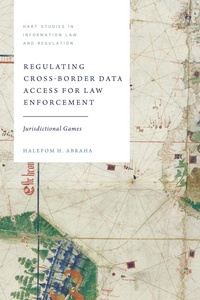
Regulating Cross-Border Data Access for Law Enforcement
Jurisdictional Games
Will be published approx. on 20. August 2026
Book
Hardback
248 pages
978-1-5099-7327-9 (ISBN)
Description
This book explores the legal, political, and practical challenges that governments face when investigating local crimes involving digital evidence held by global cloud service providers.
Criminal investigations increasingly require access to data held across borders. This gives rise to unique jurisdictional competitions and conflicts of law, as even exclusively domestic criminal investigations necessitate international cooperation when the relevant user data is stored abroad.
Traditional systems of cross-border legal cooperation were designed for the pre-internet era and are ill-suited to address these challenges. This has led to extensive calls for reform and the proliferation of new policy initiatives at national, regional, and international levels.
The book maps these emerging policy responses to cross-border data access problems and examines the extent to which they are fit for purpose. It then provides a framework to reconcile the practical necessities of law enforcement seeking digital evidence stored overseas with the territorial sovereignty of the countries hosting that data, the fundamental rights of individuals whose personal data is being sought, and the interests of technology companies whose cooperation is required.
It is an essential guide to understanding the different rules, safeguards and procedures that govern law enforcement access to data held by multinational technology companies, and key to future policy development and legal reform.
Criminal investigations increasingly require access to data held across borders. This gives rise to unique jurisdictional competitions and conflicts of law, as even exclusively domestic criminal investigations necessitate international cooperation when the relevant user data is stored abroad.
Traditional systems of cross-border legal cooperation were designed for the pre-internet era and are ill-suited to address these challenges. This has led to extensive calls for reform and the proliferation of new policy initiatives at national, regional, and international levels.
The book maps these emerging policy responses to cross-border data access problems and examines the extent to which they are fit for purpose. It then provides a framework to reconcile the practical necessities of law enforcement seeking digital evidence stored overseas with the territorial sovereignty of the countries hosting that data, the fundamental rights of individuals whose personal data is being sought, and the interests of technology companies whose cooperation is required.
It is an essential guide to understanding the different rules, safeguards and procedures that govern law enforcement access to data held by multinational technology companies, and key to future policy development and legal reform.
More details
Series
Language
English
Place of publication
Oxford
United Kingdom
Publishing group
Bloomsbury Publishing PLC
Target group
Professional and scholarly
College/higher education
Product notice
Laminated cover
Dimensions
Height: 234 mm
Width: 156 mm
Thickness: 15 mm
Weight
454 gr
ISBN-13
978-1-5099-7327-9 (9781509973279)
Copyright in bibliographic data and cover images is held by Nielsen Book Services Limited or by the publishers or by their respective licensors: all rights reserved.
Schweitzer Classification
Other editions
Additional editions
E-Book
approx. 08/2026
1st Edition
Hart Publishing
€100.99
Available for download
E-Book
approx. 08/2026
1st Edition
Hart Publishing
€100.99
Available for download
Person
Halefom H Abraha is Assistant Professor Utrecht School of Law, Utrecht University, the Netherlands.
Content
Introduction
1. Cloud Computing
2. The Cross-Border Data Access Problem: A Framework for Analysis
3. Mapping Policy Approaches and Emerging Initiatives
4. The United States' Approach: The CLOUD Act
5. The EU Way: The E-Evidence Package
6. The EU-US Jurisdictional Game and Fight for Norm-Setting
7. The Left-Outs: Lessons for Africa
8. Ways Forward: Advancing a Data-Subject-Centric Framework for Cross-Border Cloud Data Access
Conclusion
1. Cloud Computing
2. The Cross-Border Data Access Problem: A Framework for Analysis
3. Mapping Policy Approaches and Emerging Initiatives
4. The United States' Approach: The CLOUD Act
5. The EU Way: The E-Evidence Package
6. The EU-US Jurisdictional Game and Fight for Norm-Setting
7. The Left-Outs: Lessons for Africa
8. Ways Forward: Advancing a Data-Subject-Centric Framework for Cross-Border Cloud Data Access
Conclusion