

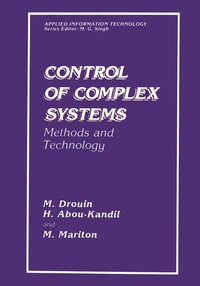
Control of Complex Systems
Methods and Technology
Published on 31. January 1991
Book
Hardback
X, 180 pages
978-0-306-43400-6 (ISBN)
Description
Since the begining of the sixties, control theorists have developed a large body of knowledge concerning complex or large-scale systems theory. Using the state space approach, their purpose was to extend methods to cope with the increasingly sophisticated automation needs of man-made systems. Despite several remarkable contributions, and some successful applications, it can be stated that this theory has not yet become an engineering tool. On the other hand, the emergence of cheap and reliable microprocessors has profoundly transformed industrial instrumentation and control systems. Process control equipment is organized in multilevel distributed structures, closely related to the concepts introduced by complex systems control theory. This similarity should favor a fruitful intersection for practical applications. However, a gap still exists between the literature on control theory and the world of technological achievements. In the many books on complex systems, few have given attention to the technological aspects of a practical control problem. The present book is an attempt to fill this gap. To do this, it consistently reflects the viewpoints that: - Theory and technology are two indivisible facets of the same problem. -On-line implementation for real time applications is the ultimate goal of a control study.
More details
Series
Edition
1991 ed.
Language
English
Place of publication
New York
United States
Publishing group
Springer Science+Business Media
Target group
Professional and scholarly
Research
Illustrations
X, 180 p.
Dimensions
Height: 260 mm
Width: 183 mm
Thickness: 16 mm
Weight
576 gr
ISBN-13
978-0-306-43400-6 (9780306434006)
DOI
10.1007/978-1-4757-9853-1
Schweitzer Classification
Other editions
Additional editions
E-Book
06/2013
Springer
€96.29
Available for download
Book
05/2013
Springer
€106.99
Shipment within 15-20 days
Content
I: Complex Control Systems.- II: Basic Concepts of Discrete-Time Optimal Control Theory.- III: Decomposition-Coordination Methods: A New Approach.- IV: Application of the Direct Decomposition Method.- V: Optimization of the Feedback Loop.- VI: Process Control Systems.- VII: The Impact of Technology on Control Methods.