

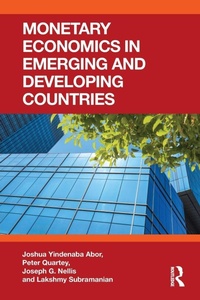
Monetary Economics in Emerging and Developing Countries
1st Edition
Published on 7. November 2024
Book
Paperback/Softback
320 pages
978-1-032-82416-1 (ISBN)
Description
Monetary economics is concerned with the role of money in economic activities. The development of monetary theory and policy plays a significant role in the growth and development of various economies. This has far-reaching implications for various sectors of the economy through several channels, including inflation, employment, interest rates, exchange rates, consumption, government spending, investment, and the level of economic activity. Much of the literature to date has focused on developed economies. This book, however, is an essential guide to the monetary and economic systems of emerging and developing countries.
The book contributes to the role of monetary policy in macroeconomic stabilisation by examining the characteristics and recent developments in emerging and developing countries' monetary and economic systems, including lessons learned in monetary policy and the associated challenges, the role of building blocks of monetary theory, and policy frameworks used in practice, especially looking at why and how these issues are relevant in these economies. It provides theoretical underpinnings and critical issues relating to various aspects of monetary theory, including the role of money, monetary systems, money supply, demand for money, central banking, monetary policy, and the instruments for its implementation in emerging and developing countries. Furthermore, it presents relevant cases, illustrating the intricacies of the monetary systems in these countries.
This invaluable resource elucidates the significant differences between developed and emerging and developing economies. It contributes to the field by providing a comprehensive understanding of monetary economics for students, scholars, researchers, policymakers, and monetary and economic policy practitioners.
The book contributes to the role of monetary policy in macroeconomic stabilisation by examining the characteristics and recent developments in emerging and developing countries' monetary and economic systems, including lessons learned in monetary policy and the associated challenges, the role of building blocks of monetary theory, and policy frameworks used in practice, especially looking at why and how these issues are relevant in these economies. It provides theoretical underpinnings and critical issues relating to various aspects of monetary theory, including the role of money, monetary systems, money supply, demand for money, central banking, monetary policy, and the instruments for its implementation in emerging and developing countries. Furthermore, it presents relevant cases, illustrating the intricacies of the monetary systems in these countries.
This invaluable resource elucidates the significant differences between developed and emerging and developing economies. It contributes to the field by providing a comprehensive understanding of monetary economics for students, scholars, researchers, policymakers, and monetary and economic policy practitioners.
More details
Language
English
Place of publication
London
United Kingdom
Publishing group
Taylor & Francis Ltd
Target group
College/higher education
Postgraduate
Illustrations
29 s/w Abbildungen, 29 s/w Zeichnungen, 14 s/w Tabellen
14 Tables, black and white; 29 Line drawings, black and white; 29 Illustrations, black and white
Dimensions
Height: 234 mm
Width: 156 mm
Thickness: 18 mm
Weight
515 gr
ISBN-13
978-1-032-82416-1 (9781032824161)
Copyright in bibliographic data and cover images is held by Nielsen Book Services Limited or by the publishers or by their respective licensors: all rights reserved.
Schweitzer Classification
Other editions
Additional editions
Joshua Yindenaba Abor | Peter Quartey | Joseph G. Nellis
Monetary Economics in Emerging and Developing Countries
Book
11/2024
1st Edition
Routledge
€198.10
Shipment within 10-20 days
Joshua Yindenaba Abor | Peter Quartey | Joseph G. Nellis
Monetary Economics in Emerging and Developing Countries
E-Book
11/2024
1st Edition
Routledge
€51.49
Available for download
Joshua Yindenaba Abor | Peter Quartey | Joseph G. Nellis
Monetary Economics in Emerging and Developing Countries
E-Book
11/2024
1st Edition
Routledge
€51.49
Available for download
Persons
Joshua Yindenaba Abor is a Financial Economist and Professor of Finance with numerous years of expertise, mainly in development finance and economic research, and is also a member of the Bank of Ghana Monetary Policy Committee.
Peter Quartey is a Professor of Economics with more than two decades of expertise, mainly in development finance, private sector development, monetary and financial sector development with senior-level roles in practitioner, policy, and consulting services.
Joseph G. Nellis is a Professor of Global Economy at the Cranfield School of Management, specialising in macro-economic analysis and policy.
Lakshmy Subramanian is a Lecturer in Financial Economics at the Cranfield School of Management.
Peter Quartey is a Professor of Economics with more than two decades of expertise, mainly in development finance, private sector development, monetary and financial sector development with senior-level roles in practitioner, policy, and consulting services.
Joseph G. Nellis is a Professor of Global Economy at the Cranfield School of Management, specialising in macro-economic analysis and policy.
Lakshmy Subramanian is a Lecturer in Financial Economics at the Cranfield School of Management.
Content
1. Introduction to Monetary Economics in Emerging and Developing Countries 2. Overview of the Financial System 3. The Nature and Role of Money and Payments Systems 4. Money Supply 5. The Demand for Money 6. Monetary Institutions in Emerging and Developing Countries 7. Conduct of Monetary Policy in Developing Countries 8. Monetary Policy and Optimal Fiscal Policy in Emerging and Developing Countries 9. Financial Markets and Monetary Policy 10. Money, Inflation and Growth 11. Exchange Rate Policy 12. Financial Crises, Contagion and Role of Monetary Authority 13. International Financial Systems