

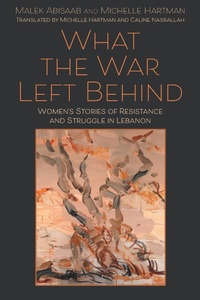
What the War Left Behind
Women's Stories of Resistance and Struggle in Lebanon
Published on 15. May 2024
Book
Paperback/Softback
288 pages
978-0-8156-3838-4 (ISBN)
Description
Conspicuously missing from narratives of the Lebanese Civil War are the stories of women who took part in daily social activism and political organizing during the tumultuous conflict. What the War Left Behind documents their stories, with eight women directly sharing their experiences of action and survival through the hardship of war.
What the War Left Behind brings together oral histories of women from a range of political affiliations, socioeconomic classes, and religious identities. These histories present an alternative image of women during war, highlighting the actions of those who sought to make life better for themselves and their neighbors during conflict. By centering women's voices in the war, Abisaab and Hartman present a new perspective on an oft-discussed historical era, demonstrating the power of resistance during difficult times. These translated texts showcase the active roles women take during wartime and how women's political efforts are an essential part of Lebanese history.
What the War Left Behind brings together oral histories of women from a range of political affiliations, socioeconomic classes, and religious identities. These histories present an alternative image of women during war, highlighting the actions of those who sought to make life better for themselves and their neighbors during conflict. By centering women's voices in the war, Abisaab and Hartman present a new perspective on an oft-discussed historical era, demonstrating the power of resistance during difficult times. These translated texts showcase the active roles women take during wartime and how women's political efforts are an essential part of Lebanese history.
Reviews / Votes
"This book rings with whispered knowing and sings aloud of struggle and striving in stories that did not die, and truths that will not be erased, because they are told here." - Tracey Jean Boisseau, Purdue UniversityMore details
Language
English
Place of publication
New York
United States
Target group
Professional and scholarly
Product notice
Paperback (trade)
Dimensions
Height: 229 mm
Width: 152 mm
Thickness: 16 mm
Weight
443 gr
ISBN-13
978-0-8156-3838-4 (9780815638384)
Copyright in bibliographic data and cover images is held by Nielsen Book Services Limited or by the publishers or by their respective licensors: all rights reserved.
Schweitzer Classification
Persons
Malek Abisaab is associate professor of history at McGill University. He is the author of Militant Women of a Fragile Nation. He coedited Women's War Stories: The Lebanese Civil War, Women's Labor, and the Creative Arts with Michelle Hartman.
Michelle Hartman is professor of Arabic literature at the Institute of Islamic Studies at McGill University. She is the author of Breaking Broken English: Black-Arab Solidarities and the Politics of Language and Native Tongue, Stranger Talk: : The Arabic and French Literary Landscapes of Lebanon, both published by Syracuse University Press.
Michelle Hartman is professor of Arabic literature at the Institute of Islamic Studies at McGill University. She is the author of Breaking Broken English: Black-Arab Solidarities and the Politics of Language and Native Tongue, Stranger Talk: : The Arabic and French Literary Landscapes of Lebanon, both published by Syracuse University Press.
Content
Introduction "What the War Left Behind"
Chapter One: Wadad Halwani "War is the ugliest thing in the world"
Chapter Two: Rima Zaazaa "I can't just go home, shut the door on the world, and forget"
Chapter Three: Arab Loutfi "War is so much more than meets the eye"
Chapter Four: Batul Ali Hashem "Political action can help women reach their full potential"
Chapter Five: Elissar Zein "I can't see someone in need and do nothing"
Chapter Six: Umm ZiadMaliha Adnan "If people let themselves be ruled by fear, they end up doing nothing"
Chapter Seven: Hajjeh Zahra Abdel Latif Sh?ayb "I could never sit still: I was always on the move"
Chapter Eight: Sanaa Ali Ahmad "You do what you have to do"
Reading Guide
Selected Bibliography
Acknowledgments
Appendix
Chapter One: Wadad Halwani "War is the ugliest thing in the world"
Chapter Two: Rima Zaazaa "I can't just go home, shut the door on the world, and forget"
Chapter Three: Arab Loutfi "War is so much more than meets the eye"
Chapter Four: Batul Ali Hashem "Political action can help women reach their full potential"
Chapter Five: Elissar Zein "I can't see someone in need and do nothing"
Chapter Six: Umm ZiadMaliha Adnan "If people let themselves be ruled by fear, they end up doing nothing"
Chapter Seven: Hajjeh Zahra Abdel Latif Sh?ayb "I could never sit still: I was always on the move"
Chapter Eight: Sanaa Ali Ahmad "You do what you have to do"
Reading Guide
Selected Bibliography
Acknowledgments
Appendix