

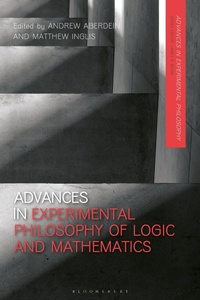
Advances in Experimental Philosophy of Logic and Mathematics
Published on 2. May 2019
Book
Hardback
296 pages
978-1-350-03901-8 (ISBN)
Description
This book explores the results of applying empirical methods to the philosophy of logic and mathematics. Much of the work that has earned experimental philosophy a prominent place in twenty-first century philosophy is concerned with ethics or epistemology. But, as this book shows, empirical methods are just as much at home in logic and the philosophy of mathematics.
Chapters demonstrate and discuss the applicability of a wide range of empirical methods including experiments, surveys, interviews, and data-mining. Distinct themes emerge that reflect recent developments in the field, such as issues concerning the logic of conditionals and the role played by visual elements in some mathematical proofs.
Featuring leading figures from experimental philosophy and the fields of philosophy of logic and mathematics, this collection reveals that empirical work in these disciplines has been quietly thriving for some time and stresses the importance of collaboration between philosophers and researchers in mathematics education and mathematical cognition.
Chapters demonstrate and discuss the applicability of a wide range of empirical methods including experiments, surveys, interviews, and data-mining. Distinct themes emerge that reflect recent developments in the field, such as issues concerning the logic of conditionals and the role played by visual elements in some mathematical proofs.
Featuring leading figures from experimental philosophy and the fields of philosophy of logic and mathematics, this collection reveals that empirical work in these disciplines has been quietly thriving for some time and stresses the importance of collaboration between philosophers and researchers in mathematics education and mathematical cognition.
Reviews / Votes
The essays are uniformly thoughtful, careful, and interesting ... This collection demonstrates that new avenues of approach can point the way to new insights into philosophical concepts, they can help adjudicate between competing theories, and they can show how various subsets of the population make sense of ideas philosophers and mathematicians take for granted. * Philosophia * Imre Lakatos' call for a renaissance of empiricism in the philosophy of mathematics has at last been answered. This volume shows that deep questions in the philosophy of mathematics and logic can be attacked through empirical studies and non-foundational reasoning. Drawing on philosophy, logic, cognitive science and mathematics education, perennial questions are answered, including the roles of aesthetics and visualisation in proofs, and logic in practical reasoning. This landmark collection will undoubtedly be an indispensable resource for future research in this important field. * Paul Ernest, Emeritus Professor of Philosophy of Mathematics Education, Exeter University, UK * How are natural language terms actually used in technical contexts, and how do people interpret them? The answer is often surprising! This book extols the use of empirical studies to challenge implicit assumptions about the practice of philosophers and mathematicians, and the way that these groups talk about their practice. * John Mason, Emeritus Professor of Mathematics Education, The Open University, UK *More details
Series
Language
English
Place of publication
London
United Kingdom
Publishing group
Bloomsbury Publishing PLC
Target group
College/higher education
Dimensions
Height: 240 mm
Width: 161 mm
Thickness: 20 mm
Weight
605 gr
ISBN-13
978-1-350-03901-8 (9781350039018)
Copyright in bibliographic data and cover images is held by Nielsen Book Services Limited or by the publishers or by their respective licensors: all rights reserved.
Schweitzer Classification
Other editions
Additional editions
Andrew Aberdein | Matthew Inglis
Advances in Experimental Philosophy of Logic and Mathematics
E-Book
05/2019
1st Edition
Bloomsbury Academic
€36.49
Available for download
Persons
Andrew Aberdein is Professor of Philosophy at Florida Institute of Technology, USA.
Matthew Inglis is Professor of Mathematical Cognition in the Mathematics Education Centre at Loughborough University, UK.
Matthew Inglis is Professor of Mathematical Cognition in the Mathematics Education Centre at Loughborough University, UK.
Content
1. Introduction, Andrew Aberdein & Matthew Inglis
2. Methodological Triangulation in Empirical Philosophy of Mathematics, Benedikt Loewe & Bart Van Kerkhove
3. Animal Cognition, Species Invariantism and Mathematical Realism, Helen De Cruz
4. The Beauty (?) of Mathematical Proofs, Catarina Dutilh Novaes
5. Can a Picture Prove a Theorem? Using Empirical Methods to Investigate Visual Proofs by Induction, Josephine Relaford-Doyle & Rafael Nunez
6. An Empirical Study on the Admissibility of Graphical Inferences in Mathematical Proofs, Keith Weber & Juan Pablo Mejia-Ramos
7. Does Anyone Really Think That ?f? Is True If And Only If f? Robert Barnard & Joseph Ulatowski
8. New Foundations for Fuzzy Set Theory, Igor Douven
9. What Isn't Obvious About 'Obvious': A Data-Driven Approach to Philosophy of Logic, Moti Mizrahi
10. Philosophy and the Psychology of Conditional Reasoning, David Over & Nicole Cruz
11. Folk Judgments About Conditional Excluded Middle, Michael J. Shaffer & James Beebe
2. Methodological Triangulation in Empirical Philosophy of Mathematics, Benedikt Loewe & Bart Van Kerkhove
3. Animal Cognition, Species Invariantism and Mathematical Realism, Helen De Cruz
4. The Beauty (?) of Mathematical Proofs, Catarina Dutilh Novaes
5. Can a Picture Prove a Theorem? Using Empirical Methods to Investigate Visual Proofs by Induction, Josephine Relaford-Doyle & Rafael Nunez
6. An Empirical Study on the Admissibility of Graphical Inferences in Mathematical Proofs, Keith Weber & Juan Pablo Mejia-Ramos
7. Does Anyone Really Think That ?f? Is True If And Only If f? Robert Barnard & Joseph Ulatowski
8. New Foundations for Fuzzy Set Theory, Igor Douven
9. What Isn't Obvious About 'Obvious': A Data-Driven Approach to Philosophy of Logic, Moti Mizrahi
10. Philosophy and the Psychology of Conditional Reasoning, David Over & Nicole Cruz
11. Folk Judgments About Conditional Excluded Middle, Michael J. Shaffer & James Beebe