

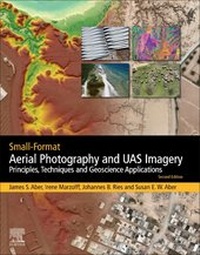
Small-Format Aerial Photography and UAS Imagery
Principles, Techniques and Geoscience Applications
2nd Edition
Published on 17. September 2019
Book
Paperback/Softback
394 pages
978-0-12-812942-5 (ISBN)
Description
Small Format Aerial Photography and UAS Imagery: Principles, Techniques and Geoscience Applications, Second Edition, provides basic and advanced principles and techniques for Small Format Aerial Photography (SFAP), focusing on manned and unmanned aerial systems, including drones, kites, blimps, powered paragliders, and fixed wing and copter SFAP. The authors focus on everything from digital image processing and interpretation of data, to travel and setup for the best result, making this a comprehensive guide for any user. Nine case studies in a variety of environments, including gullies, high altitudes, wetlands and recreational architecture are included to enhance learning.
This new edition includes small unmanned aerial systems (UAS) and discusses changes in legal practices across the globe. In addition, the book presents the history of SFAP, providing background and context for new developments.
This new edition includes small unmanned aerial systems (UAS) and discusses changes in legal practices across the globe. In addition, the book presents the history of SFAP, providing background and context for new developments.
More details
Edition
2nd edition
Language
English
Place of publication
United States
Target group
Professional and scholarly
graduate students, researchers and professionals in the areas of: Natural Resource management, environmental management, ecology, agricultural science, environmental science, energy, urban planning, physical geography, remote sensing, geology, geomorphology
Dimensions
Height: 276 mm
Width: 216 mm
Weight
1090 gr
ISBN-13
978-0-12-812942-5 (9780128129425)
Copyright in bibliographic data and cover images is held by Nielsen Book Services Limited or by the publishers or by their respective licensors: all rights reserved.
Schweitzer Classification
Other editions
Additional editions
James S. Aber | Irene Marzolff | Johannes Ries
Small-Format Aerial Photography and UAS Imagery
Principles, Techniques and Geoscience Applications
E-Book
09/2019
2nd Edition
Elsevier
€113.00
Available for download
Previous edition
James S. Aber | Irene Marzolff | Johannes Ries
Small-Format Aerial Photography
Principles, Techniques and Geoscience Applications
Book
08/2016
Elsevier
€102.50
Shipment within 15-20 days
Persons
Dr. Aber has a PhD in Geology from the University of Kansas. His interests and research experience are wide ranging in geology, tectonics, landscape evolution, wetland environments, remote sensing, aerial photography, and energy resources. He has conducted field investigations across the United States as well as Canada, Scandinavia, Central Europe and Japan. He is a distinguished professor at Emporia State University, Kansas. Dr. Marzoff is a physical geographer and remote sensing/GIS scientist holding a Ph.D. from Freiburg University, Germany. She has been working on high-resolution remote sensing methods for monitoring land degradation and erosion since 1995. She has been involved in designing and building several unmanned platforms for small-format aerial photography and has developed remote-sensing and photogrammetry-based methods for quantifying geomorphological processes in high temporal and spatial resolution. She has collaborated in numerous research projects with colleagues from Belgium, Germany, India, Morocco, Spain and the USA Dr. Ries holds a Ph.D. from Freiburg University, Germany. His research focusses on methodological questions regarding erosion, land degradation and desertification. His main expertise lies in experimental geomorphology, and small-format aerial and terrestrial photography has always been an integral part of his research concepts and projects. He has extensive international research cooperation and during recent years has conducted fieldwork mostly in semi-arid regions of Europe and Africa Dr. Susan W. Aber is the Director of the Science and Math Education Center and Peterson Planetarium at Emporia State University (ESU), Emporia, Kansas USA. She is a geologist, graduate gemologist, map librarian, and university teacher. She taught in the Earth Science Department at ESU and was Federal Depository Map Librarian. She has taught LIS courses via distance education at San Jose State University and North Carolina Central University. Her LIS dissertation focused on the information needs and information-seeking behaviors of geoscience educators in the academic community. Her research interests are in information use and user studies, amber fossil resin, as well as the scientific visualization of information using kite aerial photography.
Content
Part I. History and principles1. Introduction to small-format aerial photography 2. Basic principles of SFAP 3. Photogrammetry4. Lighting and atmospheric conditions5. Photographic composition
Part II. SFAP techniques6. Cameras for SFAP7. Manned and tethered platforms and mounts8. Unmanned aerial systems (UAS - drones) 9. SFAP survey planning and implementation10. Legal issues11. Image interpretation12. Image processing and analysis
Part III. Case studies13. Gully erosion monitoring14. Wetland environments15. Architecture, archaeology, and cemeteries 16. Recreational property17. Vegetation and soils18. Wind energy 19. Vineyards 20. Geomorphology21. Emergence of SFAP
Part II. SFAP techniques6. Cameras for SFAP7. Manned and tethered platforms and mounts8. Unmanned aerial systems (UAS - drones) 9. SFAP survey planning and implementation10. Legal issues11. Image interpretation12. Image processing and analysis
Part III. Case studies13. Gully erosion monitoring14. Wetland environments15. Architecture, archaeology, and cemeteries 16. Recreational property17. Vegetation and soils18. Wind energy 19. Vineyards 20. Geomorphology21. Emergence of SFAP