

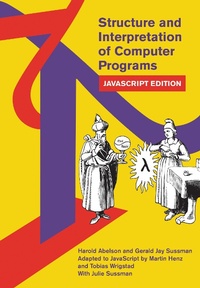
Structure and Interpretation of Computer Programs
Will be published approx. on 12. April 2022
Book
Paperback/Softback
400 pages
978-0-262-54323-1 (ISBN)
Description
A new version of the classic and widely used text adapted for the JavaScript programming language.
Since the publication of its first edition in 1984 and its second edition in 1996, Structure and Interpretation of Computer Programs (SICP) has influenced computer science curricula around the world. Widely adopted as a textbook, the book has its origins in a popular entry-level computer science course taught by Harold Abelson and Gerald Jay Sussman at MIT. SICP introduces the reader to central ideas of computation by establishing a series of mental models for computation. Earlier editions used the programming language Scheme in their program examples. This new version of the second edition has been adapted for JavaScript.
The first three chapters of SICP cover programming concepts that are common to all modern high-level programming languages. Chapters four and five, which used Scheme to formulate language processors for Scheme, required significant revision. Chapter four offers new material, in particular an introduction to the notion of program parsing. The evaluator and compiler in chapter five introduce a subtle stack discipline to support return statements (a prominent feature of statement-oriented languages) without sacrificing tail recursion.
The JavaScript programs included in the book run in any implementation of the language that complies with the ECMAScript 2020 specification, using the JavaScript package sicp provided by the MIT Press website.
Since the publication of its first edition in 1984 and its second edition in 1996, Structure and Interpretation of Computer Programs (SICP) has influenced computer science curricula around the world. Widely adopted as a textbook, the book has its origins in a popular entry-level computer science course taught by Harold Abelson and Gerald Jay Sussman at MIT. SICP introduces the reader to central ideas of computation by establishing a series of mental models for computation. Earlier editions used the programming language Scheme in their program examples. This new version of the second edition has been adapted for JavaScript.
The first three chapters of SICP cover programming concepts that are common to all modern high-level programming languages. Chapters four and five, which used Scheme to formulate language processors for Scheme, required significant revision. Chapter four offers new material, in particular an introduction to the notion of program parsing. The evaluator and compiler in chapter five introduce a subtle stack discipline to support return statements (a prominent feature of statement-oriented languages) without sacrificing tail recursion.
The JavaScript programs included in the book run in any implementation of the language that complies with the ECMAScript 2020 specification, using the JavaScript package sicp provided by the MIT Press website.
More details
Language
English
Place of publication
Cambridge (Massachusetts)
United States
Publishing group
MIT Press Ltd
Dimensions
Height: 258 mm
Width: 181 mm
Thickness: 32 mm
Weight
1091 gr
ISBN-13
978-0-262-54323-1 (9780262543231)
Copyright in bibliographic data and cover images is held by Nielsen Book Services Limited or by the publishers or by their respective licensors: all rights reserved.
Schweitzer Classification
Other editions
Additional editions
Harold Abelson | Gerald Jay Sussman
Structure and Interpretation of Computer Programs
JavaScript Edition
E-Book
05/2022
1st Edition
MIT Press
€73.49
Available for download
Persons
Harold Abelson, Gerald Jay Sussman, and Julie Sussman Adapted for JavaScript by Martin Henz and Tobias Wrigstad
Content
Foreword xiii
Foreword to Structure and Interpretation of Computer Programs, 1984 xvii
Preface xxi
Prefaces to Structure and Interpretation of Computer Programs, 1996 & 1984 xxiii
Acknowledgments xxvii
1 Building Abstractions with Functions 1
2 Building Abstractions with Data 69
3 Modularity, Objects, and State 189
4 Metalinguistic Abstraction 317
5 Computing with Register Machines 449
References 565
Index 571
List of Exercises 607
Foreword to Structure and Interpretation of Computer Programs, 1984 xvii
Preface xxi
Prefaces to Structure and Interpretation of Computer Programs, 1996 & 1984 xxiii
Acknowledgments xxvii
1 Building Abstractions with Functions 1
2 Building Abstractions with Data 69
3 Modularity, Objects, and State 189
4 Metalinguistic Abstraction 317
5 Computing with Register Machines 449
References 565
Index 571
List of Exercises 607