

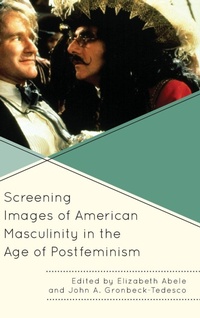
Screening Images of American Masculinity in the Age of Postfeminism
Published on 3. December 2015
Book
Hardback
234 pages
978-1-4985-2582-4 (ISBN)
Description
This collection of essays presents a sampling of film and television texts, interrogating images of U.S. masculinity. Rather than using "postfeminist" as a definition of contemporary feminism, this collection uses the term to designate the period from the late 1980s on-as a point when feminist thought gradually became more mainstream. The movies and TV series examined here have achieved a level of sustained attention, from critical acclaim, to mass appeal, to cult status. Instead of beginning with a set hypothesis on the effect of the feminist movement on images of masculinity on film and television, these chapters represent a range of responses, that demonstrate how the conversations within these texts about American masculinity are often open-ended, allowing both male characters and male viewers a wider range of options.
Defining the relationship between U.S. masculinity and American feminist movements of the twentieth century is a complex undertaking. The essays collected for this volume engage prominent film and television texts that directly interrogate images of U.S. masculinity that have appeared since second-wave feminism. The contributors have chosen textual examples whose protagonists actively struggle with the conflicting messages about masculinity. These protagonists are more often works-in-progress, acknowledging the limits of their negotiations and self-actualization. These chapters also cover a wide range of genres and decades: from action and fantasy to dramas and romantic comedy, from the late 1970s to today.
Taken together, the chapters of Screening Images of American Masculinity in the Age of Postfeminism interrogate "the possible" screened in popular movies and television series, confronting the multiple and competing visions of masculinity not after or beyond feminism but, rather, in its very wake.
Defining the relationship between U.S. masculinity and American feminist movements of the twentieth century is a complex undertaking. The essays collected for this volume engage prominent film and television texts that directly interrogate images of U.S. masculinity that have appeared since second-wave feminism. The contributors have chosen textual examples whose protagonists actively struggle with the conflicting messages about masculinity. These protagonists are more often works-in-progress, acknowledging the limits of their negotiations and self-actualization. These chapters also cover a wide range of genres and decades: from action and fantasy to dramas and romantic comedy, from the late 1970s to today.
Taken together, the chapters of Screening Images of American Masculinity in the Age of Postfeminism interrogate "the possible" screened in popular movies and television series, confronting the multiple and competing visions of masculinity not after or beyond feminism but, rather, in its very wake.
Reviews / Votes
The blurring of the line between television and motion pictures is one of the paradigmatic shifts in popular culture in the 21st century. Viewers use numerous devices to access programming and often care little about the origins of the material. This reality serves Screening Images of American Masculinity in the Age of Postfeminism well, as Abele (English, SUNY Nassau Community College) and Gronbeck-Tedesco (American studies, Rampapo College of New Jersey) demonstrate how postfeminism, along with queer studies and masculinity studies, have used popular culture to critique media and society. The 12 essays...in this volume treat Robin Williams and Will Smith, the Bourne films, The Avengers, The Wrestler, and Kick-Ass and the television shows Firefly, Fraiser, Nip/Tuck, Boston Legal, Mad Men, Dexter, Miami Vice, and Breaking Bad. Perhaps due to television's extended period of character development, the essays on that medium are particularly strong in illustrating the complicated constructs of masculinity in contemporary US culture. The editors provide an adequate discussion of the theoretical messiness of the term "postfeminism." These essays allow the reader to grasp how 21st-century depictions of masculinity can be both misogynistic and protofeminist, heteronormative and bro-romantic, reactionary and sensitive-often at the same time. Summing Up: Highly recommended. Upper-division undergraduates through faculty and professionals. * CHOICE *More details
Language
English
Place of publication
United States
Publishing group
Bloomsbury Publishing Plc
Target group
Professional and scholarly
Product notice
sewn/stitched
Cloth over boards
With dust jacket
Illustrations
14 BW Illustrations
Dimensions
Height: 235 mm
Width: 157 mm
Thickness: 18 mm
Weight
537 gr
ISBN-13
978-1-4985-2582-4 (9781498525824)
Copyright in bibliographic data and cover images is held by Nielsen Book Services Limited or by the publishers or by their respective licensors: all rights reserved.
Schweitzer Classification
Other editions
Additional editions
E-Book
12/2015
1st Edition
Lexington Books
€47.99
Available for download
Person
Elizabeth Abele is associate professor of English at SUNY Nassau Community College.
John A. Gronbeck-Tedesco is assistant professor and convener of American studies at Ramapo College of New Jersey.
John A. Gronbeck-Tedesco is assistant professor and convener of American studies at Ramapo College of New Jersey.
Content
Screening Images of American Masculinity in the Age of Postfeminism
List of Illustrations
Introduction: Liberating American Masculinity
Elizabeth Abele
Recovering Masculinities
1: Fashioning Flexibility: Racial Neoliberalism and the Vicissitudes of Masculinity
Michael Litwack
2: "Any closer and you'd be Mom": The Limits of Post-Feminist Paternity in the Films of Robin Williams
Katie Barnett
3: Rethinking the Nation and the Body Politic: The Wrestler and the Demise of American Exceptionalism
John A. Gronbeck-Tedesco
4: The Bourne Refusal: Changing the Rules of the Game
Mary T. Hartson
Masculinities for Men and Women
5: Subverting the Master's Hero: Firefly's Malcolm Reynolds as a New Kind of Space Cowboy
Laura L. Beadling
6: When Eleven Year-Olds Kick-Ass: Hit-Girl as Role Model or Victim?
Keith Friedlander
Negotiated Masculinities
7: "I'm listening": Analyzing the Masculine Example of Frasier Crane
Dustin Gann
8: Hanging With the Boys: Homosocial Bonding and Bromance Coupling in Nip/Tuck and Boston Legal
Pamela Hill Nettleton
9: Some Assembly Required: Joss Whedon's Bridging of Masculinities in Marvel Films' The Avengers
Derek S. McGrath
Loving Anti-Heroes
10: The Agency of Nostalgia in Mad Men
Maureen McKnight
11: "Out Like a Man": Straddling the Postfeminist Fence in Dexter and Breaking Bad
Brenda Boudreau
12: Last Men Standing: Will Smith as the Obsolete Patriarchal Male
Elizabeth Abele
List of Illustrations
Introduction: Liberating American Masculinity
Elizabeth Abele
Recovering Masculinities
1: Fashioning Flexibility: Racial Neoliberalism and the Vicissitudes of Masculinity
Michael Litwack
2: "Any closer and you'd be Mom": The Limits of Post-Feminist Paternity in the Films of Robin Williams
Katie Barnett
3: Rethinking the Nation and the Body Politic: The Wrestler and the Demise of American Exceptionalism
John A. Gronbeck-Tedesco
4: The Bourne Refusal: Changing the Rules of the Game
Mary T. Hartson
Masculinities for Men and Women
5: Subverting the Master's Hero: Firefly's Malcolm Reynolds as a New Kind of Space Cowboy
Laura L. Beadling
6: When Eleven Year-Olds Kick-Ass: Hit-Girl as Role Model or Victim?
Keith Friedlander
Negotiated Masculinities
7: "I'm listening": Analyzing the Masculine Example of Frasier Crane
Dustin Gann
8: Hanging With the Boys: Homosocial Bonding and Bromance Coupling in Nip/Tuck and Boston Legal
Pamela Hill Nettleton
9: Some Assembly Required: Joss Whedon's Bridging of Masculinities in Marvel Films' The Avengers
Derek S. McGrath
Loving Anti-Heroes
10: The Agency of Nostalgia in Mad Men
Maureen McKnight
11: "Out Like a Man": Straddling the Postfeminist Fence in Dexter and Breaking Bad
Brenda Boudreau
12: Last Men Standing: Will Smith as the Obsolete Patriarchal Male
Elizabeth Abele