

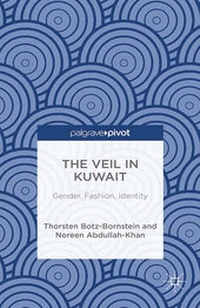
The Veil in Kuwait
Gender, Fashion, Identity
Published on 26. August 2014
Book
Paperback/Softback
X, 89 pages
978-1-349-50396-4 (ISBN)
Description
The Veil in Kuwait explores the complex reasons behind why women veil and how they are perceived by those that do not veil. Religion, culture, family, tradition, and fashion are all explored to provide insight into this fascinating phenomenon that has received global interest.
More details
Edition
1st ed. 2014
Language
English
Place of publication
New York
United States
Publishing group
Palgrave Macmillan
Target group
Professional and scholarly
Illustrations
X, 89 p.
Dimensions
Height: 21.6 cm
Width: 14 cm
Weight
143 gr
ISBN-13
978-1-349-50396-4 (9781349503964)
Schweitzer Classification
Other editions
Additional editions
E-Book
08/2014
1st Edition
Palgrave Pivot
€53.49
Available for download
Book
08/2014
Palgrave Pivot
€53.49
Shipment within 10-20 days
Persons
Author Thorsten Botz-Bornstein: Thorsten Botz-Bornstein is Associate Professor of Philosophy at the Gulf University of Science and Technology, Kuwait. Author Noreen Abdullah-Khan: Noreen Abdullah-Khan is Assistant Dean of the College of Arts and Sciences, Gulf University of Science and Technology, Kuwait.
Content
PART I: INTRODUCTION 1.1. Significance of the Study 1.2. Previous Research 1.3. Kuwaiti Society 1.4. Gulf University for Science and Technology 1.5. Methodology PART II: THE SURVEY 2.1. Survey Measures 2.2. Family Background 2.3. Limitations 2.3.1. General Context and Difficulties of the Survey 2.3.2. The 'East-West' Problem 2.4. Preliminary Conclusion PART III: RESULTS AND DISCUSSIONS 3.1. The Central Question: Why do you Veil? 3.1.1. First Findings: Answers of 'Covered Girls' 3.1.2. Second Findings: Answers of 'Uncovered Girls' 3.1.3. Third Findings: Answers of 'Male Students' 3.2. The 'Protect Women from Men' Argument 3.3. The Feminist Argument 3.4. Preliminary Conclusion 3.5. Religion as a Factor 3.5.1. Praying Attitudes 3.5.2. Knowledge of the Scriptures 3.5.3. The Qur'anic Passages 3.6. Social Interactions and Mutual Perceptions 3.6.1. Culture and Religion 3.6.2. Perception and Self-Perception 3.6.3. Respect and Virtue 3.6.4. Different Perceptions of 'Male Attention' 3.6.5. Combining the Hijab with Western Clothes and 'Veiling Fashion' 3.6.6. Does the Hijab Enhance the Woman's Beauty? 3.6.7. Preliminary Conclusion: Unequal Perceptions and the Question of Tolerance PART IV: THE GUILT/SHAME PARADIGM 4.1. Modesty and Fitna 4.2. Shame and Guilt in Islamic Culture 5. Conclusion 5.1. The Paradox of Veiling Fashion 5.2. Overall Evaluation of Responses Bibliography Appendix: The Questionnaires