

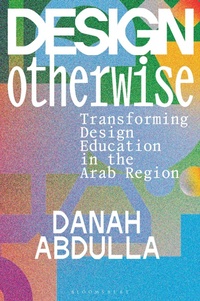
Design Otherwise
Transforming Design Education in the Arab Region
Published on 23. January 2025
Book
Paperback/Softback
208 pages
978-1-350-29577-3 (ISBN)
Description
How can we study and teach design in a way that is critical, socially engaged and relevant to place? In this timely book, Danah Abdulla challenges us to imagine a design education and culture that moves beyond blindly borrowing Eurocentric models and frameworks. Drawing on learnings from work with design students, educators and designers in the Arab region, with a particular focus on Jordan and featuring examples from Lebanon, Egypt and the United Arab Emirates, Abdulla creates a dialogue with those who have most at stake in education to imagine how we can develop a collaborative, contextually based and socially relevant design education.
By first contextualising higher education and design education in the region, and examining the issues and challenges that are pertinent to the development of curricula and pedagogy, such as power, bureaucracy, language and access, Abdulla considers the purpose and relevance of design education in contemporary postcolonial societies. She explores how regional identities and class divisions shape the development of design cultures, as well as different perceptions of design and its value. Abdulla highlights design's role in society and the models of curricula and pedagogy appropriate for developing contextually situated design education. Outlining skills and strategies for equipping future designers, she proposes new possibilities for forms of practice and an actionable framework for developing design education.
By first contextualising higher education and design education in the region, and examining the issues and challenges that are pertinent to the development of curricula and pedagogy, such as power, bureaucracy, language and access, Abdulla considers the purpose and relevance of design education in contemporary postcolonial societies. She explores how regional identities and class divisions shape the development of design cultures, as well as different perceptions of design and its value. Abdulla highlights design's role in society and the models of curricula and pedagogy appropriate for developing contextually situated design education. Outlining skills and strategies for equipping future designers, she proposes new possibilities for forms of practice and an actionable framework for developing design education.
More details
Language
English
Place of publication
London
United Kingdom
Publishing group
Bloomsbury Publishing PLC
Target group
College/higher education
Professional and scholarly
Illustrations
25 bw illus
Dimensions
Height: 227 mm
Width: 156 mm
Thickness: 15 mm
Weight
467 gr
ISBN-13
978-1-350-29577-3 (9781350295773)
Copyright in bibliographic data and cover images is held by Nielsen Book Services Limited or by the publishers or by their respective licensors: all rights reserved.
Schweitzer Classification
Person
Danah Abdulla is a designer, educator and researcher interested in new narratives and practices in design that push the disciplinary boundaries and definitions of the subject. She is a Reader in Anti/Post/Decolonial Histories, Theories, Praxes at the Decolonising the Arts Institute at the University of the Arts London. Danah is the author of Designerly Ways of Knowing: A Working Inventory of Things a Designer Should Know (Onomatopee, 2022), a founding member of the Decolonising Design platform, and founded Kalimat Magazine (2010-2016), an independent, non-profit publication about Arab thought and culture www.dabdulla.com.
Content
Introduction
1. Design Education
2. Power and Bureaucracy
3. Regional & Local Design Cultures
4. Critical [Design] Pedagogy
5. Shifting Perceptions on Design
6. Towards Design Otherwise: An Actionable Roadmap
References
Index
1. Design Education
2. Power and Bureaucracy
3. Regional & Local Design Cultures
4. Critical [Design] Pedagogy
5. Shifting Perceptions on Design
6. Towards Design Otherwise: An Actionable Roadmap
References
Index