

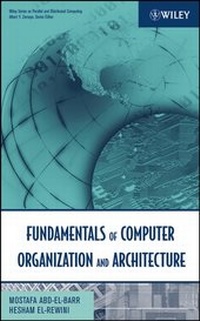
Fundamentals of Computer Organization and Architecture
Published on 7. January 2005
Book
Hardback
288 pages
978-0-471-46741-0 (ISBN)
Description
This is the first book in the two-volume set offering comprehensive coverage of the field of computer organization and architecture. This book provides complete coverage of the subjects pertaining to introductory courses in computer organization and architecture, including:
* Instruction set architecture and design
* Assembly language programming
* Computer arithmetic
* Processing unit design
* Memory system design
* Input-output design and organization
* Pipelining design techniques
* Reduced Instruction Set Computers (RISCs)
The authors, who share over 15 years of undergraduate and graduate level instruction in computer architecture, provide real world applications, examples of machines, case studies and practical experiences in each chapter.
Reviews / Votes
"The book takes its value from being very well organized, concise, and clear." (CHOICE, July 2005) "In addition to being an excellent tool for students, this is a thorough and dependable reference for engineers and programmers." (International Journal of General Systems, June 2005)"...a textbook that is useful as an introduction to computer organization fundamentals..." (Computing Reviews.com, March 10, 2005)
More details
Product info
gebunden
Series
Edition
1. Auflage
Language
English
Place of publication
United States
Publishing group
John Wiley & Sons Inc
Target group
Professional and scholarly
Product notice
sewn/stitched
Cloth over boards
Illustrations
Drawings: 100 B&W, 0 Color
Dimensions
Height: 240 mm
Width: 161 mm
Thickness: 20 mm
Weight
607 gr
ISBN-13
978-0-471-46741-0 (9780471467410)
Schweitzer Classification
Other editions
Additional editions
Mostafa Abd-El-Barr | Hesham El-Rewini
Fundamentals of Computer Organization and Architecture
E-Book
02/2005
Wiley
€147.99
Available for download
Persons
MOSTAFA ABD-EL-BARR, PhD, is currently a professor and chairman of the Department of Information Science at Kuwait University. He has co-authored two other books, published more than 120 papers, and served as chair for a number of international conferences and symposia.
HESHAM EL-REWINI, PhD, PE, is a full professor and chairman of the Department of Computer Sciences and Engineering at Southern Methodist University (SMU). He has co-authored several books, published numerous research papers in journals and conference proceedings, and chaired many international conferences.
Content
Preface.
1. Introduction to Computer Systems.
1.1. Historical Background.
1.2. Architectural Development & Styles.
1.3. Technological Development.
1.4. Performance Measures.
1.5. Summary.
Exercises.
References and Further Reading.
2. Instruction Set Architecture & Design.
2.1. Memory Locations and Operations.
2.2. Addressing Modes.
2.3. Instruction Types.
2.4. Programming Examples.
2.5. Summary.
Exercises.
References and Further Reading.
3. Assembly Language Programming.
3.1. A Simple Machine.
3.2. Instructions Mnemonics and Syntax.
3.3. Assembler Directives and Commands.
3.4. Assembly and Execution of Programs.
3.5. Example: The X 86 Family.
3.6. Summary.
Exercises.
References and Further Reading.
4. Computer Arithmetic.
4.1. Number Systems.
4.2. Integer Arithmetic.
4.3. Floating Point Arithmetic.
4.4. Summary.
Exercises.
References and Further Readings.
5. Processing Unit Design.
5.1. CPU Basics.
5.2. Register Set.
5.3. Data Path.
5.4. The CPU Instruction Cycle.
5.5. Control Unit.
5.6. Summary.
Exercises.
References.
6. Memory System Design I.
6.1. Basic Concepts.
6.2. Cache Memory.
6.3. Summary.
Exercises.
References and Further Readings.
7. Memory System Design II.
7.1. Main Memory.
7.2. Virtual Memory.
7.3. Read-Only Memory.
7.4. Summary.
Exercises.
References and Further Readings.
8. Input-Output Design and Organization.
8.1. Basic Concepts.
8.2. Programmed I/O.
8.3. Interrupt-Driven I/O.
8.4. Direct Memory Access (DMA).
8.5. Busses.
8.6. Input-Output Interfaces.
8.7. Summary.
Exercises.
References and Further Readings.
9. Pipelining Design Techniques.
9.1. General Concepts.
9.2. Instruction Pipeline.
9.3. Arithmetic pipeline.
9.4. Summary.
Exercises.
References and Further Reading.
10. Reduced Instruction Set Computers (RISCs).
10.1. RISC/CISC Evolution Cycle.
10.2. RISCs Design Principles.
10.3. Overlapped Register Windows.
10.4. RISCs Versus CISCs.
10.5. Pioneer (University) RISC Machines.
10.6. Example of Advanced RISC Machines.
10.7. Summary.
Exercises.
References and Further Readings.
11. Introduction to Multiprocessors.
11.1. Introduction.
11.2. Classification of Computer Architectures.
11.3. SIMD Schemes.
11.4. MIMD Schemes.
11.5. Interconnection Networks.
11.6. Analysis and Performance Metrics.
11. 7. Summary.
Exercises.
References and Further Readings.
Index.