

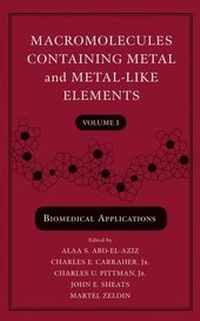
Macromolecules Containing Metal and Metal-Like Elements
Volume 3: Biomedical Applications
1st Edition
Published on 1. June 2004
Book
Hardback
218 pages
978-0-471-66737-7 (ISBN)
Description
Metal and metalloid-containing compounds exhibit a wide range of biological and biocidal activities, some of which have been employed in medicines and drugs. Polymers containing metal or metalloid functions become a natural extension of this effort; just as organic compound drugs have been chemically bound to polymers or physically imbibed into polymer matrices in order to provide a variety of useful advantages, the same opportunities exist for using metal and metalloid species. This volume will cover important biomedical applications of organometallic compounds, including metal-labeled DNA on surfaces, artificial metallo-DNA, organotin molecules as anti-cancer drugs, and much more.
* Provides useful descriptions of biomedical applications for the reader to apply in his/her research into materials, polymers, and medicine/drug development.
* Edited by high-quality team of macromolecular experts from around the world
Reviews / Votes
"This volume will make its creators fell well-deserved pride." (Journal of Metals Online, July 21, 2005) "...provides a nice overview of the field..." (Polymer News, June 2005) "...a good representative treatment of current biological and medicinal applications of organometallic polymers." (Journal of the American Chemical Society, March 31, 2005)More details
Other editions
Additional editions
Alaa S. Abd-El-Aziz | Charles E. Carraher | Charles U. Pittman
Macromolecules Containing Metal and Metal-Like Elements, Volume 3
Biomedical Applications
E-Book
08/2004
Wiley
€147.99
Available for download
Persons
Dr. Alaa Abd-El-Aziz is Professor of Chemistry and the Associate Vice-President of Research & Graduate Studies at the University of Winnipeg.
Dr. Charles Carraher is Professor of Chemistry at Florida Atlantic University and Associate Director of the Florida Center for Environmental Studies.
Dr. Charles Pittman has a B.S. in Chemical Engineering from Lafayette College and a Ph.D. in Organic Chemistry from Pennsylvania State University. He completed postdoctoral studies with G. A. Olah, and served on active duty at the U.S. Army University of Alabama. He was appointed Full Professor in 1975 and University Research Professor in 1977. Dr. Pittman came to Mississippi State in 1983 as Professor of Industrial Chemistry and Catalysis. He is also Research Director of the University/Industry Chemical Research Center.
Martin Zeldin is a Visiting Professor of Chemistry at the Hobart and William Smith Colleges. He received his Ph.D. in inorganic chemistry in 1968 from Pennsylvania State University.
John Sheats is the Chairperson of the Department of Chemistry and a Professor of Chemistry at Rider University.
Content
Preface
Series Preface
1. Organometallic Compounds in Biomedical Applications (Charles E. Carraher Jr. and Charles U. Pittman Jr.)
I. Introduction
II. Case for Metal-Containing Bioactive Agents
A. Tin-Containing Biocidal Polymers
B. Ferrocene: A Therapeutic Role in Polymeric Systems?
C. Polymeric Moderation of OsO4 Toxicity
III. Miscellaneous Polymers
A. Metal Chelation Polymers
B. Condensation Polymers
IV. Small-Molecule Analogs
V. Summary
VI. References
2. Metal-Labeled DNA on Surfaces (Heinz-Bernhard Kraatz, Yitao Long, and Todd C. Sutherland)
I. Introduction
II. Ferrocene Nucleotides
III. Ferrocene-DNA Conjugates
IV. Other Metal-DNA Conjugates
V. Metallated DNA
A. Cu-DNA
B. M-DNA
VI. Summary
VII. Acknowledgments
VIII. References
3. Artificial DNA through Metal-Mediated Base Pairing: Structural Control and Discrete Metal Assembly (Mitsuhiko Shionoya)
I. Introduction
II. Alternative Hydrogen-Bonding Schemes for DNA Base Pairing
III. Non-Hydrogen-Bonding Basepairs in DNA
IV. Metal-Mediated Base Pairing in DNA
A. Basic Concept
B. Artificial Nucleosides Designed for Metal-Mediated Base Pairs
C. Incorporation of a Metallo-Base Pair in DNA and Its Effect on Thermal Stability
D. Discrete Self-Assembled Metal Arrays in DNA
V. Future Prospects for Artificial Metallo-DNA
VI. Summary
VII. References
4. Organotin Macromolecules as Anticancer Drugs (Charles E. Carraher Jr. and Deborah Siegmann-Louda)
I. General
II. Anticancer Activity of Small Organotin Compounds
III. Molecule-Level Studies on Monomeric Organotin Compounds
IV. Anticancer Activity of Organotin Polymers
V. Future Work
VI. References
5. Organotin Oligomeric Drugs Containing the Antivirial Agent Acyclovir (Charles E. Carraher Jr. and Robert E. Bleicher)
I. Early History of Organotin Compounds
II. Mechanisms and Reactions
III. General Structures
IV. Acyclovir
V. Bioactivity of Related Compounds
VI. Experimental Work
VII. Results and Discussion
VIII. References
6. Polymeric Ferrocene Conjugates as Antiproliferative Agents (Eberhard W. Neuse)
I. Introduction
II. The Ferrocene-Ferricenium System in the Biological Environment
III. Polymer-Drug Conjugation as a Pharmaceutical Tool for Drug Delivery
IV. Polymer-Ferrocene Conjugates: Synthesis and Structure
A. The Carrier Component: Structural Considerations
B. Conjugates of Amide-Linked Ferrocene
C. Conjugates of Ester-Linked Ferrocene
V. Bioactivity Screening
VI. Summary and Conclusions
VII. Acknowledgments
VIII.References
7. Polymeric Platinum-Containing Drugs in the Treatment of Cancer (Deborah W. Siegmann-Louda and Charles E. Carraher Jr)
I. Introduction
II. Basic Mechanisms of Pt(II) Complex Formation
III. Nomenclature
IV. Currently Approved Platinum-Containing Compounds
V. Properties of Cisplatin
VI. Structure-Activity Relationships
VII. Polymer-Drug Conjugation Strategy and Possible Benefits
A. Polymers as Carriers
B. Polymers as Drugs
C. General
VIII. Mainchain-Incorporated cis-Diamine-Coordinated Platinum
A. Simple Amine Derivatives
B. Amino Acid Derivatives
C. Other Nitrogen-Platinum Products
D. Solution Stability
E. Thermal Stability
F. Antiviral Activity
IX. Platinum Carrier-Bound Complexes via Nitrogen Donor Ligands
A. Pt-Polyphosphazenes
B. Slowly Biofissionable PtN Complexes Anchored through Primary and Secondary Amines
C. Biofissionable PtN Complexes Anchored through Primary and Secondary Amines
X. Pt-O-Bound Polymers
XI. Mixed Pt-O/Pt-N-Bound Polymers
XII. Future Work
XIII. Acknowledgments
XIV. References
8. New Organic Polyacid-Inorganic Compounds for Improved Dental Materials (Bill M. Culbertson, Minhhoa H. Dotrong, and Scott R. Schricker)
I. Introduction
II. Glass Ionomer Technology
A. Amino Acid-Modified Glass Ionomers
B. N-Vinylpyrrolidone (NVP)-Modified Glass Ionomers
III. New NVP-Modified Glass Ionomers: Experimental Work
A. Materials
B. Polymer Synthesis
C. Characterization
D. Physical Properties
IV. Results and Discussion
V. Conclusions
VI. References
Index.