

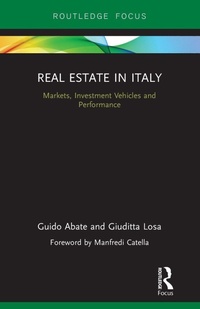
Real Estate in Italy
Markets, Investment Vehicles and Performance
1st Edition
Published on 14. October 2024
Book
Paperback/Softback
94 pages
978-1-032-93124-1 (ISBN)
Description
This in-depth case study evaluates the recent evolution of the Italian real estate market, which has lately been subject to two interlocking phenomena: a serious devaluation of physical assets and, at the same time, a deep legislative innovation of the vehicles investing in this asset class.
The novelty of the legal framework of some of the Italian real estate investment vehicles and the recent developments in the market make this detailed analysis a fascinating addition to the literature.
The book starts with an analysis of the Italian real estate sector, covering the evolution and performance in light of the economic crisis and the most recent legislative innovations. Italian real estate investment vehicles are then compared with a broader European perspective. Each Italian investment vehicle (real estate investment funds, real estate fixed capital investment companies and real estate investment trusts) is then analysed in both legal and financial details, providing insights into management structure, the rights and powers of investors, the typical investment process and the related costs. The different management models are then compared in order to assess their advantages and disadvantages, especially for institutional investors. The performance measurement of Italian closed-end alternative investment funds and the phenomenon of discount to net asset value for listed real estate investment funds are then subject to a theoretical and empirical examination.
The novelty of the legal framework of some of the Italian real estate investment vehicles and the recent developments in the market make this detailed analysis a fascinating addition to the literature.
The book starts with an analysis of the Italian real estate sector, covering the evolution and performance in light of the economic crisis and the most recent legislative innovations. Italian real estate investment vehicles are then compared with a broader European perspective. Each Italian investment vehicle (real estate investment funds, real estate fixed capital investment companies and real estate investment trusts) is then analysed in both legal and financial details, providing insights into management structure, the rights and powers of investors, the typical investment process and the related costs. The different management models are then compared in order to assess their advantages and disadvantages, especially for institutional investors. The performance measurement of Italian closed-end alternative investment funds and the phenomenon of discount to net asset value for listed real estate investment funds are then subject to a theoretical and empirical examination.
More details
Series
Language
English
Place of publication
London
United Kingdom
Publishing group
Taylor & Francis Ltd
Target group
College/higher education
Professional and scholarly
Academic and Postgraduate
Product notice
Paperback (trade)
Dimensions
Height: 216 mm
Width: 140 mm
Thickness: 5 mm
Weight
122 gr
ISBN-13
978-1-032-93124-1 (9781032931241)
Copyright in bibliographic data and cover images is held by Nielsen Book Services Limited or by the publishers or by their respective licensors: all rights reserved.
Schweitzer Classification
Other editions
Additional editions

E-Book
11/2016
Routledge
€25.99
Available for download

E-Book
11/2016
Routledge
€25.99
Available for download

Book
11/2016
1st Edition
Routledge
€92.30
Shipment within 10-20 days
Persons
Guido Abate is Assistant Professor of Financial Markets and Institutions in the Department of Economics and Management at the University of Brescia, Italy. He holds an M.Sc. in finance from Bocconi University, Italy, and a Ph.D. in financial markets and institutions from the University of Bologna, Italy. He is the author of several international publications and his main fields of research are alternative asset classes, indexed investments and behavioural finance.
Giuditta Losa, MRICS, holds a B.Sc. in business administration, an M.Sc. in architecture and another Master's degree in real estate management. She has gained 20 years of experience in real estate as an asset manager in a public company, a fund advisor in the global firm CBRE and as Head of Real Estate Italy in a bank controlled by Commerzbank AG. She is currently Manager of Operations & Corporate Affairs in COIMA SGR.
Giuditta Losa, MRICS, holds a B.Sc. in business administration, an M.Sc. in architecture and another Master's degree in real estate management. She has gained 20 years of experience in real estate as an asset manager in a public company, a fund advisor in the global firm CBRE and as Head of Real Estate Italy in a bank controlled by Commerzbank AG. She is currently Manager of Operations & Corporate Affairs in COIMA SGR.
Content
1. Real estate market in Italy
1.1 The role of Italian real estate market
1.2 Property real estate
1.3 Financial real estate
2. Italian financial real estate in European perspective
2.1 European Real estate AIFs
2.2 European REITs
2.3 Italian real estate investment companies and the AIFMD
3. Real estate investment funds
3.1 Regulatory framework
3.2 Asset allocation and leverage
3.3 Main revenues, costs and fees
3.4 Taxation
4. Real estate fixed capital investment companies (SICAFs)
4.1 Regulatory framework
4.2 Asset allocation and leverage
4.3 Main revenues, costs and fees
4.4 Taxation
5. Real estate investment trusts (SIIQs)
5.1 Regulatory framework
5.2 Asset allocation and leverage
5.3 Main revenues and costs
5.4 Taxation
6. Italian AIFs and SIIQs: comparative analysis
6.1 Real estate funds vs. SICAFs
6.2 Listed real estate AIFs vs. SIIQs
7. Performance of Italian closed-end AIFs
7.1 Issues in performance measurement
7.2 Discount to NAV
7.3 Empirical evidences
1.1 The role of Italian real estate market
1.2 Property real estate
1.3 Financial real estate
2. Italian financial real estate in European perspective
2.1 European Real estate AIFs
2.2 European REITs
2.3 Italian real estate investment companies and the AIFMD
3. Real estate investment funds
3.1 Regulatory framework
3.2 Asset allocation and leverage
3.3 Main revenues, costs and fees
3.4 Taxation
4. Real estate fixed capital investment companies (SICAFs)
4.1 Regulatory framework
4.2 Asset allocation and leverage
4.3 Main revenues, costs and fees
4.4 Taxation
5. Real estate investment trusts (SIIQs)
5.1 Regulatory framework
5.2 Asset allocation and leverage
5.3 Main revenues and costs
5.4 Taxation
6. Italian AIFs and SIIQs: comparative analysis
6.1 Real estate funds vs. SICAFs
6.2 Listed real estate AIFs vs. SIIQs
7. Performance of Italian closed-end AIFs
7.1 Issues in performance measurement
7.2 Discount to NAV
7.3 Empirical evidences