

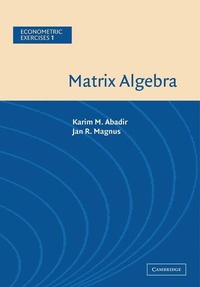
Matrix Algebra
Published on 22. August 2005
Book
Paperback/Softback
466 pages
978-0-521-53746-9 (ISBN)
Description
Matrix Algebra is the first volume of the Econometric Exercises Series. It contains exercises relating to course material in matrix algebra that students are expected to know while enrolled in an (advanced) undergraduate or a postgraduate course in econometrics or statistics. The book contains a comprehensive collection of exercises, all with full answers. But the book is not just a collection of exercises; in fact, it is a textbook, though one that is organized in a completely different manner than the usual textbook. The volume can be used either as a self-contained course in matrix algebra or as a supplementary text.
Reviews / Votes
'These authors have achieved the remarkable feat of writing a textbook of matrix algebra cunningly concealed as a structured sequence of exercises and worked answers. The book should prove popular with students intent on teaching themselves and with instructors who wish to set challenging and educative exercises. Recommended unequivocally to all parties.' Dr Stephen Pollock, Queen Mary College 'Useful as a text or reference, it is clearly written and very thorough. Besides basic topics, excellent treatment of matrix inequalities, vectorization, and matrix calculus. It belongs on every econometricians's bookshelf.' Professor Peter Schmidt, Michigan State University 'Matrix Algebra can be recommended to teachers and graduate students in all fields of mathematics.' Zentralblatt MATHMore details
Series
Language
English
Place of publication
Cambridge
United Kingdom
Target group
College/higher education
Professional and scholarly
Product notice
Paperback (trade)
Illustrations
9 Line drawings, unspecified
Dimensions
Height: 244 mm
Width: 170 mm
Thickness: 26 mm
Weight
798 gr
ISBN-13
978-0-521-53746-9 (9780521537469)
Copyright in bibliographic data and cover images is held by Nielsen Book Services Limited or by the publishers or by their respective licensors: all rights reserved.
Schweitzer Classification
Other editions
Additional editions
Karim M. Abadir | Jan R. Magnus
Matrix Algebra
E-Book
12/2007
1st Edition
Cambridge University Press
€41.49
Available for download
Karim M. Abadir | Jan R. Magnus
Matrix Algebra
Book
08/2005
Cambridge University Press
€102.75
Article exhausted; check for reprint
Previous edition
Karim M. Abadir | Jan R. Magnus
Matrix Algebra
Book
08/2005
Cambridge University Press
€102.75
Article exhausted; check for reprint
Persons
Karim Abadir has held a joint Chair since 1996 in the Department of Mathematics and Economics at the University of York, where he has been the founder and director of various degree programs. He has also taught at the American University in Cairo, the University of Oxford, and the University of Exeter. He became an Extramural Fellow at CentER (Tilburg University) in 1993. Professor Abadir is a holder of two Econometric Theory awards, and has authored many articles in top journals, including the Annals of Statistics, Econometric Theory, Econometrica, and the Journal of Physics. He is Coordinating Editor (and one of the founding editors) of the Econometrics Journal, and Associate Editor of Econometric Reviews, Econometric Theory, Journal of Financial Econometrics, and Portuguese Economic Journal. He is a Fellow of the Royal Statistical Society. Jan Magnus is Professor of Econometrics, CentER and Department of Econometrics and Operations Research, Tilburg University, The Netherlands. He has also taught at the University of Amsterdam, The University of British Columbia, The London School of Economics, The University of Montreal, and The European University Institute among other places. His books include Matrix Differential Calculus (with H. Neudecker), Linear Structures, Methodology and Tacit Knowledge (with M. S. Morgan), and Econometrics: A First Course (in Russian with P. K. Katyshev and A. A. Peresetsky). Professor Magnus has written numerous articles in the leading journals, including Econometrica, The Annals of Statistics, The Journal of the American Statistical Association, Journal of Econometrics, Linear Algebra and Its Applications, and The Review of Income and Wealth. He is a Fellow of the Journal of Econometrics, holder of the Econometric Theory Award, and associate editor of The Journal of Economic Methodology, Computational Statistics and Data Analysis, and the Journal of Multivariate Analysis.
Content
Part I. Vectors: 1. Real vectors; 2 Complex vectors; Part II. Matrices: 3. Real matrices; 4. Complex matrices; Part III. Vector Spaces: 5. Complex and real vector spaces; 6. Inner-product space; 7. Hilbert space; Part IV. Rank, Inverse, and Determinant: 8. Rank; 9. Inverse; 10. Determinant; Part V. Partitioned Matrices: 11. Basic results and multiplication relations; 12. Inverses; 13. Determinants; 14. Rank (in)equalities; 15. The sweep operator; Part VI. Systems of Equations: 16. Elementary matrices; 17. Echelon matrices; 18. Gaussian elimination; 19. Homogeneous equations; 20. Nonhomogeneous equations; Part VII. Eigenvalues, Eigenvectors, and Factorizations: 21. Eigenvalues and eigenvectors; 22. Symmetric matrices; 23. Some results for triangular matrices; 24. Schur's decomposition theorem and its consequences; 25. Jordan's decomposition theorem; 26. Jordan chains and generalized eigenvectors; Part VIII. Positive (Semi)Definite and Idempotent Matrices: 27. Positive (semi)definite matrices; 28. Partitioning and positive (semi)definite matrices; 29. Idempotent matrices; Part IX. Matrix Functions: 30. Simple functions; 31. Jordan representation; 32. Matrix-polynomial representation; Part X. Kronecker Product, Vec-Operator, and Moore-Penrose Inverse: 33. The Kronecker product; 34. The vec-operator; 35. The Moore-Penrose inverse; 36. Linear vector and matrix equations; 37. The generalized inverse; Part XI. Patterned Matrices, Commutation and Duplication Matrix: 38. The commutation matrix; 39. The symmetrizer matrix; 40. The vec-operator and the duplication matrix; 41. Linear structures; Part XII. Matrix Inequalities: 42. Cauchy-Schwarz type inequalities; 43. Positive (semi)definite matrix inequalities; 44. Inequalities derived from the Schur complement; 45. Inequalities concerning eigenvalues; Part XIII. Matrix calculus: 46. Basic properties of differentials; 47. Scalar functions; 48. Vector functions; 49. Matrix functions; 50. The inverse; 51. Exponential and logarithm; 52. The determinant; 53. Jacobians; 54. Sensitivity analysis in regression models; 55. The Hessian matrix; 56. Least squares and best linear unbiased estimation; 57. Maximum likelihood estimation; 58. Inequalities and equalities.