

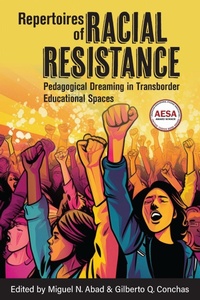
Repertoires of Racial Resistance
Pedagogical Dreaming from the Classroom to the Streets
Will be published approx. on 31. October 2024
Book
Paperback/Softback
300 pages
978-1-9755-0662-9 (ISBN)
Description
Repertories of Resistance: Pedagogical Dreaming from the Classroom to the Streets explores the integral role of dreaming and imagination in pursuing educational justice. The illuminating case studies in this book highlight how youth and adults utilize Transformative Methodologies not only to generate knowledge, but also promote social change.
Transformative Methodologies are approaches to research and knowledge production that explicitly:
center the perspectives, experiences, andexpertise of BIPOC youth and communities as essential to research
challenge conventional social scienceframeworks that relegate communities as "objects" of inquiry, and
facilitate ethnically and racially minoritized young people to leverage their educational opportunities to express theiragency, imagine emancipatory futures, and embody social change.
Chapters in the book demonstrate how researchers, practitioners, and youth utilize methodologies such as participatory action research, testimonials, counter narratives and critical storytelling to make sense of social inequalities and envision futures rooted in justice. This text considers the intimate relationship between youth leadership and empowerment with dreaming and imagination. The book includes case studies based in diverse contexts such as K-12 schools, community-based settings, and higher education. Moreover, the text specifically highlights how BIPOC young people leverage their imaginations as part of their efforts to advocate for justice in their communities, families, and schools. This book emphasizes the importance for researchers and practitioners to leverage youth imagination and freedom dreams in creating culturally sustaining educational settings and promoting transformative youth leadership. This volume will be of interest to graduate, postgraduate students, researchers and academics in fields such as multicultural education, critical pedagogy, youth development and qualitative and participatory methodologies. Pre-service teachers, practitioners, and libraries will also find this book useful.
Perfect for courses such as: Multicultural Education, Foundations of Education, Critical Pedagogy and Education, Youth Development, Out of School Time Education, Research Methodology, Anthropology and Education, Sociology and Education, and Youth Resistance
Transformative Methodologies are approaches to research and knowledge production that explicitly:
center the perspectives, experiences, andexpertise of BIPOC youth and communities as essential to research
challenge conventional social scienceframeworks that relegate communities as "objects" of inquiry, and
facilitate ethnically and racially minoritized young people to leverage their educational opportunities to express theiragency, imagine emancipatory futures, and embody social change.
Chapters in the book demonstrate how researchers, practitioners, and youth utilize methodologies such as participatory action research, testimonials, counter narratives and critical storytelling to make sense of social inequalities and envision futures rooted in justice. This text considers the intimate relationship between youth leadership and empowerment with dreaming and imagination. The book includes case studies based in diverse contexts such as K-12 schools, community-based settings, and higher education. Moreover, the text specifically highlights how BIPOC young people leverage their imaginations as part of their efforts to advocate for justice in their communities, families, and schools. This book emphasizes the importance for researchers and practitioners to leverage youth imagination and freedom dreams in creating culturally sustaining educational settings and promoting transformative youth leadership. This volume will be of interest to graduate, postgraduate students, researchers and academics in fields such as multicultural education, critical pedagogy, youth development and qualitative and participatory methodologies. Pre-service teachers, practitioners, and libraries will also find this book useful.
Perfect for courses such as: Multicultural Education, Foundations of Education, Critical Pedagogy and Education, Youth Development, Out of School Time Education, Research Methodology, Anthropology and Education, Sociology and Education, and Youth Resistance
More details
Series
Language
English
Place of publication
United States
Target group
Professional and scholarly
Product notice
Paperback (trade)
Unsewn / adhesive bound
Dimensions
Height: 226 mm
Width: 152 mm
Thickness: 24 mm
Weight
522 gr
ISBN-13
978-1-9755-0662-9 (9781975506629)
Copyright in bibliographic data and cover images is held by Nielsen Book Services Limited or by the publishers or by their respective licensors: all rights reserved.
Schweitzer Classification
Persons
Miguel N. Abad is an Assistant Professor in the Department of Child and Adolescent Development at San Francisco State University. For over a decade, he has been a youth worker collaborating with community-based and non-profit organizations in the Bay Area in numerous fields such as college access, career development, arts education and social movement organizing. As a youth studies researcher, his scholarly work touches upon race and social justice, out of school time education, youth development, youth activism, and participatory action research. His work has been featured in publications such as Race, Ethnicity and Education: Anthropology and Education Quarterly; and Race and Class.
Gilberto Q. Conchas obtained a Ph.D. and M.A. in Sociology from the University of Michigan, Ann Arbor and a B.A. in Sociology from the University of California, Berkeley. He is currently the Inaugural Wayne K. and Anita Woolfolk Hoy Endowed Chair of Education at the Pennsylvania State University and a Center for the Study of Higher Education (CSHE) research associate. Prior to Penn State, Dr. Conchas was Professor of Educational Policy and Social Context at the University of California, Irvine, Assistant Professor at the Harvard Graduate School of Education, and Senior Program Officer for the Bill & Melinda Gates Foundation. Conchas is an expert on qualitative research methods, with a particular focus on case study methodology. Conchas' research focuses on inequality with an emphasis on communities and schools. A sociologist, widely published scholar, and experienced university administrator, Conchas has designed and led mentoring programs, has a well-honed awareness of the experiences of racially minoritized students and faculty, and draws on these experiences to advocate for pathways to better diversify higher education institutions. Numerous scholarly journals have published his work. He is the author of ten books, including the award winning The Color of Success: Race and High-Achieving Urban Youth; Small Schools and Urban Youth: Using the Power of School Culture to Engage Youth; StreetSmart SchoolSmart: Urban Poverty and the Education of Boys of Color; and Cracks in the Schoolyard-Confronting Latino Educational Inequality, and Race Frames in Education. His current coauthored book, The Chicana/o/x Dream: Hope, Resistance, and Educational Success, was conferred the 2021 Book-of-the-Year Award from the American Association of Hispanics in Higher Education (AAHHE). Conchas was also named the 2022 Sylvia Hurtado University Faculty Award for teaching and research from AAHHE.
Gilberto Q. Conchas obtained a Ph.D. and M.A. in Sociology from the University of Michigan, Ann Arbor and a B.A. in Sociology from the University of California, Berkeley. He is currently the Inaugural Wayne K. and Anita Woolfolk Hoy Endowed Chair of Education at the Pennsylvania State University and a Center for the Study of Higher Education (CSHE) research associate. Prior to Penn State, Dr. Conchas was Professor of Educational Policy and Social Context at the University of California, Irvine, Assistant Professor at the Harvard Graduate School of Education, and Senior Program Officer for the Bill & Melinda Gates Foundation. Conchas is an expert on qualitative research methods, with a particular focus on case study methodology. Conchas' research focuses on inequality with an emphasis on communities and schools. A sociologist, widely published scholar, and experienced university administrator, Conchas has designed and led mentoring programs, has a well-honed awareness of the experiences of racially minoritized students and faculty, and draws on these experiences to advocate for pathways to better diversify higher education institutions. Numerous scholarly journals have published his work. He is the author of ten books, including the award winning The Color of Success: Race and High-Achieving Urban Youth; Small Schools and Urban Youth: Using the Power of School Culture to Engage Youth; StreetSmart SchoolSmart: Urban Poverty and the Education of Boys of Color; and Cracks in the Schoolyard-Confronting Latino Educational Inequality, and Race Frames in Education. His current coauthored book, The Chicana/o/x Dream: Hope, Resistance, and Educational Success, was conferred the 2021 Book-of-the-Year Award from the American Association of Hispanics in Higher Education (AAHHE). Conchas was also named the 2022 Sylvia Hurtado University Faculty Award for teaching and research from AAHHE.
Content
Acknowledgements
Series Foreword
Introduction: Repertoires of Racial Resistance and Pedagogical Dreaming from the Classroom to the Streets - Victor Dealba, Gilberto Q. Conchas, andMiguel N. Abad
Chapter 1: Fostering Belonging: How Yemeni Boys Create Counterspaces in a NYC High School - Orubba Almansouri
Chapter 2: Youth Participatory Action Research and Student Resistance: Envisioning for College Food Security for All - Rachel Brand
Chapter 3: Making Mundo Nuevo: Chicana/Latina Daughters Enacting Chicana/a/o/x and Latina/o/x Immigrant Educational Futurities and Possibilities Through Spiritual Activism and Transformative Ruptures - Brianna Ramirez
Chapter 4: Community, Care, and Relational Practice: Reimagining Freedom Dreaming in a Difficult Dialogues Program - Jie Y. Park, Borodine Chery, Eric DeMeulenaere, Elsabet Franklin, Leyla Knight, Zabrina Richards, and Chloe Wing Ching Yau
Chapter 5: Resisting Exclusion: The Civic Engagement of a Female Muslim American Student Leader - Glenda L. Wui
Chapter 6: Championing Disruptive Dreaming Among Students: A CollaborativeAutoethnography of Adult Allies - Anna Mei Gubbins and Aubry Threlkeld
Chapter 7: "We Don't See That in Our History Books..."Dialectic Conversations on Designing for Collective Social Dreaming in History Education - Ava Jackson and Corey Winchester
Chapter 8: Dreaming Otherwise: Creative Policy Negotiation and Creating Communities of Recognition for Multilingual Immigrant Youth - Reva Jaffe-Walter and Kathleen Rucker
Chapter 9: Dreamweaving Youth Expressions Through Multimedia Methodologies: "The Words That They Were Never Told and Were Wishing To Hear" - Jorge F. Rodriguez, Bernadine Cortina, and Jessica Tonai
Chapter 10: Questioning with Love: Developing Racial Literacy to Disrupt Racism - Simona Goldin, Danita Mason-Hogans, Justin Clyburn, and Shelby Freeman
Chapter 11: Dreaming of Different Pasts, Presents, & Futures: Filipino & Cambodian American Youth-Led Art & Organizing in California - Charlotee Austria, Chelsea Chhem, J Jimenez, May Lin, and Madison San Luis
Chapter 12: A Collective Dreaming Process: Reimagining Youth Space to Facilitate Latinx Youth Critical Consciousness Towards Educational Injustice and Anti-Immigrant Politics - Carlos R. Casanova and Eric Alvarez
Chapter 13: Reimagining Life After High School: Black and Latinx Students' Experience in a (Virtual) Counter-Space - Olga Correa
Chapter 14: The Politics of Faith: Father Luce and the 1968 High School Blowouts inEast Los Angeles - David Flores
Chapter 15: Dreamers Rise: A High School Pre-College Program for Undocumented Students in Wisconsin - Gerardo Mancilla
About the Authors
Index
Series Foreword
Introduction: Repertoires of Racial Resistance and Pedagogical Dreaming from the Classroom to the Streets - Victor Dealba, Gilberto Q. Conchas, andMiguel N. Abad
Chapter 1: Fostering Belonging: How Yemeni Boys Create Counterspaces in a NYC High School - Orubba Almansouri
Chapter 2: Youth Participatory Action Research and Student Resistance: Envisioning for College Food Security for All - Rachel Brand
Chapter 3: Making Mundo Nuevo: Chicana/Latina Daughters Enacting Chicana/a/o/x and Latina/o/x Immigrant Educational Futurities and Possibilities Through Spiritual Activism and Transformative Ruptures - Brianna Ramirez
Chapter 4: Community, Care, and Relational Practice: Reimagining Freedom Dreaming in a Difficult Dialogues Program - Jie Y. Park, Borodine Chery, Eric DeMeulenaere, Elsabet Franklin, Leyla Knight, Zabrina Richards, and Chloe Wing Ching Yau
Chapter 5: Resisting Exclusion: The Civic Engagement of a Female Muslim American Student Leader - Glenda L. Wui
Chapter 6: Championing Disruptive Dreaming Among Students: A CollaborativeAutoethnography of Adult Allies - Anna Mei Gubbins and Aubry Threlkeld
Chapter 7: "We Don't See That in Our History Books..."Dialectic Conversations on Designing for Collective Social Dreaming in History Education - Ava Jackson and Corey Winchester
Chapter 8: Dreaming Otherwise: Creative Policy Negotiation and Creating Communities of Recognition for Multilingual Immigrant Youth - Reva Jaffe-Walter and Kathleen Rucker
Chapter 9: Dreamweaving Youth Expressions Through Multimedia Methodologies: "The Words That They Were Never Told and Were Wishing To Hear" - Jorge F. Rodriguez, Bernadine Cortina, and Jessica Tonai
Chapter 10: Questioning with Love: Developing Racial Literacy to Disrupt Racism - Simona Goldin, Danita Mason-Hogans, Justin Clyburn, and Shelby Freeman
Chapter 11: Dreaming of Different Pasts, Presents, & Futures: Filipino & Cambodian American Youth-Led Art & Organizing in California - Charlotee Austria, Chelsea Chhem, J Jimenez, May Lin, and Madison San Luis
Chapter 12: A Collective Dreaming Process: Reimagining Youth Space to Facilitate Latinx Youth Critical Consciousness Towards Educational Injustice and Anti-Immigrant Politics - Carlos R. Casanova and Eric Alvarez
Chapter 13: Reimagining Life After High School: Black and Latinx Students' Experience in a (Virtual) Counter-Space - Olga Correa
Chapter 14: The Politics of Faith: Father Luce and the 1968 High School Blowouts inEast Los Angeles - David Flores
Chapter 15: Dreamers Rise: A High School Pre-College Program for Undocumented Students in Wisconsin - Gerardo Mancilla
About the Authors
Index