

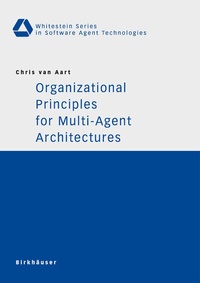
Organizational Principles for Multi-Agent Architectures
Published on 15. December 2004
Book
Paperback/Softback
X, 204 pages
978-3-7643-7213-2 (ISBN)
Description
1. 1 Background In this work, we develop a framework for the design of multi-agent systems inspired by (human) organizational principles. Organizations are complex entities formed to ov- come various limitations of individual agencies, such as cognitive, physical, temporal and institutional limitations. There is a parallel between the complexity of organizations and multi-agent systems. Therefore, we explore the use of concepts, methods and techniques from human organizational design as architectural principles for multi-agent systems. Three research lines are presented: organizational modeling and coordination, interop- ability and agent models. Organizational modeling and coordination are concerned with how resources (i. e. agents) can be identi?ed and related to each other. In order to have agents cooperate, several issues of interoperability have to be addressed. Agent models deal with the design of individual intelligent software agents, taking into account typical features of agent intelligence. Every (human) activity raises two challenges: division of labor and coordi- tion [Mintzberg, 1993]. Division of labor is the decomposition of work (or goals) into various distinct tasks. Coordination refers to managing relations between these tasks to carry out the work. The patterns of division of labor, responsibilities (people who do the work), clustering of responsibilities into units and coordination between units can be de?ned by organizational structures [Galbraith, 1973]. The design of an organization should cover how one or more actors are engaged in one or more tasks, where knowledge, capabilities and resources are distributed.
More details
Series
Edition
2005 ed.
Language
English
Place of publication
Basel
Switzerland
Publishing group
Springer Basel
Target group
Professional and scholarly
(Multi-)Agent engineers and researchers; ontology engineers and researchers
Illustrations
X, 204 p.
Dimensions
Height: 235 mm
Width: 155 mm
Thickness: 13 mm
Weight
341 gr
ISBN-13
978-3-7643-7213-2 (9783764372132)
DOI
10.1007/b137137
Schweitzer Classification
Other editions
Additional editions
Chris van Aart
Organizational Principles for Multi-Agent Architectures
E-Book
03/2006
1st Edition
Birkhäuser
€53.49
Available for download
Content
Agent Organization Framework.- Coordination Strategies for Multi-Agent Systems.- Five Capabilities Model.- Interoperation within a Complex Multi-Agent Architecture.- Message Content Ontologies.- Conclusions.